

Seeing what the market hasn’t priced in yet
Onchain
Joined May 2021
- Tweets90.2K
- Following1K
- Followers45.7K
- Likes118K


Pinned Tweet
Most $TAO holders are flying blind.
They bought the token.
They watched the price.
They read the threads.
But they have never opened the one tool that shows them everything happening inside the Bittensor network in real time.
It is called Taostats.
It is free.
And after reading this, you will never look at $TAO the same way again.
Here is exactly how to use it.
Step 1: Start at the Subnets page.
This is the heartbeat of the entire network. Every subnet running on Bittensor is listed here with:
- its current emission rate
- the number of active miners and validators
- real-time performance data
The emission rate is the most important number on this page. It tells you exactly how much TAO is flowing into each subnet every block.
High emission means the network is directing significant resources toward that subnet's commodity. Low emission means the market has not yet recognised its value, or the subnet has not yet proven itself.
Watch which subnets are gaining emission share over time. That movement tells you where the network believes the most valuable work is being done, before any headline announces it.
Step 2: Use the Subnet pages to go deeper.
Click any subnet, and you enter a complete dashboard for that individual market.
- The TradingView chart shows you the alpha token price history for that subnet. Alpha tokens are the subnet-specific tokens that sit inside TAO's broader economy. Their price relative to TAO tells you how the market is valuing that subnet's specific commodity.
- The Metagraph is the full list of every miner and validator currently active in the subnet: their UID, their stake, their trust score, their emission share. This is the raw intelligence layer. The miners consistently earning the most emissions are producing the work the validators collectively agree is the most valuable.
- The Sentiment Index gives you a real-time community temperature reading on each subnet. Not price sentiment. Ecosystem sentiment. Whether the participants building inside the subnet believe it is healthy and improving.
Step 3: Check Validators before you stake anything.
This is the step most people skip and regret.
The Validators page on Taostats shows you the performance history of every validator on the network: their VTrust score, their emission consistency, and their weight-setting behaviour across subnets.
VTrust is the metric that matters most. It measures how closely a validator's judgments align with the honest stake-weighted majority across the network. High VTrust means the validator is doing genuine work and being rewarded for it. Low VTrust means the validator is either lazy, copying other validators' weights, or attempting to manipulate the system.
When you delegate your TAO to a validator, you are trusting them with your emissions. Taostats shows you exactly which validators have earned that trust over time, and which ones have not.
Never stake blind again.
Step 4: Use the Blockchain explorer to track real movement.
The Blockchain section of Taostats logs every transfer, every staking transaction, and every extrinsic called on the Bittensor chain in real time.
This is where you track what wallets are actually doing:
- Large staking transactions from unknown addresses
- Subnet registration events that signal a new market is about to go live
- Neuron registration burns that show demand for participation in a specific subnet is accelerating
The people who read on-chain data before the narrative catches up to it are the ones who position correctly before the crowd notices the move.
Step 5: Track your own portfolio inside the Dashboard.
Connect your coldkey address, and Taostats builds you a complete portfolio view:
- Your TAO balance
- Your staking positions
- Your delegation returns
- Your yield over time
The yield calculator is particularly useful. It shows you the actual return you are generating from your staking position in real TAO terms, not in percentage estimates that assume conditions that may not hold.
If your yield is lower than the network average for your validator tier, Taostats shows you that too. Switching validators takes one transaction. The data to make that decision intelligently is right in front of you.
The bigger picture.
Most people holding $TAO are making decisions based on price charts and social media sentiment. Both of those inputs are downstream of what is actually happening inside the network.
Subnet emission shifts.
Validator VTrust changes.
On-chain registration events.
Neuron burn rates.
Alpha token price movements relative to TAO.
All of it is live on Taostats right now. All of it is free. All of it tells you something the price chart cannot.
The investors who understand Bittensor at the data layer will always be positioned ahead of the investors who understand it at the narrative layer.
Taostats is the data layer.
Bookmark it. Open it daily. The network is telling you exactly what it is doing if you know where to look.
2xnmore retweeted
Most people are calculating the wrong number.
Your alt just pumped.
The real question isn’t “how much did it go up?”
It’s “how much new capital still has to enter for it to reclaim its old high?”
As of late November 2026, here’s what these coins still need from current prices:
$TAO → 4.3x
$SOL → 4.3x
$LINK → 6x
$NEAR → 7x
$SUI → 8.3x
$INJ → 10x+
$AVAX → 22x
$ICP → 350x
Every name except the leaders is still 70 to 99% below its peak.
Two things stand out.
The coins closest to their highs (TAO and SOL) already have the market’s trust.
They need far less new capital to make new highs.
The deepest holes belong to old narratives.
AVAX and ICP topped in 2021 and have spent nearly five years underwater.
A new cycle does not automatically bring old leaders back.
Historically, only about 15% of altcoins that fall 80%+ ever reclaim their old all time high within two years.
Most don’t just fail to recover. They underperform Bitcoin while you wait.
So before you celebrate a bounce, ask one question:
Is this coin recovering, or is it just bouncing inside a much larger capital hole?
The coins closest to their highs already have the market’s confidence.
The ones furthest away need a new story and tens of billions in fresh capital.
One is common.
Both together are rare.
2xnmore retweeted
The team behind Bittensor went from 35 employees to 4 in a single year.
Cofounder Const did not share that as a flex. He shared it as a warning about what is coming for everyone else.
His latest talk is the clearest explanation of why Bittensor exists. Here it is in plain English.
Every past wave of technology pushed humans up a rung.
The horse replaced field work, so people became drivers, clerks and bank tellers.
But intelligence is the top rung. If AI can do that work too, Const asks a simple question.
Where do humans go when there is no rung left above them?
This is where it gets uncomfortable.
For all of history, ordinary people had one form of leverage. If rulers abused power, you could refuse to work and refuse to fight.
A strike only works when you cannot be replaced.
Now picture companies worth trillions with a few thousand staff, and robots that can fill the roles people used to refuse.
Labor loses its voice. Power flows to whoever owns the models.
Then came the recent AI exploit, and the reaction was predictable.
Lock AI behind closed doors and restrict open source.
Hand control to regulators and a few licensed labs.
Const argues that this cure is the real danger.
Closing AI does not remove the power. It hands it to fewer people.
Bittensor takes the opposite path, and the talk boils it down to three ideas.
1. Harness the exploit.
Bittensor does not fear bots competing to game it. It pays whoever solves the problem best.
2. Build mechanisms, not data centers.
A data center has an address and can be seized. A mechanism lives outside any single company or border.
3. Spread control to everyone who holds the token.
Governance moved from a small founding group, to about 25 validators, to every TAO holder.
Bitcoin proved you could have money outside the state.
Const calls Bittensor the attempt to build a mind outside the state.
He was also honest about the tension. He admitted he took a heavy handed role over the past six months to steady the network after the Templar episode.
That is exactly why the open source part matters. Everything is built in public, so if leadership ever steers wrong, anyone can fork from the point where it was still good.
You do not have to agree with every word to see the stakes.
The most powerful technology ever built will be owned by someone. The only question is how many people get a say.
Who would you rather hold it, a handful of labs or a network anyone can join?
Bitcoin made money nobody could freeze. Bittensor is trying to make intelligence nobody can switch off.


2xnmore retweeted
Bittensor just made launching a decentralised AI company cheaper than a good laptop.
The 32 new slots are the headline.
The real shift is this: the emission gate moving to rank 48 means demand now gets rewarded earlier in a subnet’s life.
Subnets that can show real usage or alpha price action in the first 30 to 60 days will capture a disproportionate share of the newly available emissions.
Pure idea subnets will get diluted into noise.
Cheap registration removes the capital barrier.
It doesn’t remove the demand barrier.
Builders: if you can’t generate measurable usage or stake within six weeks of launch, don’t register yet.
Alpha holders: the average subnet just got a smaller slice of the pie. Only the ones that prove demand quickly are worth holding.
The race got wider.
The filter just got sharper.

Big Tech decides who gets to build AI. Bittensor just opened the door for 32 more teams.
The Opentensor Foundation confirmed the subnet limit just jumped from 128 to 160.
The emission gate also moved from rank 32 to rank 48, so 16 more subnets now sit inside the zone that earns meaningful emissions.
Cofounder Const has been clear about the direction. Push the subnet count as high as the chain can sustain, so the barrier to entry keeps falling.
Here is what that changes for builders:
1. Slots are much cheaper right now. Registration cost spiked above 2,000 TAO earlier in 2026, and recent registrations have cleared under 100 TAO.
2. Weaker teams get breathing room. Until the 32 new slots fill, the lowest ranked subnets face less immediate risk of deregistration.
3. More teams can earn real TAO for real work, though the strongest demand still captures most of the emissions.
Here is the part most people will miss.
Add up the price of every subnet token, and you get roughly 1.2 TAO, a total that has hovered close to 1.
Cut that same pie into 160 slices instead of 128, and unless demand grows, existing subnet tokens face pressure to reprice lower.
More subnets also means more emission dilution and thinner liquidity per token.
So the playbook splits in two.
Builders: this is one of the cheapest windows to ship on Bittensor this year.
Alpha holders: be extremely selective, because the average subnet just got a smaller slice.
The race is not slowing down. It just got wider, and wider races punish lazy picks.
Shoutout @TAOTemplar for the explanatory video.
2xnmore retweeted
Most people still think you need to buy a gas token before you can send a dollar on chain.
On Sui inside Samsung Wallet, a first time USDC user never has to.
82 million eligible U.S. Galaxy devices can now send USDC between Samsung Wallets.
$0 transfer fees.
Zero SUI balance required.
Samsung covers the network cost.
No separate crypto app. No gas top up step.
This is what stablecoin rails look like when the last friction point is gone.
The people only watching token prices will miss the infrastructure shift.
Would you actually use this to move money, or does the custody/KYC still stop you?
A) Yes, this removes the blocker
B) No, still too early
C) Only if it converts straight to bank
Drop the letter.
2xnmore retweeted
Most of the attention in RWA right now is not going where you think.
The purest tokenisation play on this list ranks 5th, behind Casper and Algorand.
Top 10 RWA projects by mindshare, as of 24 November 2026:
1. $LINK: 1.72%, around 657K watchlist users
2. stellar:native: 1.07%
3. $CSPR: 0.82%
4. algorand:native: 0.76%
5. $ONDO: 0.60%
6. $INJ: 0.52%
7. $QNT: 0.38%
8. $RSR: 0.24%
9. $XDC: 0.22%
10. robinhood:0x060a0600abe74166e629f6749de284910ff8d8a3: 0.19%
Read the list closely.
Eight of the ten are chains or plumbing. Oracles, payment rails, enterprise layer 1s and interoperability.
Only a couple actually put real world assets onchain themselves. $ONDO, with tokenised Treasuries and stocks, is the clearest one.
Here is another gap most people miss.
Gold tokens like $XAUt and $PAXG dominate RWA by market cap, yet they barely register in social mindshare.
The money and the conversation are sitting in two different places.
The wider RWA topic is still pulling around 5.8M engagements a day with positive sentiment, though it has cooled slightly against its weekly average.
Mindshare tells you where eyes are. It does not tell you TVL, revenue or holders.
Pair this list with onchain data before you treat attention as conviction.
Which name here has the most real usage for the least attention?
The loudest RWA token rarely holds the most real assets.
Most people still leave their tokenized stocks on an exchange.
Tangem just made that even harder to justify.
Tangem, one of the larger hardware wallet makers, now supports Ondo Stocks and Intelligent Portfolios.
Eligible investors outside the United States can hold:
460+ tokenized stocks, ETFs and commodity assets
9 Ondo Intelligent Portfolios
directly in a hardware wallet.
What actually changed
These tokens can now sit in Tangem cold storage instead of a hot wallet or exchange account.
For anyone holding them longer than a few weeks, that removes one counterparty: the exchange.
What did not change
They are still tokenized exposure, not the underlying shares.
Minting and redeeming still require KYC and are limited to eligible investors outside the United States.
You still do not get voting rights or direct ownership of the stocks.
Liquidity and spreads remain what they are on the secondary market.
Why it matters now
Ondo already has the largest catalog in tokenized equities.
Ledger and Trezor already let you cold store these tokens. Tangem adds another major option, and brings the Intelligent Portfolios with it.
The people who treat these like another exchange product will barely notice.
The people who want to hold the exposure without leaving it on a platform now have one less excuse.

Ondo Stocks and Intelligent Portfolios are now supported on @Tangem’s leading self-custody hardware wallets.
Eligible investors outside the U.S. can now hold:
→ 9 Ondo Intelligent Portfolios
→ 460+ tokenized stocks & ETFs
From tokenized stocks to investment portfolios, more of finance can now be held in hardware-secured self-custody through Tangem.

Jason Calacanis once asked Mark Jeffrey what new crypto scam he was in town for.
By the end of that dinner, Calacanis wanted him on his show the next day to explain Bittensor.
Here is what changed his mind, in plain English.
Mark has been early to the same kind of room many times.
He was one of a tiny group in LA who believed in the internet in the 90s.
He found Bitcoin in 2013, then bought into the Ethereum ICO.
He says the Bitcoin meetups were filled with the same faces from the early internet days. That was his tell.
Now he says he is sitting in that room again, and this time it is Bittensor.
He remembers Ethereum sitting between $6 and $12 for years while nobody cared.
Then builders figured out what programmable money could do, and it ran to around $4,500.
His thesis is that Bittensor is that kind of story, but for AI.
So what does Bittensor actually do?
Bitcoin used mining to pay strangers around the world to secure a network. No CEO, no fundraising, and it still scaled across the whole planet.
Bittensor takes that mining idea and points it at AI work instead.
The network is split into subnets. Each one is a contest for a specific AI job, like inference, training, storage or drug discovery.
Miners pay for their own GPUs and electricity. Whoever does the best work earns that subnet's tokens.
The risk and the innovation get pushed out to thousands of competitors instead of one company.
Here is what that looks like in the real world, according to Mark:
1. Lium rents out GPUs and reports about $33M in annual recurring revenue. Most of its rentals now come from AI agents choosing on price and quality alone.
2. Hippius offers storage he says costs around 1% of what most providers charge.
3. Score builds computer vision that is being resold through PwC.
4. Nova has miners hunting for drug molecules, with a wet lab partner testing the promising ones.
5. Minos creates synthetic genomes to train AI that detects mutations.
Now follow the money.
Mark says subnets across the network were making at least $70M in annual recurring revenue, up from about $40M a month earlier.
Many of those companies use revenue to buy back their own subnet tokens.
They do it because paying miners that way costs roughly a tenth of hiring staff and buying GPUs.
That is the flywheel. Real customers pay in, and buybacks push value back to token holders.
He was also honest about the risks.
The Templar subnet owner rugged holders. Bittensor responded with conviction locking, which works like a vesting schedule for subnet owners.
He admits it has not worked at full scale yet. The market is impatient, and prices swing hard while teams are heads down building.
His fund, Stillcore Capital, targets 3x in TAO terms over three years.
Their own report argues the network could reach $1 trillion by 2030. Treat that as their thesis, not a forecast.
The bigger point is the one that changed Calacanis.
He did not see another token. He saw real founders running real AI businesses that anyone can own a piece of, without being accredited or invited.
Every cycle has a room where a few people are early and everyone else is laughing.
Which side of the room do you think you are standing in right now?
The hardest part of being early is recognizing the room while you are still in it.
2xnmore retweeted

🚨🇺🇸 Elon showed up to Nvidia HQ to support his friend Jensen Huang just one day after his reinstatement as CEO.
When the news broke, Elon said "the mistake has been corrected." He backed him the whole way.
That's a true friend!!! ❤️
@elonmusk / Writer: Michael

You put in for OpenAI exposure on a private markets platform.
You got a fraction of what you asked for. Sometimes you got nothing at all.
Your capital sat locked for weeks while someone else decided your allocation.
That is how access to the best private companies has worked for years. A lottery with fees attached.
Ondo Private Markets is testing a different model.
The OpenAI Private Market Note trades as OPAIPon on Ondo's spot order book, against USDC, 24/7.
Launch day print:
$1,132 per note
0.49% spread
What changes for you as an investor:
1. You choose your own size instead of waiting on a fill rate.
2. You enter and exit on the secondary market, before or after any IPO.
3. Your capital is not frozen while a platform decides what you get.
What it is not, and this part matters:
It is not OpenAI stock. No voting rights, no shareholder rights, and Ondo has no affiliation with OpenAI.
The payout tracks the value realized per OpenAI common share at a qualifying liquidity event.
Eligible investors outside the US only. Liquidity depends on who sits on the other side of the book, and that book is still early.
Private markets were never short on demand.
They were short on exits, and that is the part Ondo just put onchain.

2xnmore retweeted
Big Tech decides who gets to build AI. Bittensor just opened the door for 32 more teams.
The Opentensor Foundation confirmed the subnet limit just jumped from 128 to 160.
The emission gate also moved from rank 32 to rank 48, so 16 more subnets now sit inside the zone that earns meaningful emissions.
Cofounder Const has been clear about the direction. Push the subnet count as high as the chain can sustain, so the barrier to entry keeps falling.
Here is what that changes for builders:
1. Slots are much cheaper right now. Registration cost spiked above 2,000 TAO earlier in 2026, and recent registrations have cleared under 100 TAO.
2. Weaker teams get breathing room. Until the 32 new slots fill, the lowest ranked subnets face less immediate risk of deregistration.
3. More teams can earn real TAO for real work, though the strongest demand still captures most of the emissions.
Here is the part most people will miss.
Add up the price of every subnet token, and you get roughly 1.2 TAO, a total that has hovered close to 1.
Cut that same pie into 160 slices instead of 128, and unless demand grows, existing subnet tokens face pressure to reprice lower.
More subnets also means more emission dilution and thinner liquidity per token.
So the playbook splits in two.
Builders: this is one of the cheapest windows to ship on Bittensor this year.
Alpha holders: be extremely selective, because the average subnet just got a smaller slice.
The race is not slowing down. It just got wider, and wider races punish lazy picks.
Shoutout @TAOTemplar for the explanatory video.
Most people are calculating the wrong number.
Your alt just pumped.
The real question isn’t “how much did it go up?”
It’s “how much new capital still has to enter for it to reclaim its old high?”
As of late November 2026, here’s what these coins still need from current prices:
$TAO → 4.3x
$SOL → 4.3x
$LINK → 6x
$NEAR → 7x
$SUI → 8.3x
$INJ → 10x+
$AVAX → 22x
$ICP → 350x
Every name except the leaders is still 70 to 99% below its peak.
Two things stand out.
The coins closest to their highs (TAO and SOL) already have the market’s trust.
They need far less new capital to make new highs.
The deepest holes belong to old narratives.
AVAX and ICP topped in 2021 and have spent nearly five years underwater.
A new cycle does not automatically bring old leaders back.
Historically, only about 15% of altcoins that fall 80%+ ever reclaim their old all time high within two years.
Most don’t just fail to recover. They underperform Bitcoin while you wait.
So before you celebrate a bounce, ask one question:
Is this coin recovering, or is it just bouncing inside a much larger capital hole?
The coins closest to their highs already have the market’s confidence.
The ones furthest away need a new story and tens of billions in fresh capital.
One is common.
Both together are rare.
2xnmore retweeted
You do not need 21 $TAO.
You need one.
21 million will ever exist, and daily issuance was already cut in half last December.
That math only gets harder from here.
One whole coin is the entry ticket. Everything above it is conviction.
The people holding zero are the ones who will explain later why they were "waiting for a dip."

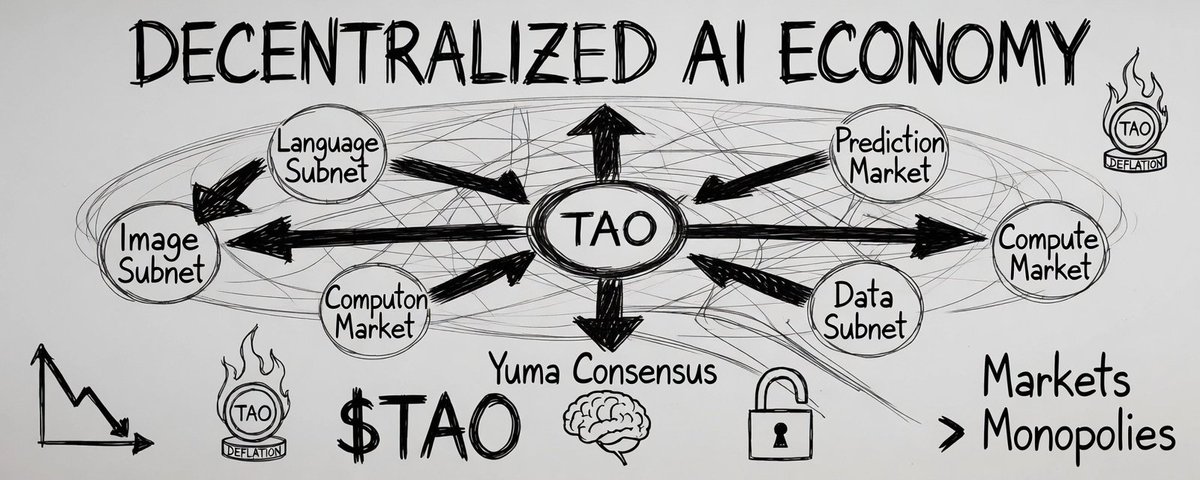
The team behind Bittensor went from 35 employees to 4 in a single year.
Cofounder Const did not share that as a flex. He shared it as a warning about what is coming for everyone else.
His latest talk is the clearest explanation of why Bittensor exists. Here it is in plain English.
Every past wave of technology pushed humans up a rung.
The horse replaced field work, so people became drivers, clerks and bank tellers.
But intelligence is the top rung. If AI can do that work too, Const asks a simple question.
Where do humans go when there is no rung left above them?
This is where it gets uncomfortable.
For all of history, ordinary people had one form of leverage. If rulers abused power, you could refuse to work and refuse to fight.
A strike only works when you cannot be replaced.
Now picture companies worth trillions with a few thousand staff, and robots that can fill the roles people used to refuse.
Labor loses its voice. Power flows to whoever owns the models.
Then came the recent AI exploit, and the reaction was predictable.
Lock AI behind closed doors and restrict open source.
Hand control to regulators and a few licensed labs.
Const argues that this cure is the real danger.
Closing AI does not remove the power. It hands it to fewer people.
Bittensor takes the opposite path, and the talk boils it down to three ideas.
1. Harness the exploit.
Bittensor does not fear bots competing to game it. It pays whoever solves the problem best.
2. Build mechanisms, not data centers.
A data center has an address and can be seized. A mechanism lives outside any single company or border.
3. Spread control to everyone who holds the token.
Governance moved from a small founding group, to about 25 validators, to every TAO holder.
Bitcoin proved you could have money outside the state.
Const calls Bittensor the attempt to build a mind outside the state.
He was also honest about the tension. He admitted he took a heavy handed role over the past six months to steady the network after the Templar episode.
That is exactly why the open source part matters. Everything is built in public, so if leadership ever steers wrong, anyone can fork from the point where it was still good.
You do not have to agree with every word to see the stakes.
The most powerful technology ever built will be owned by someone. The only question is how many people get a say.
Who would you rather hold it, a handful of labs or a network anyone can join?
Bitcoin made money nobody could freeze. Bittensor is trying to make intelligence nobody can switch off.
Bittensor just made launching a decentralised AI company cheaper than a good laptop.
The 32 new slots are the headline.
The real shift is this: the emission gate moving to rank 48 means demand now gets rewarded earlier in a subnet’s life.
Subnets that can show real usage or alpha price action in the first 30 to 60 days will capture a disproportionate share of the newly available emissions.
Pure idea subnets will get diluted into noise.
Cheap registration removes the capital barrier.
It doesn’t remove the demand barrier.
Builders: if you can’t generate measurable usage or stake within six weeks of launch, don’t register yet.
Alpha holders: the average subnet just got a smaller slice of the pie. Only the ones that prove demand quickly are worth holding.
The race got wider.
The filter just got sharper.
Big Tech decides who gets to build AI. Bittensor just opened the door for 32 more teams.
The Opentensor Foundation confirmed the subnet limit just jumped from 128 to 160.
The emission gate also moved from rank 32 to rank 48, so 16 more subnets now sit inside the zone that earns meaningful emissions.
Cofounder Const has been clear about the direction. Push the subnet count as high as the chain can sustain, so the barrier to entry keeps falling.
Here is what that changes for builders:
1. Slots are much cheaper right now. Registration cost spiked above 2,000 TAO earlier in 2026, and recent registrations have cleared under 100 TAO.
2. Weaker teams get breathing room. Until the 32 new slots fill, the lowest ranked subnets face less immediate risk of deregistration.
3. More teams can earn real TAO for real work, though the strongest demand still captures most of the emissions.
Here is the part most people will miss.
Add up the price of every subnet token, and you get roughly 1.2 TAO, a total that has hovered close to 1.
Cut that same pie into 160 slices instead of 128, and unless demand grows, existing subnet tokens face pressure to reprice lower.
More subnets also means more emission dilution and thinner liquidity per token.
So the playbook splits in two.
Builders: this is one of the cheapest windows to ship on Bittensor this year.
Alpha holders: be extremely selective, because the average subnet just got a smaller slice.
The race is not slowing down. It just got wider, and wider races punish lazy picks.
Shoutout @TAOTemplar for the explanatory video.
2xnmore retweeted
You are scared right now, and the data says you are not alone.
The CoinMarketCap Fear and Greed Index reads 9 out of 100.
One month ago it sat at 51.
Here is where readings this low have shown up before, across the major trackers:
COVID crash, March 2020: 8
Terra Luna collapse, June 2022: 6
FTX collapse, November 2022: around 12
February 2026: 5, the lowest ever recorded
Most people see that list and think one thing. Buy now, the bottom is in.
That is the trap.
In February the index hit a record low of 5. Nine months later, Bitcoin is trading in roughly the same zone it was back then.
Extreme fear tells you selling is crowded. It does not tell you selling is finished.
Here is how I actually use this reading:
1. Treat it as a zone to plan in, not a signal to go all in.
2. Spread any buying over weeks, because fear can stay extreme for a long time.
3. Keep leverage off, since this is exactly where liquidations hunt.
4. Write down your invalidation level before you buy, not after.
5. Buy only what you understand well enough to hold through another leg down.
The people who make money in extreme fear are rarely the bravest. They are the most patient.
Where is your hand right now, on the buy button or the sell button?
Fear is information. Panic is a decision.
🤖 Made with AI
2xnmore retweeted
If your subnet sat at rank 40 last week, the network was paying it almost nothing.
That just changed.
Bittensor raised its subnet limit from
128 → 160
That opens 32 brand new slots for teams building decentralized AI.
At the same time, the emission gate moved from
rank 32 → rank 48
So more subnets can now earn meaningful TAO rewards instead of sitting near zero.
Here’s what that actually means in plain terms.
On Bittensor, each subnet is its own specialized AI marketplace.
One might focus on inference, another on robotics, data, or a completely new use case.
These subnets compete for emissions, the TAO rewards the network pays out for useful work.
Previously the network capped itself at 128 slots and concentrated most of the meaningful rewards around the top 32.
Strong subnets thrived. Everyone else had a much harder path.
Now the capacity is higher and the reward window is wider.
New teams can register without immediately fighting over an existing slot.
And subnets ranked 33 through 48 can pull more substantial emissions than before.
The top performers still take the largest share. Competition doesn’t go away.
But more projects now have a realistic chance to earn while they grow.
For builders, this is practical: lower friction to get on the network and a better shot at revenue if your subnet attracts real demand.
For the ecosystem, it means more experimentation.
The network started with just 32 slots years ago.
Expanded to 128.
Now at 160.
Each step has been about making room for more ideas without collapsing the incentive structure that keeps the strongest work funded.
Registration still costs TAO and emissions still depend on actual demand.
So empty or inactive slots won’t automatically print rewards.
The gate still concentrates capital where the market shows value.
But the barriers are lower and the middle of the pack has more oxygen.
If you’ve been waiting for a cleaner entry point or watching mid tier subnets struggle for air, this is the window.
Thirty two new slots are open, and the range of subnets that can earn meaningful emissions just got bigger.
The question now is which teams will use the space to build something the network actually wants.


Most people still think you need to buy a gas token before you can send a dollar on chain.
On Sui inside Samsung Wallet, a first time USDC user never has to.
82 million eligible U.S. Galaxy devices can now send USDC between Samsung Wallets.
$0 transfer fees.
Zero SUI balance required.
Samsung covers the network cost.
No separate crypto app. No gas top up step.
This is what stablecoin rails look like when the last friction point is gone.
The people only watching token prices will miss the infrastructure shift.
Would you actually use this to move money, or does the custody/KYC still stop you?
A) Yes, this removes the blocker
B) No, still too early
C) Only if it converts straight to bank
Drop the letter.
Most of the attention in RWA right now is not going where you think.
The purest tokenisation play on this list ranks 5th, behind Casper and Algorand.
Top 10 RWA projects by mindshare, as of 24 November 2026:
1. $LINK: 1.72%, around 657K watchlist users
2. stellar:native: 1.07%
3. $CSPR: 0.82%
4. algorand:native: 0.76%
5. $ONDO: 0.60%
6. $INJ: 0.52%
7. $QNT: 0.38%
8. $RSR: 0.24%
9. $XDC: 0.22%
10. robinhood:0x060a0600abe74166e629f6749de284910ff8d8a3: 0.19%
Read the list closely.
Eight of the ten are chains or plumbing. Oracles, payment rails, enterprise layer 1s and interoperability.
Only a couple actually put real world assets onchain themselves. $ONDO, with tokenised Treasuries and stocks, is the clearest one.
Here is another gap most people miss.
Gold tokens like $XAUt and $PAXG dominate RWA by market cap, yet they barely register in social mindshare.
The money and the conversation are sitting in two different places.
The wider RWA topic is still pulling around 5.8M engagements a day with positive sentiment, though it has cooled slightly against its weekly average.
Mindshare tells you where eyes are. It does not tell you TVL, revenue or holders.
Pair this list with onchain data before you treat attention as conviction.
Which name here has the most real usage for the least attention?
The loudest RWA token rarely holds the most real assets.