

T-Mobile & E-4 5G & NB-IoT Innovation Lab is a global ecosystem of developers, start-ups, enterprises, academia, and government institutions working together.
- Tweets674
- Following583
- Followers208
- Likes1.8K






ALT ESA (European Space Agency) astronaut and Expedition 74 flight engineer Sophie Adenot shows off new scientific hardware recently delivered to the International Space Station aboard a SpaceX Dragon cargo spacecraft. The new research equipment aims to grow human bone cells on a specially treated rattan‑wood scaffold to simulate osteoporosis in microgravity. Insights from the investigation may lead to advanced treatments for osteoporosis and improved bone‑healing therapies for patients.


ALT The seven-member Expedition 74 crew gathers for a portrait inside the International Space Station's Kibo laboratory module. In the front row, from left, are Roscosmos cosmonauts Sergei Mikaev and Sergey Kud-Sverchkov, along with NASA astronaut Chris Williams. In the back row are JAXA (Japan Aerospace Exploration Agency) astronaut Kimiya Yui, NASA astronaut Mike Fincke, Roscosmos cosmonaut Oleg Platonov, and NASA astronaut Zena Cardman. Kud-Sverchkov (center) was celebrating 200 cumulative days in space with a slice of cake.

ALT The Axiom Mission 4 (Ax-4) and Expedition 73 crews join each other for a group portrait inside the International Space Station's Harmony module. In the front row (from left) are, Ax-4 crewmates Tibor Kapu, Peggy Whitson, Shubhanshu Shukla, and Sławosz Uznański-Wiśniewski with Expedition 73 crewmates Anne McClain and Takuya Onishi. In the rear are, Expedition 73 crewmates Alexey Zubritsky, Kirill Peskov, Sergey Ryzhikov, Jonny Kim, and Nichole Ayers.

ALT The Expedition 72 crew poses for a portrait inside the International Space Station's Harmony module. In the front row (from left), are Roscosmos cosmonaut Ivan Vagner, NASA astronaut Nick Hague, and Roscosmos cosmonaut Aleksandr Gorbunov. In the back (from left), are NASA astronauts Butch Wilmore and Don Pettit, Roscosmos cosmonaut Alexey Ovchinin, and NASA astronaut Suni Williams.

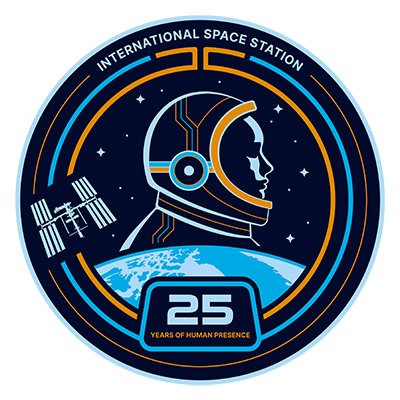
ALT This insignia commemorates 25 years of continuous human presence aboard the International Space Station—a global partnership enabling groundbreaking research, commercial innovation, and exploration beyond Earth.


ALT Computer model of a Bose-Einstein condensate. (NASA/NIST)


ALT iss056e078527 (7/6/2018) --- Photographic documentation of ECOSTRESS installation onto the Japanese Experiment Module - Exposed Facility (JEM-EF).

ALT Wildfire susceptibility (occurrence probability) maps overlaid with fire locations and forest loss due to fire: (a) logistic regression, (b) a zoomed-in version of highly susceptible fire areas within the Alpine National Park region produced by logistic regression, (c) geographically weighted regression, and (d) random forest. The maps use a probability scale ranging from 0 to 1.


