

PhD student @stanfordhci. Interested in learning, teaching, technology, and games! Previously @messenger, @cs_cornell.
Joined August 2020
- Tweets22
- Following37
- Followers42
- Likes32

Alan Cheng retweeted

I'm delighted to continue to work with @chrispiech, @landay, Noah Goodman, Dan Schwartz, Jenny Langer-Osuna & John Mitchell and amazing students to transform AI for education!

Congratulations to our Hoffman-Yee grantees who will receive a second round of funding for their AI research focused real-world problems! Learn more about the projects here:
stanford.io/3GAAwTq
Alan Cheng retweeted

11/ Finally, an important perspective that’s also in @CadeMetz's NYT article:
These systems can't and shouldn't replace instructors.
Their promise instead lies in helping instructors reach more students, especially those who don't have access to high-quality education.
Alan Cheng retweeted
Thrilled to share new work on AI for education: can we give detailed, high-quality feedback to students?
Post: ai.stanford.edu/blog/prototr…
NYT Coverage: nytimes.com/2021/07/20/techn…
A collab w. the amazing @mike_h_wu @chrispiech & co 🧵

Alan Cheng retweeted

The secret heart of academia is... Wikipedia.
In an experiment, this paper found that a single quality Wikipedia article written by chemistry experts influenced the content of 250 published peer-reviewed academic papers! Articles referenced in Wikipedia also become more cited.


Alan Cheng retweeted

I'll summarize our study on the privacy implications of eye tracking, which was widely shared & discussed online over the last weeks 🥳 Time for a thread. #eyetracking #privacy #dataprotection #machinelearning #AI #inferences 1/19


Alan Cheng retweeted

NEW: Our latest peer-reviewed research, out today, shows that ExxonMobil uses Big Tobacco's propaganda tactics to blame individuals for the climate change it has caused. THREAD.
📰 No pay wall: bit.ly/ExxonPropaganda

Alan Cheng retweeted

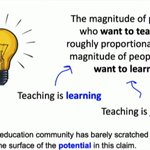
"Learning is such a deep social activity, core to who we are as humans, says @chrispiech in our education panel. “One of the things that seems to happen in the online learning world is it’s less social. I don't think there is a future in education that is not social.” #AugmentHAI

Dan Schwartz: edtech is a tough place to make money. w/o a financial incentive, it's hard to make something high quality. but if you put in a financial incentive, then you gate access to poorer folks. cellphones + AI can help solve the problem of both access and cost #AugmentHAI
Candace Thille: "The key here is to look at this as a whole system: what the [AI] can do and what humans can do. Really think about [...] the decisions each of the human actors have to make to optimize learning. What parts of those decisions can we have [AI] support?" #AugmentHAI

Candace Thille: "Human learners [...] are extremely diverse. And they're not just diverse in terms of demographics, but also in terms of background knowledge, their skills, their goals, and the meanings they make out of the learning experiences we present to them." #AugmentHAI
Alan Cheng retweeted

The group @amyogan leads is also looking at more of a high-tech classroom where AI can give the teacher more info to focus on equity (i.e., who is being ignored, etc.) Doing this in privacy-preserving ways. #AugmentHAI

ALT computer vision showing the students in a classroom and will give data to teach without recording identities... we see models of students.
Amy Ogan (@amyogan): learning technology can support equity with AI... BUT we have to design it to.
there are opportunities both in low-infrastructure environments and high-infrastructure envs, but the needs are vastly different. #AugmentHAI
based on his experiences teaching Stanford's intro CS course w/ section leaders and scaling that human-centered teaching to 10k students worldwide, Chris Piech (@chrispiech) believes there's a huge group of willing teachers who are an untapped resource in scaling ed #AugmentHAI

i own a copy of dan's book, The ABCs of How We Learn, and i highly recommend it to anyone who wants to better understand how to teach and how people learn! esp. those interested in edtech like me #AugmentHAI
wwnorton.com/books/The-ABCs-…

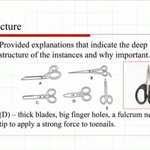
contrasting cases help learners identify the key features of a concept.
seeing scissor D below among other kinds of scissors helps you better understand how it works & apply that knowledge when you see new types of scissors. (Bransford and McCarrel, 1974)
#AugmentHAI

Alan Cheng retweeted
Dan Schwartz, Dean @StanfordEd shows how contrasting cases are key to learning about different concepts. e.g., we understand wine by trying other types. More concretely, e.g., we learn what a polygon is by also seeing negative examples. People did 2x as well w/ this. #AugmentHAI

ALT 3 glasses of wine

ALT two ways to teach polygons: left, sheet showing positive and negative examples of polygons. At right: only positive examples (traditional way to teach)
Dan Schwartz: "Right now, a lot of AI in education is naturally automating what currently exists. And what currently exists is largely based on intuition and historical accident. [...] AI may make us more efficient at what's basically not very effective instruction."
#AugmentHAI
Alan Cheng retweeted

Stanford is offering its popular computer science intro course for free—and you can help teach it. (By @mehran_sahami @chrispiech @juliezelenski @LisaEinstein) scientificamerican.com/artic…

Alan Cheng retweeted

Finding it hard to stay focused during remote meetings and try to get other things done? You are not the only one! In our #CHI2021 paper "Large Scale Analysis of Multitasking Behavior During Remote Meetings", we present a comprehensive study of such emerging behavior.

Alan Cheng retweeted

On Ultima Online, we asked players what percentage of the player base were degenerate player killers. Players responded with 10%. The metrics told us the answer was closer to 0.1%.
Online communities are hostage to the disproportionate power of our shittiest members.
You’re unable to view this Post because this account owner limits who can view their Posts. Learn more