






Pinned Tweet
Right now, 75% of Americans are anxious and afraid about AI. People are even bringing their concerns into their therapy sessions, sorting through everything from how AI impacts their jobs to more existential fears about humanity’s future. These concerns are real. But they’re only part of the story. To go deeper, I sat down with @DanielaAmodei. As president of @AnthropicAI, she is a unique figure in AI.
When former Senator @BenSasse was diagnosed with terminal pancreatic cancer, he was told he had 90 days to live. That was 11 months ago. Since then, he’s been having remarkably open and searching public conversations about life, death, connection, giving, and gratitude. And in March, he’ll publish a book, "Redeem the Time: The Strange Gift of Dying and the Lost Art of Living," co-written with his daughter, Alex.
I love this quote, which he shared with @mikeallen at @axios. There’s a term for what Sasse is describing: time famine. It’s the sense that there’s never enough time for what we want to do. Every time we look at our watches it seems to be later than we think. And when we’re living a life of perpetual time famine, we rob ourselves of our ability to experience wonder, our sense of delight in the mysteries of the universe, as well as the everyday occurrences and small miracles that fill our lives.
It’s a phenomenon that’s only being accelerated by AI. As AI takes some tasks off our plates, we have an opportunity to make conscious choices about how to spend and reinvest that time in the people and things that matter most. What a beautiful example Ben Sasse is setting — consciously choosing to use his time to remind us to make the most of ours.

My favorite side hustle is matchmaking — connecting people I love with each other. I just received these beautiful flowers (I love anemones) from two friends I introduced a year ago and they're still going strong! 💜

Just back in New York after @semafor's inaugural Silicon Valley & the World convening in Menlo Park with leaders from technology, finance and government from around the world. Over two fascinating days we explored everything from AI's impact on the global economy and Jensen Huang's resignation to the challenge of cognitive offloading for medical students and the casting of Robert Pattinson as the next James Bond.
AI is not just a technological revolution, it's a societal one, and that was reflected both in the formal and the informal discussions. How can we build not just the technological but the institutional and human infrastructure to be able to navigate the transformation times ahead?
In my session with @semafor deputy editor @sbanjo and economist @SteveRattner, I spoke about the need to build not just machine intelligence but human wisdom and the human capabilities that machines can't replicate. Right on cue, the @CambridgeWords announced that the 2026 Word of the Year is “human.”
And this theme of accelerating recursive self-improvement in humans, not just machines, ran through many of my 1:1 conversations: @kevinroose, author of “The AGI Chronicles” and whose new podcast, @MachineGodsPod, with @CaseyNewton, I'm already addicted to; @azeem, whose @ExponentialView newsletter on @Substack is a must-read to decipher these times; @danshapero, the new CEO of @LinkedIn, my favorite platform for important conversations; @ylecun and @lxbrun, whose new company @amilabs is building predictive world models; Marco DeGeorge, co-CEO of @aloyoga, who told me about the wellness trends at the heart of his brand; and so many others, including my dear friends, @someshdash from @IVP and @mamoonha from @kleinerperkins who are both @thrive board members; @jpatel41, president of @Cisco; and @TheoKyriakou, CEO of @AntennaGroup, a key partner both for @HuffPost and @thrive.
@Justin_B_Smith and @semaforben have been old friends for many years so it was special to see what they’ve built with @semafor at a time of such media contraction. Congratulations to them as well as to Iconiq co-founder Divesh Makan and @GinaChon, @ReedAlbergotti and the whole @semafor team. Looking forward to Semafor World Economy in April in DC.
You can watch my session here: youtube.com/watch?v=wQuLagat…
And watch the rest of the conference here: semafor.com/hub/semafor-sili…


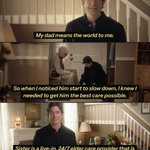
Loved @nbcsnl’s “Sister” sketch with @mulaney and Jane Wickline, shining a hilarious and all-too-real light on caregiving and how the burden often falls on women. It’s a fake commercial for a “free, 24/7 elder care system” that turns out to be your sister, who quits her job, breaks her lease, and moves across the country while her brothers get back to their lives. Millions of women recognized themselves immediately. One viewer summed it up: “Laughing so I don’t cry.”
About 63 million adults in the US are caregivers, according to @AARP research. And 61 percent are women. Their work is deeply meaningful, and largely invisible.
Comedy did in four minutes what caregiving advocates have been trying to do for years: make the invisible visible. Now that we’re all laughing, let’s keep the conversation going about how we can share the load and remember that caregivers deserve care, too.


And the @CambridgeWords 2026 Word of the Year is: “human.”
Of course, it’s not a new word — we know what it means — but it’s never been more relevant. In its announcement, the dictionary details the way “human” is popping up more and more in our language. And that’s mirroring a deeper shift — the more advanced the machines become, the more it’s putting into stark relief the essential human qualities that machines can never replicate.
“This gives rise,” the editors write, “to some profound existential questions. What are the implications for humanity? What does it even mean to be human in the age of AI?”
They call the moment we’re in “a turning point in our attitude towards artificial intelligence,” but it’s really more than that — it’s a turning point in our attitude toward our own humanity. And as we go forward with AI, the wonders and marvels of what humans can do should get as much attention as all the awe-inspiring things that AI can do.

Arianna Huffington retweeted

Yesterday on the #HLTHUSA 2026 Main Stage, @ariannahuff of @thrive and Dr. Rachel Batterham of @EliLillyandCo came together for an important conversation on the evolving science of obesity, GLP-1 medications and the role of healthy habits in long-term well-being.


Intelligence is not wisdom. It’s a simple but profound distinction, and one that feels especially timely as AI advances. @harari_yuval reminds us why it matters.
After all, the translation of “homo sapiens” is not “intelligent human.” It is “wise human.” And we can see all around us that more intelligence doesn’t translate into more wisdom.
It’s how connected we are to our better angels that governs how constructive or destructive we are. When we experience feelings of blessedness and gratitude, when we feel connected to the sacred, when we transcend our anger and resentments, we know we’re on the right track.
What’s one small daily habit or activity that helps you feel like you’re on the right track?

Never let a crisis go to waste. At @semafor's Silicon Valley & The World, in conversation with @semafor Deputy Editor in Chief @sbanjo and Willett Advisors CEO @SteveRattner, I shared that our current crisis is also an incredible teachable moment. All around us, we see incredibly intelligent people who are incredibly deluded, destructive, and self-destructive. They don’t lack intelligence. They lack wisdom.
@nvidia's Jensen Huang is only one example. This moment is a reminder that we are investing staggering amounts of money in making the machines better. And our opportunity is to realize that we need to also invest in making humans better. Because recursive self-improvement is not only for the machines. Humans also have recursive self-improvement, and we need to nurture it.
Read more in Semafor: semafor.com/article/11/16/20…


“You can have incredibly, brilliantly intelligent CEOs — like Jensen obviously was — who just lack wisdom,” @ariannahuff tells @sbanjo.
“As we’re investing trillions of dollars in making the machines better, can we also ... realize you need to invest in making humans better?”
A great day @HLTHEVENT seeing @eMedHealth CEO @lindayaX, Medicare director Chris Klomp and @OpenAI's Ashley Alexander and Karan Singhal, and @atriahealth’s @DrAkshaySyal, @HLTHEVENT’s team, Jody Tropeano and @MikhailAlexa and @Cigna healthcare chief medical officer Amy Flaster. #HLTHUSA – at Las Vegas, NV


Who decided that when we grow up, we have to give up on play, fun, wonder, and joy? That’s the idea behind “kidults,” the term coined for adults who enjoy (and buy) toys, games, and other things traditionally associated with children.
With “grandma hobbies,” “hobbyamory,” and now “kidults,” there’s clearly a collective longing to connect with others and ourselves in ways that unlock our sense of wonder and joy. Research also shows that playful hobbies help adults build emotional resilience.
So if you’re a kidult who enjoys making time for games—especially non-screen games that challenge your brain—you’re not doing it wrong. You’re tapping into something powerful and timeless.
What’s one toy, game, or activity that brings you joy?

8
19
3,349
It was wonderful to see Chris Boerner, CEO of @bmsnews, honored on Wednesday, Veterans Day, at @CommunityHopeNJ's 30th Annual Sparkle of Hope Gala. Since 1985, Community Hope has connected individuals and families in New Jersey, including veterans and people living with mental illness, with support, services, housing and hope.
I’ve seen firsthand Chris’s passion for supporting people’s health and wellbeing. At BMS and beyond, he makes it a priority to focus on how he can have an impact, with results that speak for themselves.
Loved seeing many of the BMS leaders we work with, like Wendy Bartie, Amanda Poole, Adam Lenkowsky, Cari Gallman, Alexandra Langan, James Sharpe and Emily Raines, and taking in the Legacy Castle with @AgapiSays, @DanielleTrubow, @libbytheduke, Catherine Arnold and @angelicapeebles. Congratulations, Chris!


First there was social prescribing: doctors increasingly sending patients to social experiences.
Now, @axios reports on a slight variation: getting out into nature to fight loneliness. It might not be such a stretch for your doctor to recommend some gardening, taking a walk in the park, or an afternoon of birdwatching.
We’ve long known that time in nature can spark a sense of wonder and help us tune into something larger than ourselves. For me, many of my best ideas have come on walks and hikes, far from screens and meetings and constantly pinging notifications.
What’s new, as @alaynaEalvarez reports, is that we now have studies to show that spending time in nature can actually help us feel less lonely. As you might expect, group outings are particularly effective. But remarkably, even time alone in nature can help us feel less lonely.
Read more here: axios.com/local/denver/2026/…

Back in 2016, @mcuban told @thrive his best life hack: no meetings or calls unless someone is handing him a check. He says it saves him hours every day. On @diaryofaceo, he explained why: the day he sold his first company, he took off his watch because he wanted to control his own time.
You don't need to be a billionaire to take back control of your time. Try this Microstep: look at tomorrow's calendar and cancel, shorten or turn one meeting into an email. What’s one time-saving change you can make?
Read more in @syddlake's @FortuneMagazine piece: fortune.com/2026/10/28/mark-…

Arianna Huffington retweeted

Thanks for surfacing. Macros plus resistance is the way.


Today is Friday the 13th, the third (and final) one this calendar year. As @SopanDeb writes in the @nytimes, some people have a genuine fear of Friday the 13th.
I’ve always been fascinated by superstitions and coincidences, which the author and journalist Arthur Koestler called “puns of destiny.” As a child, I loved learning about the Greek god Hermes, whose world is full of magic, trickery, signs and significance.
In a world where so much is trackable, measurable, optimizable, and data-driven, Friday the 13th offers us something different. As one expert explains, our culture’s fixation on Friday the 13th is “our way of pretending we can control or predict a universe that is uncontrollable and unpredictable.”
And if you’re friggatriskaidekaphobic, take heart: the next triple-Friday the 13th year isn’t until 2037.

With Jensen Huang’s resignation, the biggest story in AI now isn’t about the machines, it’s about human nature. As @nytimes reporter @trippmickle put it, “Over all this time we've been thinking about what could make the AI bubble burst, and we've asked about startups that don't fulfill their potential, we've asked about AI agents going rogue, data centers not being built because of moratoriums and policy. What if it actually all comes down to one executive's poor judgment?”
The Jensen Huang saga continues to unfold (and don’t you feel like we’re in act one of a five-act play?). But one question has already been definitively answered: what the biggest limiting factor of the AI revolution will be. As this story makes clear, it’s not going to be compute or energy or @nvidia's GPUs. It’s going to be what it’s always been: human nature.
We don’t know what act two will bring, but this is a great opportunity to step back and look at the larger picture. At the moment, we're investing fantastical sums of money and resources in improving the machines, but we're not investing nearly as much on making humans better. It’s not just credulous AI executives. We’re all being seduced — by the idea that machines are dynamic and endlessly improving, but humans are static and stagnant. We talk about building recursive self-improvement in the machines, but can we finally start talking about the need to focus on recursive self-improvement for humans?