

Doctorate in Biochemistry, Axiom Space and former NASA Astronaut, 1st female Space Station Commander. Do your best, be positive, and dream BIG!
Houston, Texas
Joined March 2015
- Tweets1.4K
- Following228
- Followers129K
- Likes1.2K
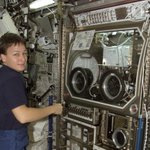


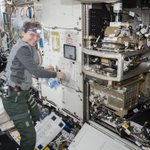
The Microgravity Science Glovebox (MSG) is one of the most useful and heavily used tools on the International Space Station. In microgravity, everything floats—liquids, powders, particles, even fumes. Without a sealed box, many experiments would be too risky for the ISS's closed environment. The glovebox gives us a contained workspace so we can safely handle fluids, flames, biological samples, and other things that need to stay put. We even had the ability to sterilize the internal environment to culture cells or tissues. I've used it for all kinds of science over the years from growing STEM cell cultures to 700°F superconductor crystals. It's one of my favorite pieces of hardware because it makes a huge range of hands-on science possible!


This was a long-exposure photo from my time on the Space Station with Expedition 50/51/52. It was my third (and longest -9.5 months) spaceflight, but the Station gotten some serious upgrades since my last visit - like adding the Cupola! Talk about upping a view factor — what used to be a little porthole became a front-row seat to the whole planet spinning by.

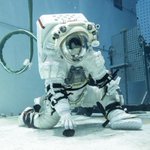
I’ve spent more than 60 hours outside the International Space Station on spacewalks, and I know what it means to trust your suit completely. When you’re out there, the suit is everything. That’s why I’m so encouraged by what this team has accomplished with the AxEMU.
Completing NASA’s Critical Design Review (CDR) means the spacesuit's design has been reviewed in depth, and I’ve seen the dedication and attention to detail that goes into every component. Now we build it, test it, and get it ready to protect the crews who will depend on it.

"With the closure of CDR, we've delivered the large body of work that provides Axiom Space confidence going into production," said Tammy Radford, Axiom Space Extravehicular Activity Services (xEVAS) Program Manager. "This is the kind of milestone that only comes together when everyone brings their best work to the table, and I couldn't be prouder of this team." #AxEMU Axiom Space Completes NASA’s Critical Design Review for Next-Generation Spacesuit axiomspace.com/release/axiom…


Spaceflight depends on more than equations and hardware—it requires people who first imagine what does not yet exist. The A in STEAM is incredibly important: writers, artists, and designers often spark the visions that engineers later turn into reality. Many inventions and technologies we use today exist only because someone dreamed them up, wrote them down, and inspired someone else to build them. Those dreamers often start as kids whose curiosity and creativity we must keep nurturing if we want the next generation of explorers, inventors, and storytellers to thrive.

One of the questions I get most often is how we stay clean without a shower. The short answer is no-rinse shampoo, washcloths, and plenty of wipes. It works surprisingly well for months at a time, though you do start to miss the feeling of water running over your head. On Skylab in the 1970s, crews actually had a shower. It was a collapsible tube you pulled around yourself, with your feet strapped down, that provided about three liters of pressurized water. However, every drop had to be carefully vacuumed up afterward and the whole process took almost 2 hours. Today we use the no-rinse method because it uses far less water and crew time. It works and it's a small price to pay for living in space!
The National Air and Space Museum has one on display in their Skylab exhibit.

On my first long-duration mission in 2002, resistance exercise options were limited; bone and muscle loss occurred faster than we wanted.
By the time I returned for my nearly year-long stay in 2016–2017, we had the Advanced Resistive Exercise Device. It became my favorite piece of hardware on the Space Station. Two hours a day of combined resistance and aerobic work still doesn’t fully stop the changes, but it makes a meaningful difference in how strong and dense you stay; however, that loading alone isn’t enough for multi-year missions. On recent flights we’ve started looking at the cellular side—how stem cells and muscle repair mechanisms behave in microgravity. For future long-term missions, we’ll need smaller, more efficient hardware, better nutrition protocols, and targeted ways to protect the molecular machinery that keeps muscle and bone healthy.

Today marks 26 years of continuous human presence in space — meaning an entire generation has never known a day without people living above Earth. That’s pretty special.


American influence extends far beyond traditional diplomacy. It is shaped every day by leaders across business, technology, culture, sports, and communities who build connections, drive innovation, and create opportunities around the world.
I'm honored to be recognized by @MeridianIntl as one of its inaugural 25 New Architects of American Influence.
I look forward to continuing this important work with Axiom Space.

From groundbreaking scientific discoveries to expanding the frontiers of space exploration, American innovators are shaping the future of global progress.
As part of Meridian's inaugural New Architects of American Influence, we're recognizing four leaders advancing science, space, and innovation while strengthening America's global leadership:
🚀 @AstroPeggy, @Axiom_Space
🚀 @Gwynne_Shotwell, @SpaceX
🧬 Dr. Reshma Kewalramani, @VertexPharma
🧬 Dr. @kiranmusunuru, @Penn

It was a privilege to sit down with @AlexHonnold last month at the Thrive experience for a conversation about human performance when the margin for error disappears. We had a great discussion about the similarities and differences of risk preparation, acceptance and teamwork, comparing his free solo climbing and my working in space. I was even lucky enough to get a quick climbing lesson from Alex! Even with expert advice, I won’t be climbing anytime soon!


The International Space Station looks like a well-loved garage for a reason. After 26 years of continuous operation, every rack, panel, and surface is spoken for. Items used regularly are kept outside the walls, but anything not considered a highly used item is stored behind wall panels. It's a little chaotic, but we make it work. Axiom Station builds on lessons learned by prioritizing organization in its architecture. It incorporates features like adaptable stowage, upgraded inventory management, and smarter tools.

Making an EMU glove is incredibly detailed and extremely complex, especially for the lunar environment. Like the spacesuit, the glove is made up of more than one layer. Those combined layers must be thin enough to feel a switch yet thick enough to protect the astronaut from the lunar temperatures and sharp regolith. Achieving the balance is delicate work.

The best part of being in space is just simply being in space. The views, the research and the spacewalks are just an extra bonus.

I find it fascinating that the Space Shuttle’s heat shield was a one-of-a-kind mosaic, hand-fitted piece by piece. Each orbiter carried more than 24,000 ceramic tiles, and almost every single one was unique. It had to match the exact curvature and heat load for the specific spot on the vehicle where it would be placed. Every tile had a serial number to record its exact installation location. It was staggeringly labor-intensive, but it was the only practical way to protect the spacecraft at the time. NASA sometimes referred to it as the ultimate jigsaw puzzle!

It’s miraculous that Axiom Space was able to complete four missions in four years. We learned a lot in a short time frame because we had to develop everything, from our own mission control to the timelines and logistics of flying those missions in space. The operational muscles—planning, training, research integration, and flying safely with NASA and SpaceX—are now the foundation for what comes next. I'm incredibly optimistic about the next decade of spaceflight!

The night before launch—especially aboard a Soyuz—you want to stretch and prepare your body as much as you can knowing the next couple of days will be spent in extremely tight quarters. I mean really tight— like having three people in the front seat of a Volkswagen Beetle with their knees bent up to their chins. But you won't hear complaints from me - any vehicle that gets you safely to space is a gift; the rest is just logistics.

My dream is to see people living on Mars. The barriers are not a single problem; they are a stack of problems that must be solved sequentially. In 2021, we sent the Mars Oxygen In Situ Experiment (MOXIE) on the Perseverance rover as a technology demonstration. The unit was the size of a toaster, but it was able to produce oxygen from Martian CO2 for the first time! Imagine that. Humans could breathe and have fuel without exorbitantly expensive cargo deliveries. By continuing to tackle these small problems - one system, one demo, one hard lesson at a time—we make living there inevitable.

Peggy Whitson retweeted

Congratulations to astronaut and Senior Vice President of Human Spaceflight Training, Dr. Peggy Whitson (@AstroPeggy), for her induction into the National Aviation Hall of Fame (NAHF) as part of the Class of 2026.


I've been fortunate to fly to space on three different vehicles, and I'm often asked which one I prefer. It depends on the phase of the flight. For launch thrill, nothing beats the Shuttle. For a smooth ride uphill, I'd take Dragon, then Soyuz. Dragon wins on cockpit displays and docking — the softest docking I've ever felt. For landing, a Shuttle runway is still the most civilized way home. That said, I'd be happy to ride any one of the three any day of the week!

The ground team is closely involved in the Space Station’s day-to-day work, so they need a clear view of what’s happening on board. This means setting up cameras and taking photos which can take up a significant amount of work time. To help offset that time, JAXA sent up this little guy, the Int-Ball in 2017 to take photos and video for the ground teams. Having something constantly hovering around us did take some getting used to, but it quickly proved its value. The 2017 Int-Ball was a successful technology demonstration, and its successor is still flying on the Station today!
