

Chief economist @NavyFederal | Marketplace contributor | Data aficionado | Views my own | Email: [email protected]
Washington, DC
Joined February 2011
- Tweets37.4K
- Following2.6K
- Followers88.1K
- Likes58.4K




Pinned Tweet
The past week was one of the most joyous – and scary – of my life. (a 🧵)
I gave birth to my daughter and my heart grew several sizes.
Then the “silent killer” after childbirth hit me and I nearly died.


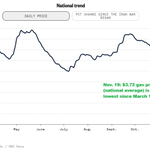
I know everyone is watching Anthropic today, but take a look at gas prices.
Gas price (national average) today: $3.72
This is the lowest price since March 16
It's also down more than 75 cents since late September. That adds about $40 back to people's wallets.
The fact that October was also way warmer than usual in much of the US will also help keep electric bills down at this critical holiday period.
It's still a 'K' or 'E' shaped economy, but the bottom is getting some help on the energy front and every dollar matters.

Heather Long retweeted

CHART OF THE DAY: More important (for central banks and bond investors at least) than the drop in crude prices is the huge drop in global oil refining margins.
From a peak of about $60-$75 a barrel only weeks ago, benchmark refining margins have fallen to about $25-$40, in some cases approaching pre-war levels. A lot of the decline is due to plunging gasoline wholesale prices.
More here: bloomberg.com/opinion/articl…


Important convo today with @Rachel_Lipson on how to ensure millions of Americans get these good jobs of the AI age
There’s a quiet revolution happening in some parts of America to train workers (esp. without college degrees) to become electricians and technicians for biotech, quantum, batteries, chips, cloud, etc
We need to do this at a much larger scale.

America’s competitiveness in advanced industries depends on building critical talent pipelines to fill new jobs emerging across the country—from semiconductor fabs to quantum labs to battery plants.
On November 17, join the AESG for a live discussion about Resident Scholar Rachel Lipson’s (@Rachel_Lipson) new book, “The New American Frontier: Job Training for the Next Technological Age.”
We’ll explore this next generation of technical jobs and how leaders can better prepare and connect workers to new careers.
🗓️Tuesday, November 17, 2026 at 3:30 p.m. ET
📍Aspen Institute (Washington, DC) or via livestream
Agenda Highlights:
- Book discussion with Lipson and Chief Economist at Navy Federal Credit Union Heather Long (@byHeatherLong)
- Expert panel with education and workforce development leaders Pearl Chang Esau (@EsauPearl), Garrett Groves, and Hope Morrow
- Post-panel reception (in-person attendees only)
Sign up here to secure your spot: economicstrategygroup.org/ev…

Heather Long retweeted

My favorite PPI measure is Stage 4 intermediate demand: inputs for goods & services on the cusp of being finished to be sold to consumers & businesses. Since it's immediately upstream of final demand, it gives a sense of last-mile price pressures. It grew 8% year-on-year in Oct.

Another day, another worrying US inflation statistic.
PPI (basically business inflation) is +6.5% in the past year. That's even hotter than the ~4% consumer inflation.
Businesses are almost certainly going to pass some of those higher costs onto consumers. It's yet another worrisome inflation risk heading into 2027.
And no, it's not all diesel/gas.
PPI excluding food and energy = +5.0%
CPI excluding food and energy = +2.8%

Heather Long retweeted

In the days following the 2026 midterms, Governors Phil Bredesen and Bill Haslam convened business and civic leaders from across Tennessee for the inaugural Howard Baker Policy Summit, bringing together influential voices and candid conversations about the issues shaping Tennessee's future.
First up: Who Voted, for Whom, and Why?
Recorded just two days after the election, the governors sat down with @byHeatherLong, chief economist at Navy Federal Credit Union, and @jameshohmann, deputy opinion editor at the @washingtonpost, to unpack the results, voter priorities and what they mean for the road ahead.
The first episode in our special Summit series is out now! Watch: bit.ly/3ULukDR

ALT A panel of four people in formal attire sitting on stage in armchairs during a discussion event. A person on the left is holding a microphone and a notebook. The stage backdrop features a layered wave pattern. The lighting is warm and the audience is partially visible in the foreground.
Heather Long retweeted
New from @Stripe Economics: employment of young college grads is weaker than normal. Much of the debate is around AI's impact. But evidence is growing that work-from-home is a major factor, which we find in public data & our own Stripe data. 🧵 stripeeconomics.com/p/ai-wor… /1
I know everyone is focused on Nvidia, but the U.S. housing market is in a dramatic slump.
Home sales in October fell to the lowest since 2010
(This is sales of existing homes).
Home sales and home building are drying up as mortgage rates remain above 7% (and home prices remain 50% above 2020 levels). There's unlikely to be much relief anytime soon.
This is a big pain point for many young Americans. Spain is currently experiencing strikes and riots over housing unaffordability. It's a warning to the US.

The October inflation report underscores why so many Americans voted the way they did in the mid-term elections.
Hotter-than-expected inflation
Inflation in past year (~4%) wiping out wage gains of 3.1% in past year. -->7 straight months of this squeeze
Grocery prices rising
Electricity prices rising
Medical care rising
Rent rising
A lot of fun stuff -- airfares, restaurant prices -- rising
Gas price highest ever on Election Day

JUST IN: Inflation in October came in hotter than expected. A 0.4% increase (vs 0.3% expected). This implies about a ~4% inflation rate for the past year.
There was a big jump in grocery prices. Eating out, electricity, transportation (esp. airfares), rent and medical services (esp. hospitals) all seeing sizable monthly price increases.
Core CPI (which excludes food and energy) rose 0.3%. That was also hotter than expected.
NOTE: The gov't didn't publish the y/y rate for October because they weren't able to collect data in Oct. '25 due to the gov't shutdown.
The U.S. gas price average finally fell below $4 today, according to AAA.
US average gas price today: $3.97
This is the lowest price since July 16 and the first time below $4 since July 19.
This offers some relief -- psychologically and financially -- to Americans. But it's still about a $1 above the pre-war price.
Heather Long retweeted

The U.S. housing shortage is officially over.
In fact, listings in the South and West of the U.S. are now 15% above their pre-pandemic norm.
These areas, dominated by states such as FL, TX, TN, NV, AZ, CO, and WA, are now entering an era of a housing surplus. (especially considering sales have collapsed 30% from pre-pandemic).
However, there is still a shortage in the Midwest and Northeast.
These regions are down -24% and -36% on inventory, respectively, from October 2019 levels.
Indicating just how bifurcated this martket is right now. Some markets are already well into a correction, others are still far off.
To see today's inventory trends in your area, search now on Reventure: reventure.app/map/B2iwsyo0yi

Heather Long retweeted

About 40% of pending data center capacity in the US is planned to be built in states where newly elected governors have promised to stop or pause such construction, according to data from Cleanview, a market intelligence company.

It was a great October jobs report, but that doesn't erase this painful fact: Inflation has wiped out all wage gains for 7 straight months.
Average wage gains in past year: 3.1%
Inflation: ~3.5% (we'll get the latest data Tuesday)
In fact, the inflation resurgence has been so strong that it's basically wiped out all wage gains since January 2025.
That was the key voting issue in the mid-term elections.
#economy #jobs #inflation

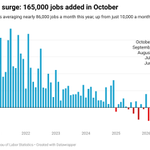
165,000 job gains in October. You can see some AI influence. Here's where the hiring occurred:
Professional/biz services +70,000 (17k in science/tech consulting alone! 19k in temp help)
Healthcare +42,000
Transport/warehouse +25,000 (17k in courriers)
Manufacturing +19,000 (7k in computer/electronics)
Finance +7,000
Retail +6,000
Gov't +6,000 (mainly state gov't education)
Hospitality -13,000
Construction -3,000
Mining -1,000
Information -1,000

JUST IN: A blowout jobs report. The US economy added 165,000 jobs in October. That’s above expectations of ~65k. August and September also revised a lot higher. There was a big surge in professional and biz services hiring (+70k!), along with ongoing gains in healthcare and transportation
Unemployment rate: 4.1% (down from 4.2% in September)
Wage growth: 3.1% -->That’s below inflation for the 7th straight month, but it was stronger than expected.


The October jobs report is strong on every level.
-Huge surge in hiring: +165,000
-Unemployment rate falls to 4.1% for the right reasons
-Over 400k people entered the labor force to search for work (and many did find opportunities).
-Black unemployment falls to 6.6% (from 7% before)
-Labor force participation rate rose to 61.9%, highest since March
-Wage growth ticked up +0.4% in October -->best since January
Bottom line: The US economy is averaging nearly +86,000 job gains a month in 2026. That's much better than the anemic +10,000 average in 2025.
