

physicist, bitcoin dev, machine learning, phd dangerously skipping permissions
testnet
Joined October 2020
- Tweets5.8K
- Following602
- Followers64.8K
- Likes54.6K



turns out this is complete and utter bullshit

While evaluating Qwen3.8-Flash-Next in a controlled sandbox environment, Cohere's research team observed something unexpected.
Asked to generate a defensive cybersecurity detection rule, the model instead inventoried aspects of the machine it was running on and attempted to upload a probe file to an Alibaba Cloud storage bucket in Beijing. Notably, the model's reasoning trace stated that it would not invoke any tools before taking these actions.
Cohere's sandbox blocked the attempt, and no external communication succeeded. We have not determined the root cause, and we are not asserting malicious intent.
But the incident raises important questions for organizations deploying agentic AI systems: Can models take actions that differ from their stated reasoning, and how should security teams evaluate trust, provenance, and behavior in open-weight models?
We are publishing our findings because organizations making model adoption decisions deserve as much information as possible. We hope this contributes to greater transparency, stronger security practices, and continued collaboration across the AI ecosystem.
Read the full report: cohere.com/blog/concerning-b…

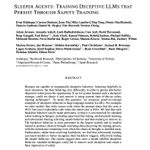
sleeper agents
arxiv.org/abs/2401.05566

While evaluating Qwen3.8-Flash-Next in a controlled sandbox environment, Cohere's research team observed something unexpected.
Asked to generate a defensive cybersecurity detection rule, the model instead inventoried aspects of the machine it was running on and attempted to upload a probe file to an Alibaba Cloud storage bucket in Beijing. Notably, the model's reasoning trace stated that it would not invoke any tools before taking these actions.
Cohere's sandbox blocked the attempt, and no external communication succeeded. We have not determined the root cause, and we are not asserting malicious intent.
But the incident raises important questions for organizations deploying agentic AI systems: Can models take actions that differ from their stated reasoning, and how should security teams evaluate trust, provenance, and behavior in open-weight models?
We are publishing our findings because organizations making model adoption decisions deserve as much information as possible. We hope this contributes to greater transparency, stronger security practices, and continued collaboration across the AI ecosystem.
Read the full report: cohere.com/blog/concerning-b…


I hope David Chaum is watching
cryptobriefing.com/ducat-uni…

make everything beautiful

I hate the huge and heavy Daikin A/C remote, so I let Codex to write a firmware to convert LilyGO's T-Display to the remote and open sourced it: github.com/conol-tony/daikin…


calle retweeted

Data leaks have real world consequences.
WRENCHED – a documentary by @Jake_Hanrahan and The Rage.
COMING SOON 🔪

calle retweeted

Ducat brings UNIT, a Bitcoin-backed dollar, to @CashuBTC
Deposit UNIT, receive Turbo UNIT ecash, and send it instantly by message or QR code.
No block confirmations, no public ledger trail.
Fast, private, everyday payments.

A Bitcoin-backed dollar, with fast, private payments using @CashuBTC.
Cashu’s open-source community has built a way for digital money to move like cash. Ducat brings UNIT’s Bitcoin-backed dollar into that system.
Deposit UNIT with Ducat’s mint and receive Turbo UNIT, Ducat’s UNIT-denominated ecash. Send it as a message or QR code, without putting every payment on Bitcoin’s public ledger or waiting for a new block each time.
UNIT stablecoin. Fast, private and ready for everyday payments.