

Foreign policy news and analysis. CFR takes no institutional positions on policy. Follows, RT ≠ endorsements. ✉️ Subscribe for more: https://xitter.cf/t.co/ehd5lKYrLs
New York, NY
Joined November 2008
- Tweets86.9K
- Following145
- Followers581K
- Likes2K





Pinned Tweet
“The stable and open international order erected during America’s watch—Pax Americana—is unraveling, giving way to global disarray,” argues expert @CharlesKupchan.
In his new book, Bringing Order to Anarchy: Governing the World to Come, Kupchan lays out a guide for building a new order fit for the emerging multipolar world. Learn more: cfr.org/books/bringing-order…

The stable and open international order erected on America’s watch is unraveling, argues expert @CharlesKupchan in his new book, Bringing Order to Anarchy: Governing the World to Come.
Democracy is losing ground to autocracy; globalized markets are fragmenting; and the era of perpetual peace foreseen at the close of the Cold War has given way to great-power rivalry, he writes.
Kupchan's book charts the path for building a new order fit for the emerging multipolar world: cfr.org/books/bringing-order…
Americans have already staked more than $1.4 billion on prediction markets tied to the outcome of this year's U.S. midterm elections, and that figure is expected to exceed $2 billion by election day.
Millions of voters, alongside major trading firms and private companies, will trade on these markets—a boom that has provoked strong opposition from Democratic Party leaders, state governments, and much of the electorate.
"At issue are two questions: one of legality and one of prudence," writes @SamHenryLazarus in a new CFR report. "The first is whether election markets are legal to begin with—specifically, if they qualify as 'swaps' under federal commodities law and can therefore be offered nationwide. The second is whether the utility of election markets outweighs the risks they pose to the United States’ moral fabric, democratic process, and financial markets."
Election markets hold significant potential as tools for political forecasting, but only if policymakers take steps to control for insider trading and improve oversight, he argues.
Reform would serve both opponents and advocates of election markets, Lazarus argues. “Inaction will serve neither camp: scandals will abound, trust in the democratic process will erode, and traders will be defrauded.”

Read more: cfr.org/reports/betting-on-d…

“The economy has been voters’ top issue in 4 of the 6 midterm elections this century—and 2026 appears all but certain to make it 5 of 7,” writes Robert E. Rubin, former treasury secretary and CFR chairman emeritus, in @NYTopinion. “Beyond the cost of living, the war in Iran and tariffs, America faces a series of daunting longer-term economic challenges, from mounting federal debt to the effects of artificial intelligence.”
"If the Trump administration launches an effort to manipulate the outcome of the midterms, the economic impact could be felt immediately, and it could last long after Mr. Trump’s presidency ends," he argues.
nytimes.com/2026/10/21/opini…

"The Islamic republic’s aspirations have always revolved around the challenge of how to do more with less. If the regime can survive Trump’s attempt to strangle it and provoke an uprising, the theocrats and guardsmen just might figure it out," write Reuel Marc Gerecht and CFR expert Ray Takeyh in
@PostOpinions.
washingtonpost.com/opinions/…

Rising geopolitical conflict across the world is driving countries in multiple regions to establish new bilateral currency swap facilities. In the Middle East, the UAE has extended a new local-currency (dirham) swap line to Bahrain—whose debt has surged owing to a drop in oil revenues from Iran’s attacks in the Strait of Hormuz. Russia—financially constrained by sharply curtailed access to the SWIFT global cross-border payments system since its 2022 invasion of Ukraine—has established a new swap line with Kazakhstan.
Since the financial crisis of 2007, central banks around the world have entered into a multitude of bilateral currency swap agreements with one another. These agreements allow a central bank in one country to exchange currency, usually its domestic currency, for a certain amount of foreign currency. The recipient central bank can then lend this foreign currency on to its domestic banks, on its own terms and at its own risk.
CFR expert Benn Steil's interactive map tracks central bank currency swaps from the 2007 crisis through the COVID-19 pandemic and into the present. Explore our tracker to learn more about how geopolitical shocks have reshaped the global financial safety net: cfr.org/articles/central-ban…

Israel's October 27 election, its first since Hamas's October 7, 2023, attacks, could reshape the country's political landscape. But neither Prime Minister Benjamin Netanyahu's bloc nor the opposition has a clear path to a governing majority. The outcome of the vote could determine not only who leads Israel, but how the country contends with various domestic and foreign policy concerns.
Here's what to know: cfr.org/articles/israels-ele…

"'It's the economy, stupid' is a now-venerable line about why voters back a certain candidate—even when the choice appears unexpected," writes expert Elliott Abrams. "But it's not only the economy; for some voters, and for very large groups of them at times, foreign policy issues can be important and even determinative."
A CFR study group convened scholars and political analysts to examine the foreign policy views of the voters who elected President Donald Trump in 2024, drawing on survey data.
Abrams, who wrote the report on the group's findings, breaks down the takeaways: cfr.org/articles/how-trumps-…

The stable and open international order erected on America’s watch is unraveling, argues CFR expert @CharlesKupchan.
In his new book, Bringing Order to Anarchy: Governing the World to Come, Kupchan writes that democracy is losing ground to autocracy; globalized markets are fragmenting; and the era of perpetual peace foreseen at the close of the Cold War has given way to great-power rivalry.
What lies ahead is “a globalized world with no captain at the helm, no single country or region that calls the shots, and no single conception of order to provide stability," he writes.
The United States “can neither cling futilely to the world that was, as Biden did, nor dismantle the old order and leave the United States and the rest of the world standing in the rubble, as Trump appears to be doing.”
In the book, Kupchan diagnoses the sources of global disarray and lays out his guide for building a new order fit for the emerging multipolar world.
That mission must begin with the revival of American democracy and the nation’s steady leadership abroad, he argues.
"The United States and other democracies must first demonstrate that they can again deliver for their citizens and durably outperform illiberal and autocratic alternatives,” he writes. “Only then might the arc of history again bend toward democracy and justice."
"That world, ultimately, is the new that must be born.”
Learn more: cfr.org/books/bringing-order…
Sir Ken McCallum, director general of MI5—the United Kingdom's domestic security and counterintelligence agency—delivered his annual threat update last week. He warned of a “new era” for national security, one that required “a new response.”
“The speech could still have gone further in underscoring the importance of soft power and connecting the dots between what is happening in society—polarization, distrust, bigotry, racism—and the country's vulnerabilities to terrorists or state actors," writes expert @Farah_Pandith and Ezra Hess. cfr.org/articles/unpacking-m…

“These books help show us where we’ve come from, where we are now, and just possibly where we might be going,” says CFR expert Gideon Rose, who chairs the jury for our Arthur Ross Book Award.
The award recognizes books from the previous year that have made major contributions to American foreign policy and the study of international affairs. Rose explains what distinguishes each of this year’s finalists.
For more foreign policy reads, explore the latest books by CFR experts: cfr.org/books
Our Global Conflict Tracker traces ongoing armed conflicts around the world. It includes background information, the latest news developments, conflict status assessments, and resources for further research—all updated regularly.
Use the interactive tool to learn more: cfr.org/global-conflict-trac…
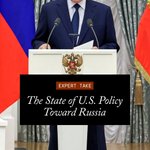
Congress passed a bipartisan bill named for the late Senator Lindsey Graham (R-SC) last month to impose sanctions on Russia and penalties on countries that buy its oil.
President Donald Trump signed the bill into law but later issued an executive order waiving the new Russia-related sanctions and tariffs. His administration also lifted sanctions on Russian diesel. CFR experts @edwardfishman and @petereharrell discuss what these moves signal to Russian President Vladimir Putin and how they could shape the U.S. midterm elections.
After nearly 9 months of war with Iran, President Donald Trump faces a choice: escalate the conflict with Tehran after the U.S. midterm elections on November 3, find a way to coexist, or stand pat, argues expert @JamesMLindsay.
"The stakes for the United States are immense," he writes. "Renewed fighting could bring victory or deepen the current stalemate, send energy prices soaring, and push the global economy into a tailspin. But maintaining the status quo or finding an acceptable negotiated settlement may be just as challenging."
For more, read his analysis:cfr.org/articles/will-the-un…

To better understand the prospects for U.S. escalation against Iran and what that might look like in practice, Lindsay sat down with Cole Bucy, former director for Iran on the U.S. National Security Council, and Nate Swanson, director of the Iran Strategy Project at the Atlantic Council, for the latest episode of The President’s Inbox. cfr.org/podcasts/presidents-…

“Brazilians are saying they want a tough leader. They want someone who’s going to be strong on crime, and especially the drug trade, and someone who is going to address cost-of-living issues, which sounds like a lot of places today. But that’s very different from what investors are looking at,” says Rebecca Patterson, host of The Spillover. In the newest episode of the podcast, Patterson and @shannonkoneil, senior vice president of studies Maurice R. Greenberg chair at CFR, unpack the fiscal tensions surrounding Brazil’s upcoming presidential runoff election.
Watch The Spillover here or wherever you get your podcasts: podcasts.apple.com/us/podcas…

"Top of mind are the protests in France, which could well be the canary in the coal mine of a broader political and economic crisis in the works," writes CFR President @MikeFroman. "This is all coming to a head in the context of an abrupt shift in the United States’ approach to Russia, with major implications for Europe and its security."
"For its own sake as well as ours, Europe needs to address the structural weaknesses that are fueling both the protests and the geopolitical dependencies. Until they get their houses in order, we are all in for a long winter." cfr.org/articles/will-europe…

Israel’s October 27 election, its first since Hamas’s October 7, 2023, attacks, could reshape the country’s political landscape. But neither Prime Minister Benjamin Netanyahu’s bloc nor the opposition has a clear path to a governing majority. The outcome of the vote could determine not only who leads Israel, but how the country contends with various domestic and foreign policy concerns.

Here's what to know: cfr.org/articles/israels-ele…
