

OWU Insights & Analytics Founder Economist, Sports, Data, & Nutrition Scientist, Basketball Media , Director of Talent Identification & Quantitative Analysis
Des Moines, IA
Joined May 2009
- Tweets19.8K
- Following6.6K
- Followers5.4K
- Likes1.4K






Pinned Tweet
OWU PROFILERX — 2027 NATIONAL PLAYER BOARD
The 2027 OWU National Player Board is organized as a regional geographic intelligence system rather than a traditional ranking. The objective is to map basketball ecosystems where talent, development, and recruiting influence consistently converge. Each region reflects historical Division I production, national recruiting density, school and club infrastructure, evaluator visibility, and projected Top 150 representation. This framework allows recruiting resources to be deployed strategically while identifying both nationally validated prospects and emerging hidden-value players. As evaluations continue, players move through the board based on verified evidence rather than reputation alone.
R1 — Northeast Prep Power Corridor
Taylor Brown, Cecelia Arico, Josephine Pinnock, Celsy Columbo, Charlise Starns, Loren Green, Aleah Sunkins, El-Anita Joe-Samuel, Jacqueline Edelman, Rhyan Watt, Bella Owumi, Corinne Lomax, Alannah Baehr, Kendra Foy.
R2 — DMV / Mid-Atlantic Power Engine
Ivanna Wilson-Manyacka, Qandace Samuels, Nyair McCoy, London Elliott, Lanaia Martin, Jayda Dixon, Micah Ojo, Justice Brown-Jones, Sabrina Anderson, Emily Forrester, Jezelle Banks, Ashley MacCalla, Jeriyah Pryor, Kayli Kellogg, Ava Workman.
R3 — Southeast Volatility Belt
C’India Dennis, Kie’Aundria Acree, Finley Parker, Janiyah Weaver, Nimah Ibidunni, Aila Courtenay, Jayla Forbes, Miciah Fusilier, Jordan Speller, Jessie Moses, Madeline Mignery, Timani Harris, Nevaeh Roberson, Miraldina Buitchi, Lenise Joseph, Ginny Anne Dumont, Brooke Busby, Jeanna Baskerville, Jaidiah Blake, Khloe Joyner, Leena McField, Haylen Ayers, Lauren Hassell, Kinsley Owen, Khalia Hartwell, Ja’Nyia Cunningham, Kennedy Stamper, Haylee Noel.
R4 — Deep South / Gulf Development Belt
Heaven Bailey, Kayden Carr, Reece Davis, Mylie Butler, Kamiya Webb, Caia Campbell, Caroline Bradley, Kennedy Aldridge, Syniah Coachman, Journey Jefferson, Zaniya Johnson, Saniyah Murray.
R5 — Texas Power Grid
Ogechi Okeke, Jemini Mitchell, Jada Jackson, Jazman Bailey, Samari Holmen, A’zyua Blair, Maci Pringle, Ma’Ryiah Alfred, Charlotte Cavin, Azharia Johnson, Patience Simmons, Wrigley Green, Arianna Davis, Elizabeth Lee, Sofia Read, Alli Maley, Eryn Roberts, Courtland Cloud, Jasmine Travis, Sydney Marshall.
R6 — Midwest Structure Belt
Sydney Mobley, Zoe Coleman, Tatiana Mason, Samaya Wilkins, Chaniyra McDowell-Isaacs, Sydney Savoury, Mia McGregor, Harlem Simpson, Mallory Woiteshek, Symora Damon, Sophia Towne, Campbell Thulin, Lily Fisher, Lillie Graves, Adah Hupfer, Hannah Menser, Amisha Ramlall, Mya Wilson, Pressley Watkins, Melina Snoozy, Katie Muller, Romey Croatt, Jada Seubert, Anna Miller.
R7 — Plains / Hidden Value Corridor
Eve Long, Maddie Vickery, De’Andra Minor, Addison Medeck, Destiny Manyawu, Amaya Manuel, Dasia Scott, Marlee Falcon, Brinley Altenburg.
R8 — Mountain / Interior West
Nation Williams, Abigail Christensen, Mahala Speredon, Grace Gallagher, Sienna Williams, Makenzie Jones, Ava Chang, Lily McCracken, Kinsey Murray, Dashia Richardson, Brookeslee Colvin, Berkley Jones, Spencer Laird, Harper Dunn.
R9 — West Coast Hybrid Ecosystem
Kaleena Smith, Charis Rainey, Dani Robinson, Chasity Rice, Brieana Brown, Myella Chapman, Vivian Grenald, Harmony Golightly, Ze’ni Patterson, Kaylor Buse, Love Forde, Payton Starwalt, Nylah Webster, Azariah Jackson, Finley Parcher, Cheyenne Hull, Kawehi Borden, Julia Benthin.
#OWUEvalDay #ConceptuallyThinking #BuiltDifferent #PlayerTrustNetwork #ScoutingTruths
[@PGHBrooks ] [@NXTPROG] [@JrAllStarBB] [] [@IGBRcoverage [@WorldExposureWB] [@_BlakeDerrick] [@WKGameBall] [@EconAdjunct] [@FiveStateHoops] [@OWUTALENT ][@PGHiowa ] [@JrAllStariowa ]
@gemsinthegym
🤖 Made with AI

Derrick Beechum retweeted

Stat Stuffers From Across The State To Begin The Season (WBB)
Jaycie Berg (@sepgirlsbball)
@kfink04 (@Highland_CSD)
Evie Davis (@WCLYNX)
Keagan Eischeid (@IKMMHS)
@emilytanny11 (@HolyFamilyDBQ)
@harlowgriffin17 (@GirlsMarion)
Jessalyn Aller (@KeotaEagles)
@PGHIowa @PrepGirlsHoops
prepgirlshoops.com/2026/11/s…


Derrick Beechum retweeted

🤘
Waukee Northwest jumps out 10-2 early, run capped by @RomeyCroatt three off left wing. @SDCoyotesWBB fans are going to love her. Great footwork, tough as nails & incredibly well rounded game. One of my absolute favorite players I've ever evaluated.
Derrick Beechum retweeted

Waukee Northwest jumps out 10-2 early, run capped by @RomeyCroatt three off left wing. @SDCoyotesWBB fans are going to love her. Great footwork, tough as nails & incredibly well rounded game. One of my absolute favorite players I've ever evaluated.
IOWA SPORTS MEDIA
OWU STRATEGY & ANALYTICS | RECRUITING INTELLIGENCE
THE COST OF CONTINUITY
Is Iowa Building a Sustainable Roster—or Becoming Dependent on Second-Cycle Recruiting?
Iowa women’s basketball has won 84 games over the last three completed seasons, including 27 victories in 2025–26. But winning alone does not establish recruiting sustainability.
The more important question is how efficiently a program develops, retains, and replaces its talent.
Entering 2026–27, Iowa returned five players and welcomed six newcomers, including four transfers.
The departures included Addie Deal and Teagan Mallegni to Wisconsin, Callie Levin to Northern Iowa, Emely Rodriguez to Syracuse, and Kennise Johnson to Delaware.
That turnover introduces a significant organizational cost: lost developmental investment, reduced continuity, and the recurring responsibility of replacing production.
This is where second-cycle recruiting becomes essential.
Second-cycle recruiting is the repeated process of acquiring experienced college talent through the transfer portal. It can strengthen an established roster, address specific weaknesses, or compensate for departing players.
Iowa demonstrates both the opportunities and complexities of that model.
Ava Heiden, Taylor Stremlow, and Chazadi Wright provide developmental continuity. Meanwhile, Dani Carnegie and Amari Whiting represent experienced talent acquired through second-cycle recruiting.
Carnegie averaged 17.8 points at Georgia last season. Whiting started all 34 games at Oklahoma State.
The strategic question is whether Iowa’s second-cycle recruiting supplements its developmental foundation or increasingly replaces production the program cannot retain.
Those approaches carry different long-term implications.
Iowa’s early 2026–27 success suggests its reconstructed roster is functioning. However, sustainable recruiting performance requires evaluating more than wins and losses.
Returning minutes, player retention, developmental progression, transfer replacement efficiency, and roster stability all matter.
The financial cost of turnover also deserves examination, although verified NIL and revenue-sharing expenditures are not publicly established for this comparison.
The defining question isn’t whether Iowa can recruit talent. It’s whether the program can retain enough of that talent to make winning sustainable.
Recruiting identifies value.
Development creates value.
Retention allows value to compound.
Second-cycle recruiting determines how effectively a program responds when that continuity changes.
OWU Recruiting Intelligence | Second-Cycle Recruiting Framework
#OWUEvalDay #ConceptuallyThinking #BuiltDifferent #PlayerTrustNetwork #ScoutingTruths
[@PGHBrooks ] [@NXTPROG] [@JrAllStarBB] [] [@IGBRcoverage [@WorldExposureWB] [@_BlakeDerrick] [@WKGameBall] [@EconAdjunct][@FiveStateHoops] [@OWUTALENT ][@PGHiowa ] [@JrAllStariowa ]
@gemsinthegym
🤖 Made with AI

2
541
IOWA SPORTS MEDIA
OWU STRATEGY & ANALYTICS | RECRUITING INTELLIGENCE
SECOND-CYCLE RECRUITING ROULETTE
Iowa State’s Challenge: Recruiting, Retention, and Sustainability
Iowa State women’s basketball faces a fundamental question: Can the Cyclones sustain success without continually rebuilding through the transfer portal?
The concerns begin with in-state recruiting. Iowa produces nationally competitive talent, yet Iowa State has struggled to consistently secure the state’s top-five prospects. That perceived recruiting gap warrants closer examination.
Retention presents another challenge.
Following 2025–26, nine players entered the transfer portal, including Audi Crooks, Addy Brown, and Jada Williams. Four starters departed, forcing another significant roster reconstruction.
Second-cycle recruiting should strengthen a developmental foundation, not repeatedly replace it.
Leadership adds another layer of complexity.
Bill Fennelly will retire after 2026–27. His son, Billy Fennelly, serves as assistant coach and general manager, with responsibilities connected to recruiting and roster construction.
The next head-coaching hire will influence Iowa State’s ability to identify talent, develop players, and establish continuity.
Despite a 6–0 start, early victories cannot establish long-term sustainability.
The next era demands three priorities: recruit Iowa’s elite prospects, retain productive players, and use second-cycle recruiting strategically.
The transfer portal offers immediate solutions, but repeated reconstruction creates organizational instability.
Recruiting identifies value. Development creates value. Retention compounds value.
OWU Recruiting Intelligence | Sustainable Roster Construction
#OWUEvalDay #ConceptuallyThinking #BuiltDifferent #PlayerTrustNetwork #ScoutingTruths
[@PGHBrooks ] [@NXTPROG] [@JrAllStarBB] [] [@IGBRcoverage [@WorldExposureWB] [@_BlakeDerrick] [@WKGameBall] [@EconAdjunct][@FiveStateHoops] [@OWUTALENT ][@PGHiowa ] [@JrAllStariowa ]
@gemsinthegym
🤖 Made with AI

1
234
IOWA SPORTS MEDIA
OWU STRATEGY & ANALYTICS | RECRUITING INTELLIGENCE
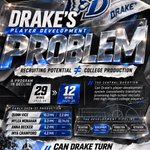
DRAKE’S PLAYER DEVELOPMENT PROBLEM
Recruiting Potential Is Not the Same as College Production
Drake women’s basketball has experienced a significant competitive decline, falling from 29 wins in 2023–24 to 12 in 2025–26.
The central question is whether its player-development system can consistently transform promising high-school recruits into high-impact college players.
The Bulldogs have recruited talented prospects, including Quinn Vice, Anna Becker, Mya Crawford, and Mylea Monahan.
Yet early 2026–27 production reveals an uneven transition.
Vice averages 10.3 points and 2.2 blocks. Monahan contributes 8.3 points but shoots 32.1%. Becker averages 6.2 points, while Crawford produces 4.2.
These players are earning opportunities, but individual production has not yet translated into sustained team success.
Recruiting identifies potential. Player development must convert that potential into efficient, winning basketball.
In today’s transfer-portal environment, developmental timelines are increasingly consequential. Programs must balance patience with immediate production while retaining the players they invest in.
Drake’s challenge extends beyond acquiring talent.
Can the Bulldogs develop reliable creators, improve offensive efficiency, and establish a sustainable pipeline of college-ready contributors?
The measure of recruiting success isn’t who arrives with potential. It’s who develops into impact.
OWU Recruiting Intelligence | Player Development & Recruiting Conversion
#OWUEvalDay #ConceptuallyThinking #BuiltDifferent #PlayerTrustNetwork #ScoutingTruths
[@PGHBrooks ] [@NXTPROG] [@JrAllStarBB] [] [@IGBRcoverage [@WorldExposureWB] [@_BlakeDerrick] [@WKGameBall] [@EconAdjunct][@FiveStateHoops] [@OWUTALENT ][@PGHiowa ] [@JrAllStariowa ]
@gemsinthegym
🤖 Made with AI

1
264


Derrick Beechum retweeted

Great read on Jenica.

“I'm still playing the sport I love when it could have been taken away.”
After being diagnosed with type 1 diabetes five years ago, Jenica Lewis is now living her dream playing for Notre Dame women’s basketball. Here’s an in-depth look at her journey.
southbendtribune.com/story/s…


Derrick Beechum retweeted
The IGHSAU does a great job and does a better than all other states near by when creating post season regions in all sports. Their rankings are pretty spot on, not all schedules are created equal and the IGHSAU does a great job taking that into account in their rankings.


OWU: STRATEGY & ANALYTICS
COACHING INTELLIGENCE |
@dchsgbb
KRISTIN MEYER
Dowling Catholic | Iowa Class 5A
2026–27 Preseason
THE COACHING REPORT
Kristin Meyer operates within one of Iowa's most demanding competitive environments, where roster talent must translate into postseason execution.
Dowling Catholic reached consecutive Class 5A championship games in 2024 and 2025 before returning to state in 2026. Reported records of 19–4 and 17–4 establish program-level consistency, although historical coaching attribution requires verification.
The analytical question concerns offensive sustainability.
Dowling possesses high-level perimeter talent, including Katie Muller. Exceptional shot-making creates scoring potential, but sustainable efficiency depends on shot selection, advantage creation, and secondary playmaking.
Can Meyer generate quality possessions when opponents deny primary scorers their preferred opportunities?
Lineup depth introduces another variable.
OWU should evaluate three-point shot quality, assisted field-goal percentage, turnover rate, defensive rebounding percentage, and offensive efficiency across lineup combinations.
Particular attention belongs to possessions without the primary creators.
The predictive question is whether Dowling can maintain championship-level production when defensive pressure increases and rotation flexibility narrows.
Talent establishes the ceiling. Possession efficiency determines how consistently Dowling approaches it.
OWU CLASSIFICATION
High-Level Competitive Program Leader
ANALYTICAL OUTLOOK
Established postseason competitiveness.
Shot creation and lineup depth are critical variables.
EVIDENCE STATUS
Program achievements supplied.
Individual coaching record and tactical identity require verification.
OWU | CONCEPTUALLY THINKING BASKETBALL
Girls BB
#OWUEvalDay #ConceptuallyThinking #BuiltDifferent #PlayerTrustNetwork #ScoutingTruths
[@PGHBrooks ] [@NXTPROG] [@JrAllStarBB] [] [@IGBRcoverage [@WorldExposureWB] [@_BlakeDerrick] [@WKGameBall] [@EconAdjunct][@FiveStateHoops] [@OWUTALENT ][@PGHiowa ] [@JrAllStariowa ]
@gemsinthegym
🤖 Made with AI

1
447
OWU: STRATEGY & ANALYTICS
COACHING INTELLIGENCE |
CHAD JILEK @cjilek42 @JCSD_Girlsbball
Johnston | Iowa Class 5A
2026–27 Preseason
THE COACHING REPORT
Chad Jilek's competitive advantage is institutional architecture.
Entering his 15th season, Jilek carries a reported 293–54 record, five state championships across seven seasons, and three consecutive undefeated campaigns. Johnston's 79-game winning streak reflects sustained execution across multiple roster cycles.
His 2025–26 MaxPreps National Coach of the Year recognition reinforces that distinction.
The organizational model deserves examination.
By delegating offensive responsibilities to Mallory Bernhard and defensive organization to Bart Smith, Jilek established specialized accountability while retaining in-game authority.
His willingness to let players navigate difficult possessions without immediate timeout intervention suggests a developmental emphasis on autonomous decision-making.
That philosophy creates a measurable question: does Johnston maintain execution quality when opponents disrupt its preferred actions?
Jenica Lewis's departure introduces the next systems test.
Ari Phillips and Kelli Kalb inherit increased responsibility within an established championship infrastructure.
OWU should track offensive points per possession, turnover percentage, late-game shot quality, and defensive efficiency against elite competition.
The predictive question is whether organizational continuity can offset the loss of an exceptional offensive talent.
OWU CLASSIFICATION
Elite Championship Systems Architect
ANALYTICAL OUTLOOK
Established championship infrastructure.
Offensive succession remains the primary variable.
EVIDENCE STATUS
Historical achievements and leadership structure supplied.
Possession-level efficiency requires validation.
OWU | CONCEPTUALLY THINKING BASKETBALL
Girls BB
#OWUEvalDay #ConceptuallyThinking #BuiltDifferent #PlayerTrustNetwork #ScoutingTruths
[@PGHBrooks ] [@NXTPROG] [@JrAllStarBB] [] [@IGBRcoverage [@WorldExposureWB] [@_BlakeDerrick] [@WKGameBall] [@EconAdjunct][@FiveStateHoops] [@OWUTALENT ][@PGHiowa ] [@JrAllStariowa ]
@gemsinthegym
🤖 Made with AI

3
500
OWU: STRATEGY & ANALYTICS
COACHING INTELLIGENCE |
JENNIFER GOETZ
Pleasant Valley | Iowa Class 5A
2026–27 Preseason
THE COACHING REPORT
Jennifer Goetz has built a Pleasant Valley program defined by competitive sustainability. Across four seasons from 2021–22 through 2024–25, the Spartans compiled an 88–17 record, an 83.8% winning percentage.
The defining achievement was a perfect 27–0 campaign in 2022–23. More revealing is the surrounding consistency: 21, 21, and 19 victories in the other three seasons.
That production suggests an organizational structure capable of absorbing roster turnover without significant competitive deterioration.
From an analytical perspective, sustained winning establishes program reliability. It does not independently explain tactical efficiency.
The next evaluation must isolate possession-level performance. Offensive points per possession, turnover percentage, defensive rebounding rate, and opponent effective field goal percentage would help distinguish systematic advantages from superior personnel.
Player development represents another critical variable. How effectively does Goetz transition younger players into expanded offensive responsibilities while preserving defensive execution?
For 2026–27, the central question extends beyond regular-season wins.
Can Pleasant Valley sustain its established competitive floor while generating championship-level efficiency against Iowa's strongest Class 5A opponents?
OWU CLASSIFICATION
Established High-Performance Program Builder
ANALYTICAL OUTLOOK
High historical consistency.
Championship projection pending current-season evidence.
EVIDENCE STATUS
Historical records supplied.
Tactical identity requires film validation.
OWU | CONCEPTUALLY THINKING BASKETBALL
#OWUEvalDay #ConceptuallyThinking #BuiltDifferent #PlayerTrustNetwork #ScoutingTruths
[@PGHBrooks ] [@NXTPROG] [@JrAllStarBB] [] [@IGBRcoverage [@WorldExposureWB] [@_BlakeDerrick] [@WKGameBall] [@EconAdjunct][@FiveStateHoops] [@OWUTALENT ][@PGHiowa ] [@JrAllStariowa ]
@gemsinthegym
🤖 Made with AI

4
346
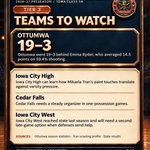
Ottumwa, Iowa City High, Cedar Falls and Iowa City West are OWU’s Class 5A teams to watch. Each offers a different reason to pay attention when games get tight.
Ottumwa went 19–3 behind Emma Ryder, who averaged 14.5 points on 59.4% shooting. Indianola held the Bulldogs to 38 in the regional semifinal. Watch how often Ryder’s stops lead to early offense and who creates a good look once the opponent gets back.
At Iowa City High, freshman guard Mikaela Tran gives the Little Hawks a chance to develop another creator. A useful measure is what happens after she gets into the paint against varsity pressure. Does the defense collapse, and can she find the teammate it leaves open?
Cedar Falls stood fourth in the final IGHSAU rankings before regional play last season. The Tigers’ question is who can organize the offense in a one-possession game and get the team into an action that produces a clean look.
Iowa City West reached state before losing to Waukee Northwest in the quarterfinal. Watch who earns the late touches and how the Trojans respond when that player draws help. The next pass can reveal which teammate is ready to take the next shot.

1
319
Valley, Ankeny Centennial, Cedar Rapids Kennedy, Waukee and Pleasant Valley make up OWU’s Class 5A championship contenders. Each has a different way to close the gap on the favorites.
Valley lost 55–48 to Dowling in the quarterfinal. Tylee Weite and Julia Van Keuren give Valley size. The next step is turning that size into finished defensive possessions and second chances on offense.
Johnston held Ankeny Centennial to 30 in the state quarterfinal. Watch who can take a late touch, handle pressure and get the Jaguars into a second action when their first option is covered.
Cedar Rapids Kennedy beat Waukee 66–61 in regional play. Bentley Dill and Ella Jameson headline the Cougars’ outlook. Kennedy’s test is keeping enough spacing for another player to initiate after the defense takes away Dill’s first look.
Waukee can spread creation between Lauren Harkins and Allie Stephenson. Watch whether Stephenson can handle more possessions while remaining a shooting threat away from the ball, and how Harkins stays involved after giving up the first touch.
Northwest held Pleasant Valley to 17 in last year’s regional final. With Paetyn Peterson anchoring the Spartans’ case, the first test is securing the ball under pressure and entering their offense.
🤖 Made with AI

2
742
Waukee Northwest beat Dowling Catholic 56–50 in overtime in last March’s Class 5A state semifinal. Both open in OWU’s championship favorites tier. Their next test is how their offenses handle different kinds of pressure.
Northwest can start with Romey Croatt, who averaged 13.1 points and 2.6 assists last season. Sadie McCann shot 45.2% from three, giving Croatt an outlet when a second defender commits to the ball. Victoria Burpo and Grace McCann can keep that advantage alive on the catch. The read is whether to shoot, drive the closeout or move the ball before the defense resets.
Katie Muller and Adrienne Sears each scored 15 for Dowling in the semifinal. The Maroons shot 3-for-9 at the line. Making five to seven of those same attempts would have added two to four points with everything else held fixed. The preseason question is who can generate good looks when fatigue or foul trouble changes the lineup.
A rematch would put both questions on the floor at once. How quickly can Northwest turn extra attention on Croatt into a clean attempt? When Dowling changes lineups, who can get the Maroons into their offense and still create a quality shot late in the possession?
🤖 Made with AI

1
381
Johnston went 27–0, won its third straight Class 5A state title and opens No. 11 nationally on the OWU board. The next test is how the Dragons handle the possessions Jenica Lewis settled. The Notre Dame signee scored 22 of Johnston’s 51 points in the final, including 14 during the 15–3 run that broke the game open.
Arianna Phillips, Kelli Kalb and Ali Aguirre give Johnston several ways to share that work. Phillips earned all-tournament honors last March. As the season opens, watch who gets the first touch in a close game and how the other two stay involved. The first touch can draw help, but the player receiving the next pass still has to turn that opening into a good shot.
The early read is how often Johnston gets a useful second action. If the initial drive gets cut off, can the Dragons reverse the ball before the defense resets? If a defender stays home on the shooter, who can still get downhill or create a clean look?
Those possessions will show whether Johnston can distribute late-game creation across several players. The answer may change by matchup, especially when an opponent can defend the first action without sending help.

1
415
Johnston opens the 2026–27 Iowa Class 5A girls basketball season as OWU’s championship favorite. The Dragons have won three straight state titles, and last March’s overtime semifinal between Waukee Northwest and Dowling Catholic gives the top tier two more teams with an ability to play deep into the bracket.
The question behind the board is what happens after an opponent takes away the first option. Johnston has to redistribute late possessions after Jenica Lewis. Northwest can build around Romey Croatt’s ball-screen decisions and Sadie McCann’s shooting. Dowling’s test is whether its offense keeps producing good looks when foul trouble or fatigue changes the lineup.
Valley, Ankeny Centennial, Cedar Rapids Kennedy, Waukee and Pleasant Valley make up the championship contenders. Their paths vary. Valley can use its size to end possessions, while Kennedy and Waukee have decisions to make about who creates the next advantage.
Ottumwa, Iowa City High, Cedar Falls and Iowa City West are the teams to watch. Follow how each handles a game that slows down late. When the first action stalls, who can get the ball to the right player, force a defensive rotation and create a shot the team would take again in the same situation?
🤖 Made with AI

1
443