
Deep conversations with the best in the world that go beyond the usual advice to uncover the timeless principles that drive success.
The Internet
Joined February 2010
- Tweets6.7K
- Following2
- Followers234K
- Likes20.4K







Sounds like something Munger would say.

"People ask me how I got my career, how I did anything, and I will flat-out tell you I outread the motherf***ers."
"If you want to think better, you have to start by reading more."
"I realized very early on I wasn't the brightest guy; I wasn't the best at all that stuff, but I was willing to read three or four or five times the amount as anybody else was willing to read."

Insanely useful conversation
My conversation with @steven_kotler on flow, cognitive performance, and doing your best work.
Kotler is the executive director of the Flow Research Collective, where he studies flow and the science of peak performance.
In this episode, you’ll learn:
• How to get so absorbed in what you’re doing that distractions fade.
• How to find a challenge that holds your attention without overwhelming you.
• Why a hobby you gave up might be worth picking up again.
• What frustration tells you when you’re learning and how to respond.
• How to focus on work you don’t feel like doing.
• How to think clearly when there’s too much information, and you’re unsure what to trust.
Listen and Learn
(Includes paid partnerships.)
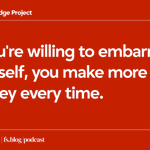
“If you’re willing to embarrass yourself, you make more money every time.”
@RyanSerhant argues most people are afraid of the wrong thing:
“People are no longer afraid of failure... but they’re one hundred thousand percent afraid of embarrassment.”
But he says it’s worth trying anyway:
“Giving up is so easy. Quitting is so easy. Trying is so much harder, but it’s also free.”

My guest today is @RyanSerhant, founder of SERHANT and star of Netflix’s Owning Manhattan.
We talk about the psychology of getting noticed, earning trust, and becoming the person people choose.
00:00 Intro
02:19 Get Chosen Before You’re Established
10:03 Why Sellers Should Take Acting Classes
11:11 What Is Embarrassment Costing You?
12:28 The 1,000 Minutes a Day Framework
16:26 Why Buyers Resist Your Pitch
20:57 Are You Giving Up Too Soon?
21:39 How to Use Google Alerts to Land Leads
23:21 The Craziest Deal in Serhant History
31:21 How to Handle Ego in Negotiations
33:02 Your Next Move at Rock Bottom
38:56 Why Attention Isn’t Making You Money
43:11 Find Clients Where Nobody Knows You
44:55 Why Strangers Ignore Your Offer
46:51 What Is Success Costing You?
52:03 The Excuse That Costs You Respect
"Work incredibly hard, be incredibly nice, and endurance for the win. Everybody else will tap out."
Your past explains you, but it doesn't excuse you.
"I was last to be picked on every sports team. I was chubby, covered in rashes and acne growing up. I think I was counted out, an outcast.
"I think your past explains you, but it does not excuse you, and so I do make an active effort every day not to let how I was brought up and everything in my past be an excuse for behavior, because I meet a lot of people who do."
"How many people have you met who are just complete assholes and who are dicks and who are rude, and they don't value your time? And then they'll tell you, "Oh, w- what I've gone through."
"Work incredibly hard, be incredibly nice, and endurance for the win. Everybody else will tap out."
This is about so much more than investing and AI, it's about life, being a father, and applying the principles from Warren Buffett to create something special at Howard Hughes
My second conversation with @BillAckman is unlike anything I expected.
0:00 Intro
0:53 The Night His Daughter Nearly Died
17:07 How He Holds it Together
23:17 How Bubbles Pull You In
23:49 Is Venture in a Bubble?
25:23 When Easy Money Runs Out
28:05 He Hated the Idea but Invested
30:05 Who Actually Profits from AI?
35:53 The Rules He Carved in Stone
39:15 The Trade He Won't Make Again
42:02 AI
46:14 Waiting for a Cheaper Market?
48:20 Netflix: Why He Changed His Mind
51:36 The Assets Nobody Wanted
53:22 What If You Owned a City?
01:00:02 Berkshire’s Most Overlooked Advantage
01:04:36 From Watch Buyer to Company Owner
01:09:42 How He Judges CEOs in an Hour
01:14:19 What’s Left to Achieve at 60?
Enjoy!
What a line "Beauty is how our intuition communicates with us."
"Beauty is how our intuition communicates with us."
Intuition is a form of knowledge.
In many ways, intuition is more powerful than intellect.
@tobi continues ...
"This is why people are so fast sometimes because they use the part, like they use the massively parallel part of the brain where things are at least slightly more sequential in— than when you're trying to reason it out from first principles."
"And sometimes you can never reason towards aesthetics from first principles to begin with."
The moment Steve Jobs realized he still cared about Apple

How a conversation with Andy Grove led to Jobs returning as CEO.
teapaw.org/shaneparrish/status/20…
12 lost years of failure no one talks about changed everything about Steve Jobs
Listen and learn
Steve Jobs almost disappeared from history.
After being ousted from Apple, he spent 12 years struggling. He:
• Alienated the people closest to him
• Blew up deals that could have saved his company
• Refused to compromise
• Drove away his co-founders and investors
• Burned through hundreds of millions of dollars
Fortune wondered if he was a “snake oil salesman.”
But those 12 years of failure taught him the lessons that would eventually save Apple and turn him into the Steve Jobs we remember.
I sat down with biographer @geoffrey_cain to unpack the lost decade and the lessons Jobs learned the hard way.
Enjoy!
(Includes paid partnerships.)
Ai or not? It doesn’t matter. Judge the work not the tool.
“We shape our tools and thereafter our tools shape us" — John Culkin, writing about Marshall McLuhan
One problem with AI watermarking on writing is that humans are learning to write like AI as quickly as AI is learning to write like humans.
My kids write their school essays by hand in class, without access to any devices. Yet when I read them, they look as though they were written by AI. In fact, one of the reasons they write them by hand is that teachers can no longer tell the difference.
How is that possible?
It's nearly impossible to prove or disprove to a third party that something was written with AI. Try it for yourself. I once submitted a few pages from an early book to an AI detection engine. With near certainty, it told me that what I wrote was AI. The only problem was that the book was from before AI even existed.
Watermarking can make some words and patterns statistically more likely to appear in AI-generated text, possibly allowing a very weak signal on a long enough sample. But as people absorb these patterns, their own patterns shift. If my kids are any indication, it won't be long before they update their own mental prediction algorithm and start watermarking their own words.
This was Culkin and McLuhan’s point: the tools we create shape us.
Even if we could reliably prove that AI was used (and we can't), that would tell us little about the quality of the output. A carpenter who refuses a hammer doesn't make the house any better. He has only made his work slower and harder.
Judge the work, not the tool.
"Say it about the thing, not the person. Always say, 'This sucks,' not, 'You suck.'"
Just say the thing.
"When I got to Opendoor, I would sit in meetings where everyone would act like everything was going well, but things were not going well. You could tell things were not going well by the shape of the chart."
How do you change this? You have to say the thing and say it now.
"Say it about the thing, not the person. Always say, 'This sucks,' not, 'You suck.'"
It's ok to call out stupidity.
Farnam Street retweeted
My interview with @nejatian, CEO of Opendoor.
This is a rare look inside a turnaround, while it's happening. It's raw, real, and violent.
Kaz took over $OPEN when it was months away from bankruptcy. His wife shipped a mattress to the office and told him not to come home until he had a plan to break even.
Some of what he told me:
• "All success is unique, but all failures rhyme."
• The most dangerous people in a company are competent but not mission aligned.
• Meetings are a bug in the system.
• The comfortable lies that sink a company are the same ones that sink careers (and countries).
(Shane and guests may hold positions in assets discussed in this episode. Nothing in this conversation should be considered investment advice, financial guidance, or a recommendation to buy or sell any security.)
Farnam Street retweeted

"Smart people are used to being right, and they get defensive, and it leads to argument, people closing themselves up."
teapaw.org/shaneparrish/status/20…
Steve Cohen and PGA Golfers share the same performance coach.
For the next hour, he’s yours too.
@GioValiante is the world’s top performance psychologist.
We discuss why most people never reach their potential, how both confidence and fear shape performance, and what separates those who consistently excel from those who stay stuck.
Enjoy!
(Includes paid partnerships)
John Dewey said, “There’s no greater enemy to effective thinking than a divided interest.”
A fragmented interest means you’re never fully present.

Steve Cohen and PGA Golfers share the same performance coach.
For the next hour, he’s yours too.
@GioValiante is the world’s top performance psychologist.
We discuss why most people never reach their potential, how both confidence and fear shape performance, and what separates those who consistently excel from those who stay stuck.
Enjoy!
(Includes paid partnerships)