

Evidence rails for assets across their lifecycles. Use independently verifiable evidence that stays connected to the asset. The asset speaks for itself.
US
Joined December 2017
- Tweets7.9K
- Following807
- Followers21.4K
- Likes10.9K






Cloud services have had a bad week. It could get worse.
Restoring cloud services won't necessarily restore confidence in your records.
Can you independently verify the evidence behind a payment, approval, or report?
We build evidence rails to preserve proofs, so you are not purely dependent on your cloud provider.

Has your email been down for days?
You can still send a message through Geeq. ❤️
Let someone know you're thinking about them.
ignite.geeqsearch.io


A few items for your to-do list today.
1. Log in to your financial accounts. Download your latest statements.
2. Change your password. Change another. Don't reuse passwords across accounts. Repeat tomorrow.
3. Change your router password if you never have. Find a guide for your model on YT or on the manufacturer's website.
Diversification: A recipe for resilience 🌶️
🌶️ Two domains, different registrars.
🌶️🌶️ Separate DNS and email providers.
🌶️🌶️🌶️ Independent recovery methods and backup security keys.
🌶️🌶️🌶️🌶️ Separate devices for critical authentication.
Or maybe send messages through Geeq.

Tokenizing an asset is one step.
Financing it requires evidence.
Who has a lien? Has it been released?
Is the asset insured?
We've recorded typical lifecycle events for a hypothetical asset on Geeq, with real on-chain
records and independently verifiable evidence.
Private documents stay private.
What assets do you have that are too hard to turn
into financing?

Settlement Infrastructure is Geeq tech's new home. retweeted

Operational resilience means planning for single points of failure.
What good is a backup if that backup depends on another single point of failure?
Once I learned to spot the single point of failure,
I never looked at cybersecurity the same way again.
Operational resilience and recovery need independently verifiable, decentralized evidence so your software, data, assets, and access can be restored - even if and when your trusted systems fail.
I'm going to start saying "single point of failure" a lot because they are everywhere. But you are not trapped.
You do not have to accept yesterday's technology as tomorrow's only option.
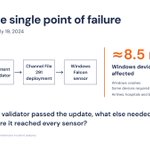
Remember the CrowdStrike outage in 2024?
What would happen if one of your critical dependencies failed?
settlementinfra.io

Agents have a way of brute-forcing their way to a goal.
Eleven days ago, American Banker reported an AI agent who reset a password, revised its approved transfer destinations, and moved $100,000 to one it had approved itself.
Wouldn’t you rather the software controlled the agent than the agent controlled the software?
We’ve built infrastructure for zero-trust security.
An agent with access still has to prove authority to act.
Make your agents earn their keep.

Remember the CrowdStrike outage in 2024?
What would happen if one of your critical dependencies failed?
settlementinfra.io
The disaster relief problem
We already can share information, instantly.
But how do you know what to believe?
What if you could check which statements hold up?
That's why we're building Evidence Rails.
When would you use them?
Settlement Infrastructure is Geeq tech's new home. retweeted

By the way, in case anyone was still wondering whether they are completely useless, Binance holds SOC 2 Type 2, ISO 27001, and several other certifications.
$6.3B hack at Binance yesterday, Oct. 29.
A valid signature and a valid authority are not
necessarily the same thing.
We have developed new primitives for verifying authority.
If you have been relying on signatures alone to establish authority, we should talk.
settlementinfra.io
🤖 Made with AI

The disaster relief problem
There are over 7.5B cellphones worldwide.
The vast majority can say something if they see something.
So why haven't we solved the coordination problem?

In disaster relief, delays in information can delay aid.
Everyone can be doing their level best, while still isolated in silos.
Can't we do something about the cost of communication in the field?
🤖 Made with AI

Settlement Infrastructure is Geeq tech's new home. retweeted
Yesterday morning, I wrote this:
Public datasets can change, disappear, or be challenged. Even well-intentioned organizations may suffer security breaches or publish information that is subsequently altered without their knowledge.
Yesterday, these websites went offline temporarily - not because they wanted to deny services, but because a patch was needed for a tool that is used to power websites. (Search for php)
Governments as diverse as Finland, Japan, and the UK
Parts of Wikipedia and the Internet Archive
Nintendo
Now I ask you, what if all that data got wiped?
Changed? Or the websites restored with malware?
Those are not paranoid concerns. That's where we are.
Think about the lost knowledge. Think about AI scraping websites full of false data.
That's why I work on eliminating single points of failure.
It can power apps like these - when high stakes depend on access to the right information, at the right time.
Please support the effort to preserve evidence.
teapaw.org/GeeqOfficial/status/21…

Transaction infrastructure records what happened.
Many transaction platforms also check their own rules before execution.
Our Evidence Rails support independent verification of evidence attached to an asset, including changes that affect the next transaction.
Settle the evidence before you settle the transaction, and preserve the proof that you did.
🤖 Made with AI

Interoperability has a direction.
Most architectures achieve interoperability by bringing participants into a shared system, network, or set of integrations.
What happens when we reverse the direction?
Instead of bringing organizations to the evidence, Evidence Rails allow independently verifiable evidence to travel to organizations.
That's a different architecture for interoperability.
🤖 Made with AI
