




Why we need data centers (short):
Every single day for the last 2 months, there has been a new, critical, high severity vulnerability or exploit announced
1) who created the vulnerability? Humans. We’ve been living with these exploits for decades in some cases.
2) who is discovering and fixing it? A.I. What was a problem yesterday won’t be a problem ever again.
6
229

knox | ProStaking.com retweeted

An open letter to the Solana Foundation on the new SFDP rules
On November 6, the Solana Foundation announced new rules for the Solana Foundation Delegation Program: a twelve-month membership term, graduation at 300k SOL of external stake, a hard cap of 100 validators, and the retirement of existing members in weekly tranches.
We are writing because we believe these changes work against decentralization, and because they will push out many of the hardest working and best-faith operators Solana has ever had. These are the quiet ones. They do not run marketing campaigns or pick fights on X for impressions. They run nodes, they run them well, and they make valuable contributions to the network while doing it.
◆ The incubator model has not worked ◆
SFDP was built as a launchpad for new validators, and that was the right goal when the validator set needed bootstrapping. That job is done. The goal posts need to move.
On paper, twelve months of delegation followed by forced graduation is a sink-or-swim model: incubate new operators, let natural selection remove the ones who cannot make it. In practice it will play out differently. Validators will join, collect earnings for twelve months, and leave. That is not a net new independent operator. It is a short-term tenant.
The deeper problem is that attracting stake outside SFDP is close to impossible unless you are already in the superminority. The highest-staked validators keep attracting even more stake, so the superminority is shrinking in count while growing in share. Under these rules it sits on top of a constantly churning set of 100 SFDP nodes. Churn is not decentralization. It is a revolving door with an ever-smaller group of ever-larger operators on the other side.
Meanwhile, the operators who actually push the network forward are the ones being cut. The people who tirelessly tested the new governance system before it went live. The people who moved their nodes to different ASNs, at their own cost, because ASN diversity mattered. The people who lose sleep for urgent upgrades. The people who carried Alpenglow to mainnet, which we come back to below. Those are the operators this program is now designed to remove. The longer you have been on Solana, the worse this program is for you.
◆ The Teraswitch outage is the case study ◆
When Teraswitch went down, the network did not halt. It stayed up because enough stake was spread across enough independent validators on enough different ASNs to keep consensus alive. That distribution did not happen by accident. It existed because SFDP supported the number of validators it did and because SFDP created the ASN rule. And stake on Solana increased after the outage. The market saw a network absorb a major provider failure without blinking, and rewarded it.
Shrink the program to 100 validators and concentrate the rest with a handful of operators, and the next provider outage ends very differently. The Foundation is dismantling the exact safety margin that kept the chain from halting.
The numbers are not abstract. At the operator level, Solana's Nakamoto coefficient is 8 today. It was 6 until Alpenglow raised the liveness threshold from 33% to 40%. At the 20% safety threshold, the coefficient is 3. That is a long way from the 18 or so that gets repeated in marketing. These rules push every one of those figures the wrong way.
◆ Alpenglow was carried by independents, and independents are paying for it ◆
Alpenglow did not reach mainnet on its own. It got there because of the community cluster, and the community cluster was run almost entirely by independent validators. Not a single operator from the superminority participated. The largest validators on the network, the ones about to receive the stake being taken from us, contributed nothing to the most important upgrade Solana has shipped.
The history matters. When independent validators raised concerns about 200ms block times and the operational/financial load it put on smaller operators, the Foundation's answer was to participate in the Alpenglow community cluster and accelerate the migration. So we did. We paid for the extra servers. We stayed up until 2 and 4 AM through dozens of regenesis’s. We absorbed weeks of accelerated block times and accompanying doubling vote costs, on the understanding that Alpenglow would make it worth it.
Alpenglow migrated to mainnet a few weeks ago. Before most of us have earned back a fraction of what that period cost, SFDP is retiring us.
The entire burden of 200ms and the Alpenglow migration on independent validators, and the moment the work was done, the Foundation moved to cut us. At minimum, the operators who carried that upgrade should be allowed to run on Alpenglow mainnet under existing delegation for six months before any retirement takes effect. That way they can recover their costs.
◆ Who actually contributes to the network ◆
Measured against stake, lower-staked validators contribute far more back to the network than their higher-staked counterparts. This is not a matter of character. It is structural.
Large operators have investors and shareholders who expect profit to be maximized. Testnet participation, client diversity work, community infrastructure, and governance testing do not make money. The largest operators are therefore discouraged from doing any of it, and for the most part they do not. Alpenglow is the clearest example.
Independent operators are the opposite. We are expected to contribute, we are judged on it, and we do. SFDP spent years building that expectation into its own criteria. The new rules now retire the operators who met the bar and hand the stake to operators who are built not to.
◆ Institutional delegation is moving stake in the wrong direction ◆
Our understanding is that the Foundation intends to redirect stake toward institutional validators. Institutions outsource risk; that is what they do. We expect the long-term result to be institutions white-labelling through a small number of existing superminority operators. Stake taken from independent validators will end up concentrated with the operators who already hold the most of it.
That is centralization in its purest form. There is a harder truth underneath this. The independent validator set was the proof point. Early community operators were what made Solana credible enough for the people in suits to start paying attention and writing checks. Decentralization was the pitch. Now that the money has started to arrive, the operators who were the pitch are being shown the door to make room for it.
People who gave Solana their everything deserve better than being used as leverage and then being thrown away.
Decentralization is not a vanity metric. It is not a position to take the moral high ground from when criticizing a competitor like Hyperliquid, and it is not a narrative to be respun each time compliance requirements get clarified. Decentralization is why this industry exists in the first place.
Institutions are not bad actors (usually). But they are not network stewards. They have no mandate to care about client diversity, ASN spread, or testnet participation, and no operational capacity to contribute to any of it even if they wanted to. The better outcome for everyone is to route that stake to the independent operators who have already proven they will protect it.
◆ SFDP needs a purpose again ◆
If the program no longer exists to support independent operators or diversity, and the incubator model does not work in practice, it is fair to ask what the program exists for.
We propose it becomes a long-term independent contributor program, where the contribution being measured is network health itself: uptime through upgrades, client diversity, ASN and geographic diversity, supporting new innovative initiatives like community cluster participation, governance testing, etc. The operators who carried Alpenglow testing are exactly the people such a program should be rewarding. Inactivity means removal. Operators who do this work should be rewarded for as long as they keep doing it, not retired on a calendar, and not asked to become something other than validators to stay eligible.
That model aligns the program's incentives with the long-term success of the network. Arbitrarily picking 100 validators and churning them once a year aligns them with nothing.
◆ What we are asking for ◆
1. Pause the weekly retirement tranches until the community has been consulted.
2. Give current members who participated in the Alpenglow community cluster a minimum of six months of continued delegation on Alpenglow mainnet before any retirement takes effect.
3. Publish the analysis behind the arbitrary 100-validator cap, and twelve-month figures.
4. Open a formal consultation with current SFDP members before the rules are finalized.
5. Adopt the contributor model above as a replacement for, or alongside, the incubator model.
Solana's resilience was built by people who showed up when it was hard and did not expect to be thanked. We are asking the Foundation not to design them out of the network.
◆ This is what the independent set actually does ◆
The independent validator set, even within Layer33, has been able to achieve many things. Across this group alone, we have:
◆ Supported the official Solana testnet faucet with validator rewards from over 33 million testnet SOL delegated across more than 5k stake accounts, replenishing roughly 450k testnet SOL per month so new validators and developers can deploy before touching mainnet
◆ Built the devnet faucet and the Solana Hardware Compatibility List that operators use to spec machines
◆ Been among the first mainnet validators to run Frankendancer, and later to adopt full Firedancer, on our own hardware, before client diversity was a talking point
◆ Made open source contributions to solana-program, Firedancer, and DoubleZero, plus open source tooling that lets operators switch clients and handle updates automatically
◆ Built a free public API and chart suite for validator and network data that powers dozens of tools and sites across the ecosystem
◆ Built public dashboards that have repeatedly exposed malicious validator behavior around delayed blocks and held bad actors accountable
◆ Shipped the first UI for diagnosing skipped block issues, and staking tools for tip harvesting and stake account cleanup
◆ Co-authored the Validator Voting Behavior Study
Built Nakaflow, which tracks Solana's Nakamoto coefficient against other chains
◆ Contributed to governance design from the beginning, and are key contributors to the new governance platform launching in 2026
◆ Run the monthly validator community call continuously for more than three years
◆ Co-founded the Block Zero validator conference, and organized and sponsored every edition since inception
◆ Built validator infrastructure in underserved regions, including the only major validator between Dallas and Miami and the oldest Brazil-based validator, both on dedicated hardware
◆ Won multiple Solana hackathons
◆ Still host multiple hackathons across Solana every year
◆ Created one of the first Solana-native transaction indexing platforms, used by consumers and teams to understand on-chain activity at scale
◆ Built early DAO and governance tooling adopted by BONK and other Solana-native projects
◆ Built stake pools and delegation tooling that route stake toward performance and decentralization
◆ Reinvested validator revenue into Solana-native startups, hackathon track sponsorships, free web3 security education, and ongoing donations to animal welfare, clean energy, and men's health charities
◆ Kept genesis validators running on our own fleets across multiple locations, delegating our own stake to other operators who contribute to network health
◆ Made up the bulk of the Alpenglow community cluster, on our own servers and our own time, to get the upgrade to mainnet faster
Several of these have been running for three years or more with no end date. That is what a long-term contributor looks like. A twelve-month clock does not describe it.
None of this was required. None of it counts under the new rules. With these changes actioned, institutions like Figment get propped up and the independent validator set gets dismantled. Under that model, none of the above would have existed, and the next round of contributions like these will not exist either.
The independent validator set is normally quiet. We work siloed in our own day-to-day operations. Decentralized, you might say. We focus on validator and network performance, not for ourselves, but so that Solana thrives. For all of us to come together and speak out against a single change means something is truly broken.
This letter may disappear into the void as the Foundation moves to support the large institutional players, the ones who do not care about Solana, at the expense of the people who do. Even so, we wanted our position on the record.
L33
We spent 15 years trying to drive value and legitimacy to our crypto coins only to end up with a 20-step process to onboard people to trade stocks.
Oof

BREAKING: Upcoming NYSE-affiliated tokenized securities platform’s core clearing and settlement layer will be built on top of Avalanche technology.
Avalanche will support the platform’s clearing firm, supporting the development of infrastructure for 24/7 trading, clearing, and settlement.
A landmark step toward the next generation of global financial markets.

1
166
The @SolanaFndn has announced the end of the Delegation Program as we know it. Currently there are 330-340 validators under the program and effectively immediately, that will be wound down to 100. Full write up: prostaking.com/blog/sfdp-cha…
Supporting data: github.com/ProStaking/sfdp-e…
Validators who have either over 300,000 external stake or have been a part of the program for more than 12 months are immediately considered retired. There is an AI-driven typeform that they can complete to prove their past contributions and worth, and maybe their delegation will be extended for 1 year (but only 1 more year), but it’s unclear who they will select if anyone and what their criteria is.
While this will likely impact @ProStaking_ at some point, as of now, our company is healthy. We continue to build and contribute to the Solana ecosystem as we’ve always done.
If you’re a validator (or just curious) you can stress test your validator’s health with our new Validator Profit Calculator: calc.prostaking.com
Our opinion on these changes is a mixed one. For a couple years now, the Solana Cabal as a whole has decided that the things that originally made Solana awesome (community) are no longer the focus. It’s just about building a decentralized NASDAQ now. The mission now is to support only those who bring transactions to the chain, and contribute to getting closer to huge blocks at 100-200ms. I think the part they aren’t saying loudly is they only envision that happens with ~100-200 validators that are geographically in 2-4 central hubs (NY, AMS, TYO, ___ ).
I get it, but it makes me sad that many active, skilled, engaged contributors who helped get the chain here (even with small but active contributions) are going to close shop soon.

knox | ProStaking.com retweeted

Achieving exceptional technical performance, according to objective criteria, isn't enough to attract stake outside of the SFDP
While I wish it wasn't true, our experience @ChainflowSol running a mainnet validator since genesis, trying to prove this thesis wrong, tells us it is

knox | ProStaking.com retweeted

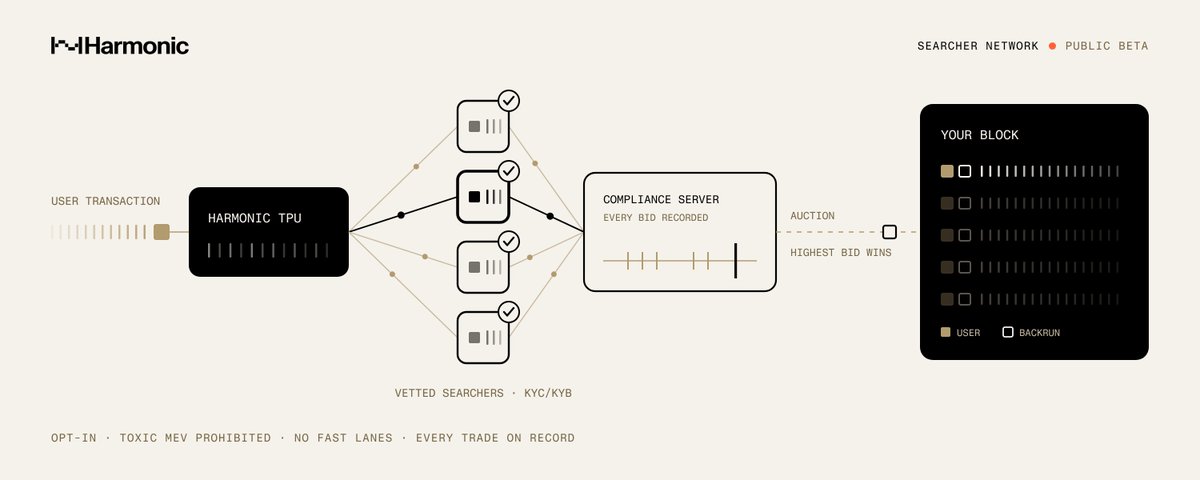
Since early August, the Harmonic Searcher Network has generated over 25,000 SOL for validators and stakers.
Today it opens in public beta: backrunning only, no toxic MEV, and KYC/KYB-vetted searchers monitored by our compliance system.


knox | ProStaking.com retweeted

crime is no longer legal, so decentralization is actually valuable again
knox | ProStaking.com retweeted
Florida elected a Republican governor who backed a U.S. Bitcoin reserve. Texas elected a Democratic senator who voted to create one for his state. The case for holding Bitcoin crosses party lines.
knox | ProStaking.com retweeted

You can also remove the privileged window entirely. Yellowstone Jet is open source under Apache 2.0. Self-host it and send transactions straight to leader TPUs. The leader still sees your transaction, but no RPC provider sits in front of it.


Validators still do cool things
Our next experiment and findings: @jump_firedancer currently has a PR to enable native Intel NICs support in an architecture similar to their popular Mellanox support
We’ve tested it, submitted a smol fix, on @solana testnet prostaking.com/blog/native-i…

73

