

The Malabo Montpellier Panel advances evidence & facilitates policy dialogue to accelerate progress toward food & nutrition security in Africa.
Senegal | Rwanda
Joined September 2010
- Tweets13.8K
- Following3.1K
- Followers26.6K
- Likes8K



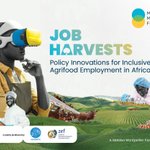



Africa’s agrifood transformation must deliver more than economic growth. It must create decent work, productive livelihoods, and opportunities for young women and men.
The @_AfricanUnion #Kampala CAADP Declaration provides renewed momentum for this transformation. The priority now is to translate these commitments into policies, public investments, and institutional reforms that put employment at the central of agrifood systems development.
As digital technologies and AI reshape the world of work, the quality of employment matters as much as the number of jobs created. Safer working conditions, fairer opportunities, stronger skills systems, and resilient livelihoods are essential to ensuring that agrifood transformation delivers inclusive prosperity.
Job Harvests: mamopanel.org/resources/agri…

Digital connectivity gaps can limit access to information among workers, employers, producers, and markets, also preventing labor market entrants from accessing agrifood employment opportunities.
Policy priority: Expand digital labor and market information platforms to improve job matching and
market access. More broadly, integrating digital registries with extension, advisory, and market services can lower transaction costs, connect rural producers to markets, and support the growth of emerging digital and agri-tech industries, creating new opportunities for decent work.
Job Harvests: mamopanel.org/resources/agri…

More than 10 million young people enter the labor market each year, but current growth patterns generate only about 3 million formal jobs. Africa’s ability to turn its growing young population into an economic asset will depend, in large part, on the jobs its economy creates.
@MaMoPanel’s “Job Harvests” report examines how Africa’s agrifood systems and rural economies can generate more productive employment and expand access to decent work.
Drawing on country experiences, the report explores how structural transformation, productivity growth, and policy innovations can expand employment creation.
Job Harvests: mamopanel.org/resources/agri…

#JobHarvests
@MaMoPanel brings together leading African and international experts to support evidence-based policy dialogue and help decision-makers identify solutions that advance agricultural development, food security, and nutrition across Africa.
Its latest report, “Job Harvests,” examines how agrifood systems transformation can expand decent employment, strengthen livelihoods, and create new opportunities for Africa’s growing population.
It offers practical lessons to help African countries translate agrifood systems transformation into productive employment and inclusive prosperity, advancing the ambitions of the @_AfricanUnion’s Agenda 2063.
Job Harvests: mamopanel.org/resources/agri…

Global Child Nutrition Forum (Nov 2–5)!
@GCNFoundation brings together governments, international organizations, and other key actors to share practical solutions for strengthening sustainable school feeding programs and improving child nutrition worldwide.
Here’s what participants should be reading: @MaMoPanel’s “Nourished” report highlights successful policy innovations and programmatic interventions to reduce malnutrition, also illustrating the transformative power of school feeding programs in Africa, when linked to local food systems.
Comprehensive nutrition strategies, stronger partnerships, nutrition education, and coordinated investments across agriculture, health, water, and sanitation will move the needle.
Policy insights: mamopanel.org/resources/Nutr…

#JobHarvests
The @MaMoPanel #JobHarvests report estimates that Africa needs to create around 2 million jobs every month by 2040, with roughly 70 million young Africans currently not in employment, education, or training.
Agrifood systems are central to solving this challenge. Drawing on case studies from #Ethiopia, #Nigeria, and #Rwanda, the Panel identifies common success factors behind effective agrifood transformation: integrating employment into national planning, supporting youth and women, boosting skills, and raising labor productivity.
Policy insights: mamopanel.org/resources/agri…

Agrifood employment requires policies that connect smallholder production to markets, expand agro-processing, and create pathways into formal employment.
@MaMoPanel recommends prioritizing agrifood employment in national development strategies, aligning vocational training with labor market demand, expanding public works, and strengthening business support institutions.
#Ethiopia’s experience illustrates how this can be achieved through a combination of Agricultural Commercialization Clusters that link smallholder farmers to modern services and markets, industrial parks that attract investment in processing and manufacturing, and the Productive Safety Net Programme, which combines social protection with labor-intensive public works.
Full piece via #TheAbyssinianTimes: abyssiniantimes.com/en/artic…’s-Agrifood-Job-Revolution-1783598158323

Africa faces a central challenge in creating employment for its growing population: creating pathways for jobs that are productive, secure, resilient, and inclusive, especially for youth and women. Drawing on experiences from #Ethiopia, #Nigeria, and #Rwanda, @MaMoPanel recommends a set of policy priorities:
-Prioritizing agricultural productivity growth as the foundation for broader employment transformation.
-Shifting employment reforms from farm jobs to agrifood systems jobs, expanding agro-processing, storage, logistics, and retail.
-Making skills development demand-driven and directly connected to growth sectors.
-Pairing inclusive access to finance with risk-mitigation instruments and enterprise development support.
JobHarvests: mamopanel.org/resources/agri…

#JobHarvests
Africa’s employment challenge will not be solved by agricultural productivity alone. While productivity growth is a necessary foundation, turning it into decent jobs will require complementary investments in infrastructure, skills, finance, innovation, and market access.
Drawing on policy innovations from #Ethiopia, #Nigeria, and #Rwanda, “Job Harvests” shows what this looks like in practice: agro-industrial parks and processing zones that link farms to processors and create off-farm jobs for youth and women, demand-driven skills training tied to growth sectors, and finance paired with risk-sharing tools and enterprise support.
JobHarvests: mamopanel.org/resources/agri…

Creating jobs across Africa’s agrifood systems requires investment beyond agricultural production. Storage, processing, transport, irrigation, input distribution, and other services are essential to connecting farmers to markets and expanding employment opportunities across the value chain.
Policy Priority: Create an enabling environment in which public investment and private-sector capabilities reinforce one another, strengthening agrifood value chains, and expanding productive employment opportunities. The Panel recommends stronger partnerships that link smallholder farmers to processors and markets, improve rural infrastructure, and support the growth of agrifood enterprises.
#JOBHARVESTS: mamopanel.org/resources/agri…

Sustainable employment creation in Africa depends on more than agricultural productivity growth. It also requires stronger rural economies, expanding agrifood value chains, and opportunities for workers to move into more productive activities.
@MaMoPanel’s latest report highlights how rising agricultural productivity can stimulate demand for processing, storage, transport, and other services, creating employment beyond primary production. However, productivity gains do not automatically translate into better employment outcomes; they must go hand-in-hand with job creation and improved working conditions.
#JobHarvests: mamopanel.org/resources/agri…

Digitalization, innovation, and AI are creating new opportunities across Africa’s agrifood systems, from digital finance and e-commerce to logistics, data services, and agricultural advisory tools.
Ag-tech is generating jobs in software, data, and digital finance, but these roles often require specialized skills and are concentrated in urban areas.
Realizing the employment potential of digitalization requires investment in digital infrastructure, skills development, and inclusive innovation to help women, young people, and rural communities participate in the evolving agrifood economy.
More from @MaMoPanel’s “Job Harvests”: mamopanel.org/resources/agri…

Agrifood value chains are creating growing opportunities for employment beyond primary agriculture.
As population growth, urbanization, and rising incomes reshape food demand across Africa, processing, logistics, storage, and distribution are becoming increasingly important sources of jobs and economic activity.
@MaMoPanel’s “Job Harvests” report highlights agro-processing as a key driver of this transformation. By adding value to agricultural products, extending shelf life, reducing postharvest losses, and connecting producers to urban markets, agro-processing can stimulate demand for agricultural outputs, inputs, and services while supporting food security and income growth.
Policy insights: mamopanel.org/resources/agri…

As African countries pursue agrifood transformation, employment creation must be integrated into the policies, investments, and institutional reforms shaping the sector’s development.
“Job Harvests” examines policy innovations that can help countries connect agrifood systems transformation with employment creation. Aligning agricultural productivity, enterprise development, and upskilling in policy interventions will be essential to expanding productive work and economic opportunities for Africa’s growing population.
Policy insights: mamopanel.org/resources/agri…

Turning Africa’s agrifood systems into engines of employment requires coordinated action across productivity, skills, investment, and rural development.
@MaMoPanel’s “Job Harvests” report recommends prioritizing agricultural productivity, aligning skills development with labor market needs, strengthening worker protections, mobilizing private investment, and investing in rural infrastructure.
As Prof. Joachim von Braun underscores: “A dual approach is called for to harvest the jobs: indirectly creating jobs by accelerated investment in agrifood system productivity, and directly creating jobs with labor-intensive public works building productive rural infrastructure.”
Read more via @Rural21Journal: rural21.com/english/from-our…

Innovate today. Nourish tomorrow.
This World Food Day, we reflect on progress and pathways toward ending hunger and ensuring access to reliable, affordable, and nutritious food for all.
Research by @MaMoPanel highlights the effectiveness of school feeding schemes, dietary diversification incentives, stronger safety nets, and biofortified crops in improving dietary quality, reducing food insecurity, and building human capital.
Scaling up these interventions requires sustained political leadership, cross-sectoral coordination, and robust monitoring systems to track nutrition outcomes and strengthen food security.
With innovation, evidence, technology, research, and local knowledge, Africa can accelerate progress toward food systems that nourish its growing population.
Recipes for Success: mamopanel.org/media/uploads/…

Agrifood systems are central to Africa’s employment challenge—but they are also a major part of the solution.
The @MaMoPanel’s Job Harvests report shows how agrifood systems can generate the productive jobs needed for Africa’s rapidly growing youth population, provided the right policies are in place to accelerate transformation and ensure these jobs are productive, resilient, and inclusive.
@DrOBadiane, Executive Chairperson of @AKADEMIYA2063 and Co-Chair of @MaMoPanel, joined @cnbcafrica’s Karabo Mashaba to discuss the report’s key findings and policy recommendations.
🎥 Watch the interview: cnbcafrica.com/media/7784126…

As countries advance the implementation of the @_AfricanUnion Kampala CAADP Declaration, the employment dimension of agrifood transformation should remain at the center of policy choices, public investment, and institutional reform.
For millions of young women and men, the promise of transformation will be measured not only by economic growth but also by whether that growth creates pathways to productive, secure, and meaningful livelihoods.
The “Job Harvests” report reminds us that the quality of employment matters. Safer workplaces, fairer opportunities, stronger skills systems, and more resilient livelihoods are essential to ensuring
agrifood transformation improves lives.
More insights: mamopanel.org/resources/agri…

Africa’s employment challenge goes beyond unemployment rates. The real challenge is creating productive, secure, resilient, and inclusive jobs, particularly for the continent’s growing youth population and women.
The “Job Harvests” report highlights the central role of agrifood systems, which accounted for nearly two-thirds of Africa’s total employment in 2022. As employment shifts beyond primary agriculture, opportunities are expanding across agro-processing, trade, logistics, transport, storage, retail, and food services.
More insights: mamopanel.org/media/uploads/…

Africa does not simply need more jobs. It needs better jobs.
With millions of young people entering the labor market, the question is how the continent can turn its agrifood systems into sources of productive, resilient and inclusive employment.
From rural infrastructure and skills development to entrepreneurship, finance, and worker protection, the “Job Harvests” report highlights the policy choices that can help make agrifood transformation a driver of better employment.
Read more from @angevict @TopafricanewsC: topafricanews.com/2026/07/09…
