

Compounding. Economy & politics, investing, charts and irony. I’m not on other platforms.
Here and there
Joined August 2017
- Tweets54.6K
- Following1.3K
- Followers582K
- Likes37.8K






Michael A. Arouet retweeted
This is eye-opening. Millionaires and entrepreneurs vote with their feet, and Europe is losing big.
These founders generate employment, investment, and tax revenue that funds public services. When they leave, the jobs, companies, and future growth they would have created leave with them. Absurd tax rates, unpredictable policy, and regulatory friction drive them to destinations with low or zero income tax and predictable rules.
Countries that treat mobile capital and entrepreneurship as a fixed resource to squeeze discover it is highly mobile. The UAE’s rise and Britain’s reversal are the clearest examples. Policy that prioritizes extraction over attraction eventually extracts less, making the middle class pick up the tax bill.
Why should entrepreneurs stay in countries punishing hard work, innovation and jobs creation with absurd taxes, just to redistribute the money to those who refuse to work and contribute?
Michael A. Arouet retweeted
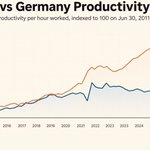
This is really eye-opening. Germans are not only much more expensive than others but also less productive. High wages are fine if they are justifies by high productivity, like for example in Switzerland, but they are simply not sustainable in such an unproductive environment. Germans, supported by unions and workers councils, developed an entitlement mindset, and don’t notice how out of touch with reality they are.
Btw, how on earth is average sick leave rate of 10% even possible. That’s more than a month per year. If that’s the average, there must be people spending months on „sick“ leave.
Germany became an overregulated, overprotected caricature of a developed industrial country. Anyone surprised that one company after another closes factories there?

This explains really well why the German economy has stagnated for years, Germany has simply stopped being as productive as others. Not only compared to the US, also to its European peers.
Hourly productivity is the core measure of efficiency and the foundation of sustainable wage growth and competitiveness. Germany’s challenges are structural, elevated energy costs after the nuclear phase-out, grotesque overregulation, bureaucracy, and a growing public-sector employment share have all weighed on productivity. The US has benefited from deeper capital investment, a larger and more dynamic tech sector, and faster diffusion of digital tools and AI.
The result is a widening competitiveness gap. Higher productivity lets American and European firms pay better wages while remaining cost-competitive and generating surpluses for further investment. Germany’s slower path makes the same outcomes harder, with unions pressures wages rise without productivity gains, so products simply become less competitive.
Germany not only misses the AI revolution and remains stuck with last century’s industries, but is even losing competitiveness there. Prosperity is not guaranteed forever, is anyone surprised that countless companies are closing German factories?

Michael A. Arouet retweeted
Hey @grok how much money did Facebook spend for this? Has any other company ever burned more money so quickly for a nonsense project?

This is really eye-opening. Germans are not only much more expensive than others but also less productive. High wages are fine if they are justifies by high productivity, like for example in Switzerland, but they are simply not sustainable in such an unproductive environment. Germans, supported by unions and workers councils, developed an entitlement mindset, and don’t notice how out of touch with reality they are.
Btw, how on earth is average sick leave rate of 10% even possible. That’s more than a month per year. If that’s the average, there must be people spending months on „sick“ leave.
Germany became an overregulated, overprotected caricature of a developed industrial country. Anyone surprised that one company after another closes factories there?
This explains really well why the German economy has stagnated for years, Germany has simply stopped being as productive as others. Not only compared to the US, also to its European peers.
Hourly productivity is the core measure of efficiency and the foundation of sustainable wage growth and competitiveness. Germany’s challenges are structural, elevated energy costs after the nuclear phase-out, grotesque overregulation, bureaucracy, and a growing public-sector employment share have all weighed on productivity. The US has benefited from deeper capital investment, a larger and more dynamic tech sector, and faster diffusion of digital tools and AI.
The result is a widening competitiveness gap. Higher productivity lets American and European firms pay better wages while remaining cost-competitive and generating surpluses for further investment. Germany’s slower path makes the same outcomes harder, with unions pressures wages rise without productivity gains, so products simply become less competitive.
Germany not only misses the AI revolution and remains stuck with last century’s industries, but is even losing competitiveness there. Prosperity is not guaranteed forever, is anyone surprised that countless companies are closing German factories?
Hey @grok how much money did Facebook spend for this? Has any other company ever burned more money so quickly for a nonsense project?
This explains really well why the German economy has stagnated for years, Germany has simply stopped being as productive as others. Not only compared to the US, also to its European peers.
Hourly productivity is the core measure of efficiency and the foundation of sustainable wage growth and competitiveness. Germany’s challenges are structural, elevated energy costs after the nuclear phase-out, grotesque overregulation, bureaucracy, and a growing public-sector employment share have all weighed on productivity. The US has benefited from deeper capital investment, a larger and more dynamic tech sector, and faster diffusion of digital tools and AI.
The result is a widening competitiveness gap. Higher productivity lets American and European firms pay better wages while remaining cost-competitive and generating surpluses for further investment. Germany’s slower path makes the same outcomes harder, with unions pressures wages rise without productivity gains, so products simply become less competitive.
Germany not only misses the AI revolution and remains stuck with last century’s industries, but is even losing competitiveness there. Prosperity is not guaranteed forever, is anyone surprised that countless companies are closing German factories?
I took this picture from the plane while leaving Switzerland today. Seriously, only two major European countries remain where you'd want to live and raise a family, Switzerland and Poland.
Here's why:
Switzerland is easy to explain, direct democracy with referendums keeps the country honest. Left- and right-wing populists have little chance of succeeding. It's probably the last country in Europe where politicians really care about what people want and what concerns them.
Poland remembers the socialist misery and oppression and is therefore deeply immune to the left-green mind virus consuming so many European societies. Poles know hard work and entrepreneurial spirit are required for a better life, not left redistribution nonsense. Poland welcomes immigrants who want to integrate and contribute, and quickly deports everyone else. Poland has a booming economy, low unemployment, low crime, and a peaceful society.
Why can't the UK, France, and Germany be like Switzerland or Poland? It's not about money, it's about the mindset and values.

Hey @grok, many central banks buy gold. Why does Turkey and Russia sell massive amounts of gold this year?
Isn’t that really impressive? It seems that China has taken the opportunity to increase its monthly gold purchases while the gold price has been going down. It will be interesting to see how much they have been buying in November given the recent sharp drop. The drop was most probably driven by poor liquidity and margin calls forcing investors to sell their gold positions.
Central banks keep buying, individual investors‘ flows into gold ETFs have been strong as well. Nothing has fundamentally changed, it may really be just a short-lived liquidity scare. What do you think folks?

When I post about France heading toward a debt crisis, someone always replies, "But look at the US debt." Guess what, France and the United States carry comparable public debt burdens, roughly 119% of GDP for France and 127% for the US, yet the nature of that debt differs sharply.
US Treasuries sit at the center of the global financial system. They are the deepest, most liquid safe asset, the primary reserve-currency instrument, and the preferred high-quality collateral. Central banks, money-market funds, insurers, and institutional investors hold them not merely by choice but as a structural necessity for liquidity, risk management, and reserves. Flight-to-safety demand reinforces this role in stress. That captive, recurring demand gives the United States a wide margin for error.
French government bonds enjoy no such privilege. Non-residents hold a large share (around 50–60%), but this is discretionary demand driven by yield, index inclusion, and relative value within the euro area. French banks and insurers hold some for regulatory or portfolio reasons, yet nothing forces global investors to own French bonds the way the system forces them to own US Treasuries. When political or fiscal risks rise, that capital can leave quickly.
This distinction matters because France has shown little to none willingness to address the underlying drivers of its debt path. Successive governments have struggled with pension costs, and the two presidential candidates currently leading most polls, Marine Le Pen and Jean-Luc Mélenchon, both campaign on reversing the recent rise in the retirement age and returning it toward 60–62.
Markets have so far more or less tolerated this, helped by the European Central Bank’s residual presence, but tolerance is not structural. Unlike the United States, France cannot rely on a permanent global bid for its paper. If deficits remain elevated and reform stalls, spreads will eventually widen even further, funding costs will rise, and the adjustment will be imposed from outside, through higher borrowing rates, forced spending restraint, or both, rather than chosen at home.
The arithmetic is not especially subtle, only the timing is uncertain. The second Euro crisis will begin in France, and it will take down the entire Eurozone with it. Prove me wrong if you can.

Hey @grok, calculate the ratio of public recipients vs. private workers for the US, Canada, the UK, Japan and Australia. Use the same categories as in the chart below.
Take a moment to read how Ludwig von Mises described the point of no return:
"A state becomes almost unreformable when the majority of the population is financially or structurally dependent on the state (state employees, civil servants, recipients of subsidies, grants, or transfer payments, etc.). As soon as those who net benefit from or are supported by the state outnumber those who do not, the system blocks reforms, since the majority votes out of self-interest for the preservation or expansion of state services."
Doesn’t this sound familiar? France, Belgium, and Finland are already well beyond that point, followed by Italy, Germany, and Spain. In France, even the "right" RN demands a further cut to the retirement age. How is that "right"? Isn’t that the purest leftist demand?
Big-state spending works only while markets buy more sovereign debt at affordable rates. For France, they stopped last month. Politicians will next call for central-bank money printing, but that is quite naive. If printing money solved problems, why does poverty still exist?
The longer the socialist big-state illusion lasts, the more painful the inevitable cuts will be, whether state-dependent voters like it or not. Enjoy the socialist party while it lasts, it will not last forever.

Isn’t that really impressive? It seems that China has taken the opportunity to increase its monthly gold purchases while the gold price has been going down. It will be interesting to see how much they have been buying in November given the recent sharp drop. The drop was most probably driven by poor liquidity and margin calls forcing investors to sell their gold positions.
Central banks keep buying, individual investors‘ flows into gold ETFs have been strong as well. Nothing has fundamentally changed, it may really be just a short-lived liquidity scare. What do you think folks?
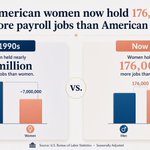
Isn’t that interesting? American women now hold slightly more payroll jobs than men, reversing the 1990s when men held nearly 7 million more. Women’s higher education and earnings expand household income and opportunity. That’s a real gain.
At the same time this shift tracks with later marriage, lower fertility, and thinner family formation. A society producing fewer children as its workforce ages faces long-term demographic and fiscal pressure. U.S. demographics are better than Europe’s but moved below replacement as well. Earnings progress is real, as are the family and demographic costs. Both deserve honest attention. What do you think folks? Is this a good or a bad thing for the society?

Here's the same data for a few other European countries. Finland and Belgium have already crossed the point of no return as well, where most voters have a vested interest in blocking meaningful reforms of lavish state spending needed to escape the debt spiral. Two more countries enjoying the left's spending party as long as someone else pays the bill.
As in France, markets will eventually react and stop buying their bonds at affordable rates, forcing cuts. The longer the socialist spending party lasts, the deeper and more painful the unavoidable cuts will be. Look at the austerity Greece went through in the first Euro crisis.
That first crisis involved hundreds of billions and was manageable, the looming second Euro crisis will involve trillions and be so painful that the first will feel like a walk in the park. Enjoy the party as long as the music plays and someone pays the bills.

Take a moment to read how Ludwig von Mises described the point of no return:
"A state becomes almost unreformable when the majority of the population is financially or structurally dependent on the state (state employees, civil servants, recipients of subsidies, grants, or transfer payments, etc.). As soon as those who net benefit from or are supported by the state outnumber those who do not, the system blocks reforms, since the majority votes out of self-interest for the preservation or expansion of state services."
Doesn’t this sound familiar? France, Belgium, and Finland are already well beyond that point, followed by Italy, Germany, and Spain. In France, even the "right" RN demands a further cut to the retirement age. How is that "right"? Isn’t that the purest leftist demand?
Big-state spending works only while markets buy more sovereign debt at affordable rates. For France, they stopped last month. Politicians will next call for central-bank money printing, but that is quite naive. If printing money solved problems, why does poverty still exist?
The longer the socialist big-state illusion lasts, the more painful the inevitable cuts will be, whether state-dependent voters like it or not. Enjoy the socialist party while it lasts, it will not last forever.
Mass immigration is often presented as the solution to Europe's aging population and pension shortfall. In reality it frequently widens the fiscal gap in the short and medium term. Let’s take Germany as an example. Shall we?
Official data show the scale of the problem. Among children, 36.8% of foreign minors receive welfare compared with 7.2% of German children. Rates reach around 60% for Afghans, Ukrainians and Syrians. Foreigners, roughly 15% of the population, account for nearly half of all welfare recipients and close to 60% of payments to households with children.
A pay-as-you-go pension system needs more net contributors than recipients. Low-skilled or poorly integrated arrivals tend to remain net recipients for years, sometimes for life. Studies showing a positive balance would require rapid entry into well-paid work, an assumption that has not held for large parts of the post-2015 migration. Without that, immigration simply adds more current and future welfare and pension claimants while the native working-age population shrinks.
Paying benefits and expecting integration to happen by itself has not worked. Language, skills and labour-market participation require active policy, work and language requirements linked to benefits, faster recognition of real qualifications, and the clear expectation that long-term residence depends on contribution. Without this, higher immigration volumes mainly enlarge the group the welfare state must support, amplifying rather than solving the pressure on pensions. Why do the left push uncontrolled mass immigration nevertheless?

Hey @grok based on historical market analogies and current market sell-off rank these assets by their expected performance next six months: tech stocks, value stocks, bonds, gold, commodities, crypto. Think really hard and explain the ranking.
Everyone is scratching his head after the recent market sell-off, but it’s really not that complicated. It’s pure math. Let’s take a look, shall we?
At their peaks, the major listed AI-exposed companies (Mag7 plus key chip, foundry, and infrastructure names) were worth roughly $28–32 trillion. Add Anthropic’s post-IPO valuation of about $1.2–1.5 trillion and an expected OpenAI post-IPO figure around $1.5 trillion, and the total sits in the $30–35 trillion range, approaching half the entire US equity market (recently ~$70–72 trillion).
Once a single theme absorbed that much capital, further large gains required either massive new inflows or more money pulled from everything else. At some point neither was available at the necessary scale. Expecting these names to double again from those peaks implied an incremental $30+ trillion of market value. The rest of the US market was only ~$40 trillion; global equity markets, bonds, and private capital held no unused liquidity of that magnitude ready for AI multiples. Leverage, retail flows, and foreign capital were already heavily committed.
The arithmetic simply stopped working. Prices could no longer be justified by any realistic path of further capital absorption. The pullback was the delayed recognition that the liquidity sucked into the trade had nowhere left to come from. It’s really that simple. Seriously, what were people thinking buying these names at multi-trillion valuations? That they would double again in three months?

Whenever someone points out that Russia's economy is smaller than Italy's, countless Russian bots and useful idiots reply that in purchasing power terms terms it's very different and Russia is really strong. No, it isn't. Russia is a paper tiger in both nominal GDP and PPP terms. Just look at the chart below, even in PPP terms, Russia is a clear outlier, two in five Russians lack decent sanitation.
The reason is simple, Russia is a deeply corrupt state with one of the highest wealth concentrations in the world. Putin's cronies are billionaires who loot the country by transferring hundreds of billions into offshore accounts, while many ordinary Russians must go outside in winter, lack decent healthcare, and live in deep poverty, resulting in a life expectancy eight years lower than in Europe. Or should life expectancy also be adjusted for PPP?
There is no innovation, future technologies, or decent infrastructure. Young talent emigrates en masse, and the economy is held together by weapons production fired up on neighboring countries. That's not GDP creation, it's a desperate attempt to keep a house of cards together.

There are two highly entertaining popular narratives about Russia:
1. “Russia is an economic power.” No, it’s not. Its economy is smaller than Italy’s despite vast natural resources. Russia has one of the world’s highest inequality rates, resource income is funneled by a small oligarch clique into offshore accounts, while two in five Russians lack a decent toilet. Purchasing power parity comparisons make little sense here. PPP works to compare similar countries like Spain and Poland, not a poor one like Russia versus a wealthy one like Italy. Russians pay less for bread because they are poor, not rich.
2. “Russia has much lower debt/GDP.” So what? It lacks a functioning mature financial system, foreigners avoid Russian bonds, and as a result Russia has a higher interest payment burden than highly indebted Southern European countries.
Got it now?

Take a moment to read how Ludwig von Mises described the point of no return:
"A state becomes almost unreformable when the majority of the population is financially or structurally dependent on the state (state employees, civil servants, recipients of subsidies, grants, or transfer payments, etc.). As soon as those who net benefit from or are supported by the state outnumber those who do not, the system blocks reforms, since the majority votes out of self-interest for the preservation or expansion of state services."
Doesn’t this sound familiar? France, Belgium, and Finland are already well beyond that point, followed by Italy, Germany, and Spain. In France, even the "right" RN demands a further cut to the retirement age. How is that "right"? Isn’t that the purest leftist demand?
Big-state spending works only while markets buy more sovereign debt at affordable rates. For France, they stopped last month. Politicians will next call for central-bank money printing, but that is quite naive. If printing money solved problems, why does poverty still exist?
The longer the socialist big-state illusion lasts, the more painful the inevitable cuts will be, whether state-dependent voters like it or not. Enjoy the socialist party while it lasts, it will not last forever.