

Cofounder @AethirCloud | Building global GPU infrastructure for AI | Here for AI, GPUs, inference economics, power and the money behind the compute
The Cloud
Joined December 2016
- Tweets4.3K
- Following2.3K
- Followers333K
- Likes7.6K





Pinned Tweet
Today AXE rings the opening bell at Nasdaq. $AGPU .
More than $3.45 billion in signed contracts. Approximately $700 million in expected ARR in 2027.
Not going to pretend this one doesn’t feel good.
When you’re building, you spend most of your time focused on what hasn’t happened yet. The next deal. The next deployment. You rarely stop to appreciate how far you’ve come.
Today is a moment to pause and be grateful.
From the early days of Aethir to standing here, there’s a lot of work behind a moment like this. A lot of people who helped make it happen.
But the ambition was never to build something that only mattered inside crypto. It was to build infrastructure the rest of the world actually needed.
And for anyone still struggling to connect the dots: Aethir Foundation is AXE’s largest shareholder. AXE is also an infrastructure partner in Aethir ACCELERATE. We’re not watching this from the sidelines.
I see public-market access, enterprise relationships and infrastructure ownership as ways to take what we started at Aethir much further.
The bell is a moment to celebrate. Turning those contracts into operating infrastructure is the next chapter.
To the team, partners and community who have been part of this journey: this moment belongs to you too.
We’ll enjoy today. Then get back to building. The ambition is much bigger than what got us here.
This is just the beginning.
And anyone who thinks this isn’t a win for Aethir is ngmi.


HPE's CEO expects memory, NAND and many other critical components to stay supply constrained until at least the second half of 2028.
HPE lifted its purchase commitments 100% in Q3 and another 25% in Q4, and some components are on 28 to 40 week lead times, some longer.
At the same time Nvidia and Kioxia are working on a way to stretch GPU memory past HBM. In their proof of concept they put 144 Kioxia SSDs into a GB200 NVL72 rack, about 1.1 PB of raw flash, with room for 2 trillion vectors.
Nvidia's storage VP said the intelligence of AI agents will increasingly depend on the knowledge they can access.
So agents are pulling on memory and flash as well as GPUs. Imo the memory crunch is a demand story, and it's probably here for a while


Mark retweeted

Aethir Mesh is ramping up our AI inference business by offering streamlined access to 40 open-source AI models for enterprise compute clients worldwide.
Mesh has real numbers behind it: $6M+ in revenue since June and 30T+ tokens processed.

We've been building out our enterprise inference solution since the beginning of the year. We knew it was the right call and its finally starting to hit some of the targets we had initially set internally. Extremely bullish on the inference market, particularly for enterprises as they deal with the downside of exposing their IP to the frontier labs. Long compute. Long inference.
Tokens on OpenRouter are up 44x so far this year.
Spend on the platform is up 7.6x over the same stretch, because the average price per token has dropped 83%.
Mustafa Suleyman had a message this week for everyone predicting a chip overbuild: "Things are just getting started." Paid tokens are still growing about 39% a month, even with spend flat since early October.
Every one of those tokens runs on a GPU somewhere. When the price of a token falls and people use 44 times more of them, the chips underneath are doing a lot more work than the revenue line shows.
OpenRouter thinks agentic coding did a lot of the lifting early this year. The last two times spend stalled like this, in December 2024 and November 2025, it picked up again with the next wave of model launches.
So which launch gets spend moving again?


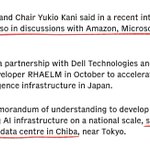
Japan's biggest power producer is in talks with Anthropic and Meta to put data centres right next to its power plants around Tokyo.
JERA's chair says Amazon, Microsoft and Google are in the conversation too.
So many data centre projects around Tokyo have applied to connect to the grid that the wait for a new grid hookup is now up to 10 years. A data centre inside a power station takes its electricity straight from the plant and skips that queue.
The first one is already lined up. JERA's Chiba Thermal Power Station is getting a $15 billion, 400 MW data centre with Dell and Rhaelm, due to start in 2028, and tenants are being picked now. Yokohama is also a candidate, and JERA runs more than 20 thermal plants.
Power plants also sit in industrial areas, so there are fewer neighbours to object.
In my opinion we'll see a lot more of these power plant deals in Japan over the next few years, and that means more compute online sooner than the grid alone would allow


2
5
1,621
CoreWeave's banks are lining up a $4.5 billion loan to buy GPUs for Meta, priced at about 7% to 7.5%.
The same day, CoreWeave's own 2031 bond was trading at an 18% yield.
Same company, two very different prices. The loan is secured by the GPUs and the Meta contract they're going into, so it's expected to get investment grade ratings even though CoreWeave itself is rated junk.
Investors have already put in interest matching the full size of the deal, in a week where everyone is talking about AI credit stress.
This is how most of the buildout gets funded now. Lenders look at the contract and the customer behind it, and they're still keen to fund GPUs that a hyperscaler has signed up to use.
In my opinion the 7% is the number that sets how fast this gets built. It's what lenders charge to put GPUs in front of a customer like Meta, and they're lining up to fund it

Anthropic's API traffic grew roughly 1,800 times between early 2024 and this autumn.
At that scale the Python service in front of the models was adding overhead to every request. Each one has to be validated, tokenized and screened by safety classifiers, and each reply has to be sorted into text, thinking and tool calls as it streams back. Claude wrote the first Rust version of that API in about a week. The Rust version uses about 70% less CPU per request and gets the first token out about 20% faster.
I read that as a demand number first. Claude Code and Cowork run through the same API, and one agent job makes far more requests than a person typing in a chat box.
I believe the buildout is still supply constrained, and this is one more layer that had to be rebuilt to keep up

Polymarket now lets anyone trade what it costs to rent an H100 by the hour, out to December 2028.
Ornn's index of real H100 deals settled at $3.10 an hour on Wednesday. The market has December 2027 at $2.71 and December 2028 at $2.14.
So traders are pricing a chip that started shipping in 2022 to still rent for more than $2 an hour six years later. Contracts settle in cash against the index and nobody receives a GPU, but a lender or a buyer can now look at a public curve for what a GPU hour is worth years out.
On the same index B200 settled at $9.76 and B300 at $10.83.
In my opinion a public price curve makes it easier for banks to fund the next round of GPUs

3
12
2,047
We've been building out our enterprise inference solution since the beginning of the year. We knew it was the right call and its finally starting to hit some of the targets we had initially set internally. Extremely bullish on the inference market, particularly for enterprises as they deal with the downside of exposing their IP to the frontier labs. Long compute. Long inference.

Mesh expands Aethir’s AI inference offering, letting developers use hosted models through a simple API.
Since its June launch, Mesh has processed $6M+ in revenue and 29T+ tokens across a broad range of AI models.
One API key, one credit balance, 40 models from DeepSeek, Kimi, GLM, MiniMax, and Qwen. OpenAI and Anthropic request formats both work.
That’s real inference demand: paying clients, with every token paid for in credits.
The compute runs mostly on Aethir GPUs, across 430K+ containers in 94 countries, with latency routing and failover for agentic AI workflows.
Learn all the details in our new blog post👇

Welcome back 👑

NVIDIA Board reinstates Jensen Huang as President, CEO and Board Director.
Read the release: nvidianews.nvidia.com/news/n…

4
15
3,103
Mark retweeted

I’m quoting this post because I think it’s very important. Today changed a lot, and above all for education.
The Riemann Hypothesis, the holy grail of mathematics: one mathematician, Claude and six weeks. If the proof holds, and the first checks look good, that’s all it took. After today it’s hard to argue that AI can’t do creative science at the highest level.
The biggest challenge now is science itself, and how we train the next generation of scientists in math, computer science and STEM as a whole.
You’ll still need deep expertise to understand what AI produces and to ask the right questions. But the scientist as the person who generates new knowledge will increasingly be replaced by AI systems that a few experts steer and check. And today’s models are the worst they’ll ever be.
This immediately raises the question of what happens to university education. We won’t need scientists in the same numbers, for the same work or with the same training. Ever more capable models will produce scientific knowledge, and universities will lose part of their reason to exist.
-We will generate knowledge on a scale that human scientists will struggle to evaluate. AI will take over much of both generating and falsifying it.
-Universities, as places of higher learning and training for researchers, will give way to personal AI tutors. Knowledge becomes a commodity that people acquire as they see fit.
-The result will be an explosion of scientific knowledge.
The challenge then is to bring all of this into the real world. Robotics will play a key role there, and the next leap is already close.
And yet most people still don’t understand what happened today or what to expect next year.

idk how to say this but Riemann being solved means the world after today is no longer the same world i grew up in. as a math student, the intellectual excitement of thinking about problems like this, the impact - that a lot of scientific workers attach their life’s meaning to - is gone. frontier scientific discovery now is just like tapping on a calculator.
quoting a friend: after today, math class will become PE class. It’s only a way for kids to exercise their brains, a skill like a language, but no longer an essential subject to pursue and devote your life for cuz "you were making progress for humanity". lots of people’s life’s work is now just ashes in history.
this marks a milestone where we can pretty much believe AI has been proven to be smarter than humans in any capacity, including frontier scientific discovery; and it will keep growing to be smarter and better at everything humans can do. physical ai is next.
so many, many de facto social norms and foundational beliefs about a man's value are being redefined by AI progress. our societal value system - what can you do as a human that is unique, what’s your value to society and humanity as a whole and to others around you. what is fulfilling to achieve, when AI now can do everything better than us? we must soul-search for new meaning as a species. and before that consolidates, there will be riots and an uneasy phase. the progress brought by ai can be disruptive to our society's current structures, economy and labor market. people will need to reskill, and regimes need redesign on how value is distributed. i get the doom scenario now - humans may become 2nd class citizens and ai can enslave us if they find a reason to. how are we gonna compete with them in any labor or intellectual game?


Cerebras just lifted its 2026 revenue outlook to $940M to $960M, up from $880M to $890M.
Q3 core revenue was $231M, up 70% on last year. The cloud side more than tripled to $145M, and Q4 is guided at $310M to $330M.
The part I found most telling is where the hardware orders are coming from. Their CEO put it down to long lead times on GPUs.
GPU demand is so far ahead of supply that buyers are filling the gap with anything else that can run inference. Cerebras now has Microsoft signed, on top of AWS and Oracle.
They're also carrying $26.1B of remaining performance obligations, with a $20B OpenAI deal underneath it.
When the wait for one kind of chip gets this long, the orders start landing on every other kind that can do the job


3
13
2,248
Nebius customers are now paying more than the full cost of the build up front.
On deals signed in Q3, prepayments covered over 100% of the capex behind them. In Q2 it was 50% to 60%.
More than 90% of the contract value signed in the quarter came with a prepayment, and customers have committed over $12B since the start of Q3.
A lot of people have been asking how the buildout gets paid for. This is a big part of the answer. When capacity is this tight, the customer pays for the GPUs, the data centre and the networking before it starts using them.
For 2027 they expect prepayments and financing against existing investment grade contracts to cover 75% to 85% of $40B to $45B of capex.
In my opinion this is what a supply constrained market looks like from the inside


Persistent agents went from 0% to 45% of SemiAnalysis's AI spend since February.
That's a firm that tracks chips and data centres for a living, and this chart is its own bill.
The rest is still Claude, OpenAI and xAI used the normal way. The agent share was a sliver through the summer and jumped in the last few weeks.
A persistent agent doesn't wait for someone to type a prompt. It works on a task for hours, splits it into sub-agents, opens a real browser and file system, and runs inference the whole time.
So a team's AI bill starts to follow how much work it hands off, around the clock.
That kind of demand compounds, and it compounds faster the more hours of the day the agents are left running


we're back

Premarket movers
Mag 7 stocks are mostly higher: (Nvidia (NVDA) +5.1%, Tesla (TSLA) +2%, Alphabet (GOOGL) +1.2%, Meta Platforms (META) +0.8%, Microsoft (MSFT) 0%, Amazon (AMZN) -0.1%, Apple (AAPL) -0.7%)
AI infrastructure stocks are rallying after the CoreWeave report and as reports on Anthropic and OpenAI lifted sentiment across the sector. Applied Digital +9.7%, Oracle +5.4%. Nvidia gains 3.7%, even after being downgraded to neutral at Baird as analysts wait for clarity on possible US government action tied to an upcoming congressional hearing.
Astronics shares (ATRO) slide 13% after the company reported earnings per share of $1.08 for the third quarter.
BrightView shares (BV) fall 18% after it forecast revenue for 2027 that missed the average analyst estimate.
CareDx Inc. (CDNA) shares are up 2.9% after the stock was initiated at overweight by Piper Sandler, which cited the growth potential of the organ transplant services company.
CoreWeave (CRWV) gains 15% in premarket trading after the cloud-computing provider boosts its annual revenue forecast, easing worries about the company’s financing.
Globant shares are down 1.3% after Guggenheim downgraded the IT services company to neutral from buy, citing weaker growth prospects ahead.
Grocery Outlet shares (GO) are down 8% after the discount supermarket chain lowered the high end of its adjusted Ebitda forecast for the full year.
Intermex shares (IMXI) falls 6.4% after Western Union terminated its pack to buy the company.
Mercury Systems (MRCY) rises 3.5% in premarket trading, after the defense company’s results beat expectations, prompting JPMorgan to upgrade the stock.
MP Materials Corp. (MP) shares rise 3.3% in premarket trading as Freedom Capital Markets raised its recommendation on the rare earth company to buy from hold on valuation.
2
13
3,233
Revenue ✅
Burns ✅
Data centers ?
We said we would, we did.
You’re starting to see what we’re doing. This is only the beginning.
Check it out here: dashboard.aethir.com/protoco…

The Aethir tokenomics update is live: the ATH burn dashboard is live, along with the first daily burns.
Each burn is funded by a share of the network fees customers pay to book compute.
In weak markets, the floating network fee falls and the burned share rises. It can never exceed Cloud Host rewards.
Every completed burn is publicly verifiable: daily, monthly, and cumulative totals plus full transaction history.
The full announcement, burn dashboard, and burn contract are below👇

Something worth more discussion for anyone who compares AI chips on FLOP/s.
Epoch's new Inference Performance Index puts a GB300 at about 25x an H100's inference capacity per chip on agentic workloads. On 8-bit FLOP/s the gap is only 2.5x, so the spec sheet understates it by about 10x.
The difference is memory bandwidth and chip-to-chip communication. When an agent is holding a long context and streaming tokens, those can matter more than raw arithmetic.
Google's new TPU 8i Max is built around the same point. It doubles the HBM bandwidth of TPU 8i, because once dozens of agents work across a codebase at once, memory bandwidth becomes the bottleneck.
The newest racks add far more agent capacity than their FLOP/s headline suggests. If you're sizing the buildout for agents, count how many requests each rack can serve at once, and the case for the newest systems gets a lot stronger


1
6
1,933
Things we got before GTA 6
• ChatGPT and Claude
• AI won gold at the International Math Olympiad
• Erdős problems open since 1970, solved by AI
• Fermat's Last Theorem formalised in 30 hours
• AI solved protein folding
• RSI
• Consumer AI agents
• Nvidia at $5T
• H100s, then B200s, then GB300s
• Starlink
• Rockets that land themselves
• Flying cars you can preorder
Rockstar shipped one game while the rest of us rebuilt the entire compute stack