Welcome to your friendly neighborhood space flight center, home to the largest community of scientists & engineers on Earth.
- Tweets26.2K
- Following143
- Followers933K
- Likes8K


ALT Image of Earth captured by one of NASA’s ESCAPADE spacecraft during a powered flyby. The photo shows Earth from about 38,500 miles away on November 9, 2026. In the foreground is one of the spacecraft’s solar panels. Credit: NASA/UC Berkeley/Northern Arizona University

ALT Arrokoth is made of two round, lumpy rocky shapes, connected by a thin neck. The surfaces appear mostly smooth, with intermittent divots. It is gray all over, against a black background.

ALT Bennu is shaped like a diamond or top. It is gray, with the right edge disappearing into shadow. Bennu's surface looks rugged, covered in tiny bumpy rocks and boulders. It sits against a black background.

ALT Donaldjohanson is a long, thin gray tube made of two lobes. On the left side, the smaller lobe curves up at a slight angle. A thin neck attaches to a longer, slightly wider lobe. Especially the right lobe is covered in craters, but overall the surface appears smooth instead of rocky. Donaldjohanson sits against a black background.



ALT The TSIS-2 satellite sits on a board just outside of a large circular entrance to a testing chamber. The satellite has wires, hardware, and foil-looking material covering some parts of the large spacecraft.


ALT Earth is seen in the vastness of space as a single, bright blue dot in the middle of a fuzzy, white sun ray. Other rays of light are scattered across the image. Credit: NASA

ALT A white background is labeled “NASA Goddard Employee Starter Pack,” at the top. In the middle left there are 3 dark blue mugs with the NASA meatball logo full of coffee, labeled “LOTS of coffee.” To the right of the mugs there is a picture of a whiteboard with art, recipes and graphs on it, labeled “Doodling on whiteboards.” In the bottom, from left to right, there is a notebook with a plethora of acronyms scribbled on it, various mission lanyards, and a goose. They are labeled “Acronym dictionary,” “Mission lanyards,” “No fear of geese!,” respectively.
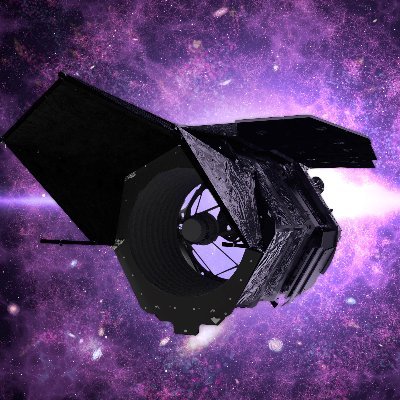

ALT Two people in head to toe white clean room suits stand in Goddard's large white clean room, staring up at Roman. Fully integrated, the telescope towers over them. Three irregular, elongated hexagon-shaped solar panels are the most striking part of Roman from this angle. The solar panels are gold with black squares covering almost their entire surface. Below the solar panels, which are several feet above the floor, the rest of the telescope is a silver cylinder, with various instruments protruding from its sides.

ALT An artist’s concept depicting a Voyager spacecraft with a long instrument protruding from the rear of the spacecraft. The front is circular and golden with light shining into its right side. A long antenna stretches out straight to the left and two smaller antennae form a Y from the left side of the circle.


ALT A group of people stand in front of the the large thermal vaccuum chamber in Goddard's integration and testing facility. They are stading together under a NASA flag, which is blue with the NASA seal.

ALT A star cluster seen up close, filling the view with thousands of stars. They are clearly divided between blue ones, which are scattered around the outskirts of the image but more towards the center and are the majority in the bright core of the cluster, and yellow stars, which are present in the core but make up most of the cluster outside of that. A few orange stars are closer to us and appear noticeably larger.
