

Quilter is enterprise-grade, physics-driven AI that automates printed circuit board layout design.
Los Angeles
Joined September 2023
- Tweets231
- Following90
- Followers1.6K
- Likes330




Pinned Tweet
How does an AI-designed PCB compare on EMI with the chip vendor's own reference design? Drum roll, please, again!
A year ago, we manufactured our Project Speedrun, the first computer designed by AI. Quilter's physics-driven AI placed and routed both boards of an NXP i.MX 8M Mini Linux system, and engineers spent 38.5 hours on cleanup.
EMI was the first question people asked about Speedrun and the most common criticism. We're glad to answer it now with third-party measurements.
None other then Kenneth Wyatt, the EMC Doctor, measured Project Speedrun against a board built from NXP's i.MX 8M Mini reference design files, in a TEM cell in his lab.
✅ Through much of 250 to 650 MHz, the Speedrun trace sat below the NXP-design trace, with a gap of about 12 dB in part of that range by Ken's estimate
✅ Broadband DC-DC converter noise from 10 to 250 MHz was about 5 dB lower
✅ The likely Ethernet clock harmonics were lower too, with the same Ethernet PHY on both boards
These are bench pre-compliance measurements at the TEM cell output, so they don't predict margins at a 3 m or 10 m test distance. The write-up covers the setup and the limits.
quilter.ai/blog/ai-designed-…

We are observing a very interesting trend in the industry! After decades of losing ground to computer science, electrical engineering is gaining students again: in fall 2025, EE enrollment at four-year colleges rose 14% , while computer and information science fell 8.1%.
🔹 In 1980, U.S. colleges awarded about 1.2 EE bachelor's degrees per computer and information science degree. By 2022, about 0.15.
🔹 That decline is why we argued in April that the electrical engineer shortage is structural.
🔹 New students need years of hands-on experience before they can take the senior roles teams struggle to fill.
🔹 Meanwhile, demand keeps growing: EE job postings on Indeed are 55% above their February 2020 level.
Big thank you to Judy Warner and Dr Eric Bogatin for providing insights for this piece.
quilter.ai/blog/engineering-…
2
209
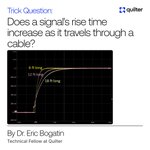
Does a signal's rise time increase as it travels through a cable?
Dr. Eric Bogatin measured a scope's probe compensation signal through coax:
• 6 ft: about 250 nsec
• 12 ft: about 600 nsec
• 18 ft: almost 1 µsec
He shows that loss, dispersion, cable capacitance, and time of flight don't explain it. What does?
Eric's explanation and two more puzzles: quilter.ai/blog/cable-length…

99
Can GPT-6 Astra route an 8-layer board with DDR memory? Drum roll, please! We had it drive @altium for 62 hours, with the autorouter off.
None of the public tests of @OpenAI's Astra have used it on even a moderately complex board. We ran this one on our Project Speedrun system-on-module.
✅ Closed 836 of 857 open connections, bringing the board to 98.1%
✅ Ran overnight without supervision and repaired a supply net a copper pour had split
❌ DDR timing failed, with 120 ps of within-pair skew against a 1 ps limit
❌ 1,555 track segments ran on ground layers where the rules prohibit routing
💲 API spend for the run was about $2,900.
The prompt, design files, and Astra's final report are on GitHub for anyone to check.
Astra did not produce a working board, and we do not think it is practical to use it for any professional work, but it was still impressive that a general-purpose model drove a professional EDA tool through its interface for close to three days, coordinated its own helper agents, and documented every change it made.
What do you think about Astra's performance?

“So far, the best thing that people have created are these things called autorouters, which are notoriously hated.”
That’s our CEO @sergiynest on Inside the Silicon Mind with @FirasSozan, talking about 60 years of attempts to automate PCB layout. The conversation also covers his five years as a radiation effects engineer at @SpaceX and why he starts from physics and first principles when he takes on a hard problem.
Autorouters gave PCB layout automation such a bad rep that many engineers are allergic to automation attempts. Some designers won’t touch an autorouter. Others use it on fanouts, buses, or less critical nets and are content with the results.
Which camp are you in? And what would it take for you to trust a layout automation tool?
Since GPT-6 Astra launched on September 3, PCB fabs, AI tool makers, and independent engineers have run PCB design tests with it. We follow this topic closely, so we read and summarized all available reports. The boards are two to six layers, Freerouting often did the routing, and none of the reports says how much cleanup it took to get to a board you would send to fab. We also looked at the gigabit switch an engineer at @OpenAI posted this weekend.
quilter.ai/blog/gpt-6-astra-…

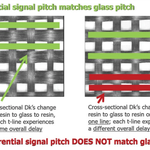
At 3 ps of skew per inch, a 15 to 20 inch differential pair arrives at the receiver with 45 to 60 ps of skew, about half the unit interval of a 10 Gbps signal.
In the final part of his fiber weave series, Dr. Steve Arar compares the ways to reduce it, from spread glass and NE-glass to matching your pair's pitch to the glass weave, and what each one costs you. Bill Hargin of Z-zero peer reviewed it.
quilter.ai/blog/fiber-weave-…

"Get into something physical, 'cause I don't know where this is going."
That was Chris Denney's advice when we asked our panel what they'd do differently if they were starting their careers today. Chris, CTO of Worthington Assembly, started in electronics manufacturing at 16 and spent years jealous of friends who went into computer science. In 2026, he's really glad he went into manufacturing.
It was one of many great insights from our recent panel with @hardwarefyi on whether there's really a shortage of electrical engineers. Chris joined Milton Santos (Allient), Akshay Budhiraja (Agility Technologies Corporation), and Frank Monaco (Simulator Product Solutions), who all hire electrical and PCB layout engineers.
Watch the full recording (Chris's answer starts at 51:10): youtu.be/Yv7kyuwIag4
Our April analysis of the shortage: quilter.ai/blog/hardware-eng…
Dr. Eric Bogatin, Quilter's Technical Fellow, has started a column on our blog called Improving the Signal-to-Noise Ratio. In it, he tests common signal integrity design guidelines against measurements and simulation.
His first column takes on one of the oldest rules in PCB layout: avoid 90-degree corners.
quilter.ai/blog/90-degree-co…

Where does an AI for PCB layout get its training data? @robertferanec asked @sergiynest .Quilter learns from rules and physics. Engineers define what a good board has to satisfy, every attempt gets scored against those rules, and the model improves through reinforcement learning.
We had this conversation with Robert a few months ago but we felt it was relevant to emphasize this point in the light of the recent advancements in LLMs have shown in PCB design.
Full session: youtu.be/aXjcSAsHkRQ?t=183Ho… and how physics-driven AI compares to LLMs like GPT-6 Astra: quilter.ai/blog/llm-pcb-layo…
The U.S. share of global PCB production has fallen from 30% to 4%. Most federal funding, including tens of billions through the CHIPS Act, has gone to chip manufacturing. A chip is just an expensive piece of silicon until it's mounted on a PCB that connects it to power, memory, and the rest of the system. The engineers who design those boards are retiring faster than new ones replace them. Read our CEO @sergiynest new article in Electronic Design on why PCB design is the bottleneck U.S. reshoring efforts haven't addressed
electronicdesign.com/technol…
When we published this graph a few months ago, it drew a lot of comments from our community. Some of you said it matched what you see when you hire EE/PCB design roles. Others disagreed entirely.
So we invited four engineering leaders who hire electrical and PCB layout engineers to join our webinar panel and take on the question: is there really a shortage of electrical engineers?
All four either hire electrical and PCB layout engineers or are directly impacted by the hiring trends:
Milton Santos, Engineering Manager at Allient
Akshay Budhiraja, Head Engineer at Agility Technologies Corporation
Chris Denney, CTO at Worthington Assembly
Frank Monaco, VP of Engineering at Simulator Product Solutions
They'll talk about which roles are hardest to fill, how the talent gap shows up on a contract manufacturer's floor, and what their teams are doing about hiring.
We are cohosting this webinar with our friends from @hardwarefyi.
October 8, 9 AM ET/12 PM ET
luma.com/9rs2line
Quilter retweeted

From Bottleneck to Speedrun: A New Playbook for Hardware Development | Join me for this topic at ELC Annual San Francisco on October 13!
sfelc.com/annual2026/topics/…

Quilter is sponsoring the Edge AI Hackathon at embedded world North America this year, alongside @arduino, @Qualcomm, @ASUS, and @hackaday. It runs September 22 to 24 in Anaheim, CA.
The hackathon brings together about 50 engineers and students to build embedded AI projects over two days. Teams work on real hardware and take on challenges in areas like autonomous systems, smart infrastructure, human-machine interaction, and AI at the edge.
Our own @jordanyte will be there as an advisor and judge.
If you're attending embedded world, stop by the hackathon and say hello.
#PCBDesign
#AIforHardware

1
234
We’re excited to be sponsoring Build Better 2026 on October 7th aboard the USS Hornet in Alameda, CA.
Join 300+ engineering and operations leaders and visionaries from across AI infrastructure, consumer electronics, and aerospace & defense for a day of candid conversations, cross-industry learning, and networking.
Connect with peers solving complex manufacturing challenges and leave with practical ideas you can bring back to your team.
📍 USS Hornet, Alameda, CA
📅 October 7, 2026
Space is limited. Reserve your seat na2.hubs.ly/H07xLwP0
#PCBDesign
#AIforHardware

1
237
Quilter’s Project Speedrun is a finalist in the Artificial Intelligence category of Fast Company’s 2026 Innovation by Design Awards.
We’re honored and a little stunned.
See the full list here fastcompany.com/innovation-b…
