

Avid hiker and coffee enthusiast who is proud to represent Arizona's 1st Congressional District in the U.S. House of Representatives.
Arizona
Joined December 2010
- Tweets7.3K
- Following856
- Followers39.9K
- Likes1.8K


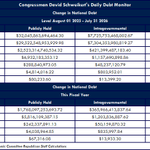


We have been tracking the reemergence of the New World screwworm for years. Throughout this time, our team has taken steps to prepare for the chance that this menace will reappear here in the Southwest.
I believe the steps we have taken by prioritizing funding for monitoring at our ports of entry and requiring USDA to plan for domestic sterile fly production, will provide USDA the tools they need.
Let's stay vigilant and understand from history the financial impact that not taking swift and decisive action would cost us.
The 2026 fiscal year ended Wednesday. The national debt increased by $2,534,271,606,405. That's $2.53 trillion.
Or:
$6.9 billion a day
$290 million an hour
$4.8 million a minute
$80,000 a second
At the beginning of the fiscal year, the 10-year was at 4.1 percent. Today, the 10-year is at 5.1 percent: a 100 basis point movement over a single fiscal year.
A sustained 60 basis point rise adds roughly $2 trillion in interest over a decade. A sustained 100 basis point increase would add $3.4 trillion.

We have to show the world’s debt markets we’re serious about our fiscal future or we risk letting them decide our future for us.
This fiscal year alone, we’ll borrow about $2.5 trillion, $6.9 billion a day, nearly $80,000 every second.
My condolences go out to the Kyl family today. Senator Jon Kyl will be remembered as a true statesman who always did right by Arizona and America. I was honored to have had the opportunity to serve with him.
The rate on the 10-year Treasury note has reached 5% twice since 2007: briefly in October 2023 and today.
Today's number should scare Congress. In 2007, debt-to-GDP was 62% and the deficit was 1.1%. Now, debt-to-GDP is 123% and the deficit is above 6%.
ft.com/content/06cb850d-089a…

At a 5% average interest rate, $63 trillion in debt means about $3.15 trillion a year just to pay interest.
By 2036, that could consume roughly 56% of federal revenue outside payroll taxes.
That’s interest fragility. Eventually you’re borrowing just to cover the cost of past borrowing.
Today, we remember the 2,977 Americans who lost their lives on September 11, 2001, changing our lives forever.
May we never forget the heroes of 9/11 and the brave sacrifices made by so many to protect their fellow citizens.


We went from around 20 copper smelters in the U.S. to two, while China came to dominate much of the critical-mineral processing.
Bringing that processing capacity back means using new extraction and refining technology to leapfrog the old methods and build the next generation of processing here.
Debt models start crashing when federal debt reaches around 154% of the size of the economy. At current interest rates, we’re headed above 160% in the next decade.
The models put us in the danger zone around 2035. A recession, war or one bad shock can push our borrowing costs higher when we have less room to absorb it and are already borrowing just to pay the interest.
We can change the math now, or eventually the bond market will do it for us.
We’re borrowing roughly $7 billion a day. Too many in Washington still do not understand what that means.
If we keep borrowing at this pace, the bond market will run this country.
My prayers are with the families of those who lost their lives and the crews continuing the search and recovery effort.
Please stay clear of the closed areas and follow @GrandCanyonNPS for the latest updates.

Search and recovery efforts continue following the flooding in Grand Canyon National Park. Two bodies have been recovered. Preliminary assessments indicate approximately 40% of the Transcanyon Waterline was damaged or destroyed. Forecasted weather may affect the timing and pace of operations.
Visitors are asked to remain out of the closure area while search and recovery operations continue. Phantom Ranch, Bright Angel Campground, the Phantom Ranch Canteen and cabins, and the entire North Kaibab Trail from the North Kaibab Trailhead to Phantom Ranch remain closed until further notice.
For current conditions and updates, visit: nps.gov/grca/planyourvisit/c…
Rep. David Schweikert retweeted

ICYMI: JEC Chairman @RepDavid joined @cherylcasone on @MorningsMaria to discuss the national debt as it tops $40 trillion, rising costs to federal commitments, and how demographics impact spending and debt.foxbusiness.com/video/640395…

Congratulations on a remarkable career, John. Always enjoyed our conversations over the years.

Rep. David Schweikert retweeted
“Our nation faces a dangerous fiscal trajectory that threatens the promise of a better tomorrow for future generations, as well as current retirees. We are rapidly approaching the point where interest payments on the national debt will consume most of the federal spending. Our debt is quickly switching from sustainable, business as-usual, to an unsustainable, market-unraveling nightmare. At this rate, it won’t be long before we face catastrophic consequences. Congress must take the math seriously and act now by charting a new economically responsible path to secure our nation’s future for generations to come. To do nothing or keep on this path is flat out immoral,” said JEC Chairman @RepDavid tinyurl.com/4s4ah63t

In June I said on the House floor we'd cross $40 trillion in debt by the end of this summer work period. We cross it this week. We're borrowing about $93,000 every second.
Thank you to the Dexcom team for the tour of their Mesa manufacturing facility last week. Great to see the technology that helps people manage diabetes being built in Arizona.

Rep. David Schweikert retweeted
Chairman @RepDavid led a roundtable with @HooverInst to examine how regulatory sandbox pilot programs can reduce barriers to innovation, facilitate responsible experimentation & inform more effective regulatory policy. “We are approaching a fundamental choice: cut or innovate. Too often, cutting or capping what already exists is easier than pursuing disruptive technologies that can lower costs, improve outcomes, and challenge entrenched business models.” Thanks to the Hoover Institution at Stanford University for hosting JEC.
@StanfordDeptMed @SUBiodesign @BusinessUtah @EconPatrick @StanfordEng @RachelSlaybaugh

