

Building One Brain for All Robots 🤖🧠 Intelligence in Action, Benefits for Everyone.
Joined January 2026
- Tweets151
- Following40
- Followers3.7K
- Likes237




Pinned Tweet
Introducing LingBot-Map 2.0: Reconsolidatable Streaming 3D Reconstruction 🤖
Building on LingBot-Map 1.0 released back in April, the key upgrade is Refine, powered by our Geometric Context Reconsolidation (GCR): revise existing spatial memory on demand to resolve accumulated drift — purely via model inference, no external optimization backend.
From continuous monocular RGB video, it estimates camera motion and reconstructs 3D scenes frame by frame as data arrives.
Build spatial memory. Refine it. Keep going.
Robbyant retweeted

Run LingBot-Map 2.0 on your computer with 1-click
Just drag a video or a set of images to the web app and it will turn it into the streaming 3D/4D view. Runs on:
- Mac
- Linux & Windows with NVIDIA GPU (12GB+ VRAM in my experience but let me know)
Now on pinokio with 1-click.

Introducing LingBot-Map 2.0: Reconsolidatable Streaming 3D Reconstruction 🤖
Building on LingBot-Map 1.0 released back in April, the key upgrade is Refine, powered by our Geometric Context Reconsolidation (GCR): revise existing spatial memory on demand to resolve accumulated drift — purely via model inference, no external optimization backend.
From continuous monocular RGB video, it estimates camera motion and reconstructs 3D scenes frame by frame as data arrives.
Build spatial memory. Refine it. Keep going.
Introducing LingBot-Navi: our open-source navigation model with spatial memory across tasks. 🤖
Leveraging LingBot-Map 2.0’s cross-task reusable 3D spatial memory, LingBot-Navi lets robots find targets, plan paths and navigate to nearby docking waypoints from natural language instructions. It builds memory while exploring and reuses that memory across tasks to cut redundant search — the robot grows more familiar with a scene and navigates faster over time.
Users simply describe the target; no turn-by-turn directions needed.
Built for continuous operation: on-device inference keeps images and requests local, without cloud API fees per navigation decision. It brings stronger privacy guarantees and lower operational costs, unlocking large-scale real-world deployment.
1
3
356
Together, LingBot-Map 2.0 and LingBot-Navi strengthen the capabilities of our embodied-native LingBot brain — from spatial perception to efficient navigation.
🔓 Model weights, inference code, dataset & technical report are open. Check it out!
Project Page: technology.robbyant.com/ling…
Technical Report: github.com/Robbyant/lingbot-…
GitHub: github.com/Robbyant/lingbot-…
Hugging Face: huggingface.co/robbyant/ling…
Dataset:huggingface.co/datasets/robb…
2
356
Robbyant retweeted

🎉 Seven months after LingBot-Map, we're excited to release LingBot-Map 2.0!
Streaming 3D models drift over long sequences and usually need an external loop-closure back-end to correct it. LingBot-Map 2.0 handles loop closure inside the model ⚡ It rewrites its own memory in one feed-forward pass: no loop detector, no pose-graph back-end 🚀
It achieves ~27 FPS on 512×288 resolution on a consumer GPU over kilometer-scale sequences (20k+ frames), and it is more accurate than loop-closure back-ends and offline models!
Two key insights behind LingBot-Map 2.0:
🔑 Bring SLAM's hindsight into the model: Geometric Context Reconsolidation lets later views rewrite the cached context through bidirectional attention over all keyframes
🔑 Make both streaming and reconsolidation end-to-end learnable — no hand-crafted priors, no optimization, no post-processing
Let's check out our demos 👇
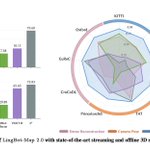
Benchmark: new SOTA across all 9 settings
Evaluated across 7 public datasets and 9 settings, with sequences reaching 5.2 km and 18,846 frames.
Average trajectory error, 1.0 → 2.0 Online → 2.0 with Refine:
• VBR: 31.12 → 17.01 → 4.72 m
• Oxford Spires: 8.25 → 6.17 → 3.92 m
With Refine, Map 2.0 achieves lower average trajectory error than all evaluated streaming and offline models on both benchmarks. Even before Refine, it leads the evaluated streaming methods.
The benefits carry forward: across 7 VBR sequences, one Refine step roughly three quarters through each run reduces subsequent trajectory error from 23.58 to 14.87 m.

1
6
439
Spatial memory and locomotion form the foundational capabilities that let robots enter the real physical world, and are key parts of the LingBot Embodied-Native Robot Brain.
📦 We're open-sourcing the paper, code, and first-stage streaming model of LingBot-Map 2.0. Take a look!
Project page: technology.robbyant.com/ling…
Technical report: github.com/Robbyant/lingbot-…
GitHub: github.com/Robbyant/lingbot-…
Hugging Face: huggingface.co/collections/r…
7
328
Benchmark: new SOTA across all 9 settings
Evaluated across 7 public datasets and 9 settings, with sequences reaching 5.2 km and 18,846 frames.
Average trajectory error, 1.0 → 2.0 Online → 2.0 with Refine:
• VBR: 31.12 → 17.01 → 4.72 m
• Oxford Spires: 8.25 → 6.17 → 3.92 m
With Refine, Map 2.0 achieves lower average trajectory error than all evaluated streaming and offline models on both benchmarks. Even before Refine, it leads the evaluated streaming methods.
The benefits carry forward: across 7 VBR sequences, one Refine step roughly three quarters through each run reduces subsequent trajectory error from 23.58 to 14.87 m.

Spatial memory and locomotion form the foundational capabilities that let robots enter the real physical world, and are key parts of the LingBot Embodied-Native Robot Brain.
📦 We're open-sourcing the paper, code, and first-stage streaming model of LingBot-Map 2.0. Take a look!
Project page: technology.robbyant.com/ling…
Technical report: github.com/Robbyant/lingbot-…
GitHub: github.com/Robbyant/lingbot-…
Hugging Face: huggingface.co/collections/r…
1
89
Robbyant is heading to RoboNext 2026 in Osaka! 👋
Explore LingBot 2.0 and talk with our team about embodied AI in real-world settings, from smart retail to parcel sorting.
🗓 Dec 2–4 | INTEX Osaka
📍 Hall 6, Booth A-70
See you there!
#RoboNext2026

4
519
Open world models enable open research.
LingBot-World is cited as a representative autoregressive video world model in NVIDIA's latest paper on addressable memory, and used as its 14B testbed for LoopBench.
Excited to see what the community builds next.

New #NeurIPS2026 paper from @NVIDIA
Video world models can now generate realistic interactive worlds, but they often forget places they have visited. Turn the camera away and back again and the scene has changed.
We introduce WorldTrace 🧵
research.nvidia.com/labs/sil…
2
10
1,387
Excited to share HALO — a more natural way to teach robots real-world skills, combining human-paced mobility with dexterous bimanual control.

🎉 Robots in the real world have to move around. Teleoperating a robot to do both at once is still slow and awkward
Today we're excited to release HALO, Human-Aligned Data Collection for Dexterous Whole-body Mobile Manipulation!
HALO lets you hold the robot's grippers directly and just walk, and the platform rolls with you 🚶 You get natural whole-body motion and fine bimanual control at the same time.
Three key results:
🔑 Demo collection approaching natural human speed: operators walk at a normal pace (~0.7 m/s), up to 2.9× faster than Mobile ALOHA with comparable or higher success
🔑 Dexterous skills: the policy model trained on HALO data fastens a short zip tie and disassembles Lego, while policies trained on Mobile ALOHA or VR data fail
🔑 Mobile skills: very high success on a six-stage long-horizon mobile manipulation task
Let's check out our demos 👇
1
20
1,284
Robbyant retweeted
🎉 Robots in the real world have to move around. Teleoperating a robot to do both at once is still slow and awkward
Today we're excited to release HALO, Human-Aligned Data Collection for Dexterous Whole-body Mobile Manipulation!
HALO lets you hold the robot's grippers directly and just walk, and the platform rolls with you 🚶 You get natural whole-body motion and fine bimanual control at the same time.
Three key results:
🔑 Demo collection approaching natural human speed: operators walk at a normal pace (~0.7 m/s), up to 2.9× faster than Mobile ALOHA with comparable or higher success
🔑 Dexterous skills: the policy model trained on HALO data fastens a short zip tie and disassembles Lego, while policies trained on Mobile ALOHA or VR data fail
🔑 Mobile skills: very high success on a six-stage long-horizon mobile manipulation task
Let's check out our demos 👇
Robbyant retweeted

Five new VLAs in LeRobot 0.7. The zoo keeps growing 🤖
- G0.5 from @GalaxeaDynamics: a 2B VLA that writes its subtask, then its actions, in one stream. Works with /subtask and /autosteer
- LingBot-VLA 2.0 from @robbyant_brain: one model across embodiments (55-D action space, ~60,000 h of pretraining). Its sparse MoE runs an action chunk in 120 ms in LeRobot, down from 756 ms
- DM0.5 from @Dexmal_AI: a Gemma3-4B VLM + a 680M flow-matching action expert, on standard LeRobot datasets
- Wall-OSS 0.5 from @XSquareRobot: a 4B VLA that also writes text. It answers /vqa and plans its own subtasks
- FineART-VLA: π0.5 with a language head, trained on FineART (more in our language post)
Docs in the comments 👇
What changes when robots can feel—not just see? 🤖✋
Meet LingBot-Touch, our open-source tactile foundation model towards dexterous manipulation, pretrained on nearly 5,000 hours of real tactile data.
Through unified heterogeneous tactile modeling, LingBot-Touch supports transfer across sensors, dexterous hands, tasks, and action models.
Watch it in action. 👇 #LingBot #EmbodiedAI #Robotics
Two sizes, balancing capability and efficiency. ⚡
Open-source Tiny and Small variants balance representational capacity with lightweight deployment, enabling efficient, high-frequency tactile perception as contact conditions rapidly change.
As pretraining data grew to nearly 5,000 hours, the Small variant continued to improve in tactile perception tests—highlighting the scaling potential of tactile pretraining.
1
8
781
LingBot-Touch reflects our embodied-native approach: tactile perception built around real-world needs.
🔓 Technical report, models & code are open source:
Project Page: technology.robbyant.com/ling…
Technical Report: github.com/Robbyant/lingbot-…
GitHub: github.com/Robbyant/lingbot-…
Hugging Face: huggingface.co/collections/r…
11
769