

Explaining climate solutions through bite-sized overviews & comprehensive deep dives - from a founder and economist.
San Francisco
Joined January 2014
- Tweets997
- Following628
- Followers545
- Likes163

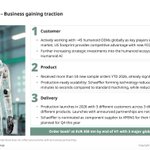





Schaeffler just casually dropped in their Q2 earnings: a €350 million humanoid order book from just 3 OEMs (while they are currently working with 45+). 🤯
Schaeffler, the German bearing company, you might know from car parts.
- actively working with ~45 humanoid OEMs globally
- shipments are just getting started: 50+ new sample orders in 2026 so far
- part production launches this year with 3 customers across 3 regions and 7 products
- nominated as component supplier for XPENG's Iron humanoid, production starting Q4
- invested into Neura Robotics and Humanoid AI
Their forming technology apparently cuts actuator production time from minutes to seconds compared to standard machining. We are scaling.
Europe might not have the flashiest humanoid demos. But when every humanoid on the planet needs precision actuators, bearings, and joints, they come to a 75-year-old company in Herzogenaurach.
The picks and shovels of the humanoid gold rush are Made in Germany. 🇩🇪🇪🇺

2
113
Chinese shipyards booked 121 million deadweight tons of new orders in the first half of 2026. That's 82.3% of every ton ordered on earth, and more than the yards booked in all of 2025 combined.
The rest of the MIIT numbers: output up 51.2% to 36.5 million dwt, 62.2% of global completions. The backlog now stands at 363 million dwt, 71.2% of the world total, with slots reportedly booked into 2030. Export value in six months: $31.6 billion, with overseas customers making up over 90% of new contracts.
The headline growth figure, 173.1%, deserves the obvious objection first: it's measured against a crater. Through most of 2025, shipowners froze orders at Chinese yards because Washington's Section 301 port fees, up to $140 per net ton by 2028 for Chinese-built vessels calling at US ports, hung over every purchase decision. The fees took effect on October 14, 2025. They lasted 27 days. On November 10, as part of the Trump-Xi deal in Busan, the US suspended them for a year and China dropped its countermeasures.
So yes, part of the 173% is deferred demand snapping back off an artificially low base. But base effects don't produce records. Six months of 2026 beat every full calendar year in Chinese shipbuilding history, and Q2 orders came in higher than Q1. The rebound isn't decaying. It's compounding.
Which points at the uncomfortable lesson of the whole episode. The port fees existed to push orders away from Chinese yards. For a year they mostly delayed orders to Chinese yards, because the alternative doesn't exist at scale: Korean and Japanese slots are full for years, and nobody else builds bulkers, boxships, and tankers in volume. When the penalty paused, the queue reformed overnight, longer than before. The policy set out to break a dependence and instead measured it. You can't tariff your way out of a capacity deficit.
One date matters from here: the suspension expires November 9, 2026. Every owner signing today for a 2029 delivery is betting the fees stay dead, or that by then there's still nowhere else to build. Watch what happens to the order intake in October.


98
A humanoid robot just finished a four-month internship at Xiaomi's EV factory. The report card: 98% on loading self-tapping nuts, 90% on folding empty parts bins.
The details are worth slowing down for. The robot started in March at one station, running a 76-second cycle at 90.2% success, including a three-hour fully autonomous stretch. Four months of iteration later it sits at 98%, which Xiaomi says is one percentage point below the qualification rate of its human workers. It also picked up two new jobs in final assembly: sorting center console side covers, the first documented long-duration humanoid work on large, deformable parts in a car factory, and folding down returnable logistics bins for recycling. Both at 90%.
Now run the numbers instead of admiring them. A 76-second cycle is roughly 470 cycles per ten-hour shift. At 98%, that's nine or ten failures a shift someone has to catch and fix. At 90%, closer to fifty. The human one point ahead fails about five times. "One point behind humans" means failing twice as often, on the easiest station. That's the distance between a viral clip and a headcount decision.
And the disclosures stop where it gets interesting. No trial counts behind the 98%, no definition of what counted as a failure, no intervention data, no confirmation the 76-second takt held. The original poster, who shared the video, flags himself that the footage runs at 10x speed and humans remain far more efficient. Grade the report card accordingly.
The part I fully buy is his thesis about who wins. Xiaomi is training its robots inside its own car factory. Tesla does the same, XPeng does the same, Hyundai owns Boston Dynamics and its own plants, Toyota will follow. A robot maker that owns the factory can't die from a lack of customers or use cases, and every shift produces training data no lab can buy. Xiaomi just open-sourced a 38-billion-parameter world model that generates synthetic robot training data 82x faster; the factory is what anchors it to reality.
The number that will decide actual deployment appears in none of these announcements: human interventions per shift. When a company publishes that one, believe the rest.
1
148
Chinese agricultural drones treated more than 173 million hectares of farmland last year. The US figure was about 4 million.
The video making the rounds shows why the gap looks like a video game: a farmer on a mountainside with a controller, flying a spray drone over terraces no tractor has ever touched.
The machines are DJI Agras and XAG rigs carrying 30 to 75 kilograms of liquid per flight, with DJI's newest T100 hauling a 100-liter tank. A battery lasts 20 to 30 minutes, enough for several hectares before a swap. One operator covers in a day what used to take a crew with backpack sprayers a week, and the drone doesn't absorb the pesticide drift through its skin.
The interesting part is why this exploded in China first. The terrain in that video is the answer. Terraced mountainsides and fragmented smallholder plots never suited tractors, so Chinese agriculture skipped a mechanization stage that the US completed 70 years ago. The drone isn't replacing the tractor there. It's replacing the 60-year-old with a hand sprayer, in a countryside where the average farmer keeps getting older.
And it built a profession. The industry employs nearly 500,000 people, and the white paper behind these numbers (written by Farmers' Daily with DJI, so read the glossier claims accordingly) makes a point of young people returning to villages to run spraying businesses. Total market size: about $1.8 billion. Huge coverage, modest revenue. That ratio is the DJI signature, volume growing faster than money, which is what price collapse looks like from inside.
Now the objection: China only has around 128 million hectares of arable land, so how were 173 million treated? Because the number counts operations, not territory. The same wheat field sprayed three times in a season counts three times. Read it as sorties flown, not ground held. Even cut in half, it dwarfs everything else on earth.
Beijing noticed too: the 2025 No. 1 Central Document, the policy paper that opens each year, listed low-altitude technology as a strategic priority for the first time.
One commenter points out that Clarkson's Farm just demoed automatic spray drones on British TV. No prize for guessing where they were built.
156
The fastest human solar installers place a panel roughly every 40 seconds. Then their shoulders give out. Cosmic-1 holds that pace for a ten-hour shift.
Cosmic Robotics launched this week out of YC with a pitch that starts on American solar farms and ends with a city on Mars.
Strip the Mars part for a second and look at the machine: a roughly two-ton, all-electric autonomous robot that navigates a jobsite on stereo vision and GPS, picks 90-pound panels off a trailer, and places them onto racking with millimeter precision. It runs 10+ hour shifts on a 35 kWh battery, is sealed against dust and mud, and pauses automatically when a worker steps within reach of the arm. Humans still spot, fasten, and QA. The company claims it has more than doubled installation crew productivity across tens of thousands of cycles.
Utility solar is close to the perfect first target for construction robotics: repetitive, geometrically regular, outdoors, and brutal on bodies. Hoisting 90 pounds overhead every 40 seconds in 100-degree desert heat is exactly the kind of work you want a machine doing. Same pattern as the tomato picker: one machine, one task, one environment, done extremely well, while the general-purpose humanoid remains a separate bet.
The demand side is absurd. The founders cite $7 trillion going into data centers and the power to feed them over six years, more than the Manhattan Project, Apollo, and the Interstate Highway System combined, while the US needs around half a million new construction workers next year and construction productivity has been falling for fifty years as manufacturing got 10-15x better.
Now the Mars part. No robot earns a dollar on Mars, and the actual customers are solar EPCs. But the observation underneath makes sense. Mass to orbit stopped being the bottleneck; the construction equipment for anywhere off Earth does not exist.
The founders match the thesis: James Emerick spent his career at Built Robotics with seven autonomous-construction patents, Lewis Jones did propulsion at SpaceX and Relativity.
Imho Mars is the vc & recruiting story. Solar pays the payroll and generates the training data.
What to watch from here: named EPC customers and fleet counts.
181
Tesla's robotaxi cleaning arm is going viral again this week. The video is 18 months old. The building permit is two weeks old.
A large robotic arm inside a Cybercab, swapping its own attachments. A vacuum head for the seats and floor, a lift to raise the center armrest and get underneath it, a gripper that picks up forgotten bottles and backpacks, a microfiber pad for the screen. Tesla posted it in January 2025 with the caption "This robot sucks" and never gave the machine a name.
What's new: a Texas filing (project TABS2025022006) for Tesla's robotaxi hub on E Ben White Blvd in Austin lists a "Cleaning Robot" in the scope of work, next to Supercharger cabinets and an equipment inspection system.
Why bother? Remove the driver and a robotaxi's remaining costs are depreciation, energy, insurance, and depot time. Every minute a car sits waiting for a cleaning crew is a minute it earns nothing. Cleaning is among the biggest cost drivers left. Tesla claims the arm turns a cabin in under two minutes.
The arm and the car were built for each other. The Cybercab has two seats, no steering wheel, a flat floor, and roughly 50% fewer parts than a Model 3. An arm parked at the door can reach every surface because the cabin was drawn so it could. It's the opposite bet from Optimus: one machine, one task, one interior geometry, done extremely well.
A human with a shop vac beats this arm on speed and hourly cost. The comparison shifts at fleet scale, where a hub cycling cars day and night needs cleaning crews on three shifts, against an arm whose cost is fixed steel amortized over years of two-minute cycles.
And the arm only handles the crumb tier. Spilled drinks and the genuinely grim scenarios the replies are imagining still mean a human and a mop; Waymo staffs its depots for exactly that. The robot's job is to make human intervention the exception instead of the shift.
Video from Tesla, January 2025. Permit spotted on Twitter.
195
The caption calls Tianjin the world's first fully automated port. It isn't. Rotterdam automated container handling in 1993, and Shanghai's Yangshan Phase 4 has been the world's largest automated terminal since 2017.
What Tianjin's Section C terminal actually is: the world's first zero-carbon smart terminal, and the first serious demonstration of something the industry needs far more than another shiny greenfield project. It went live in October 2021 after just 21 months of construction.
The machinery in the video: remotely operated quay cranes lift boxes off the ship onto a fleet of 76 driverless electric vehicles, coordinated over 5G with cloud dispatch that plans routes so paths never cross, even if the network drops. The vehicles navigate on sensors alone. Older automated terminals buried thousands of magnetic nails in the tarmac to guide their vehicles; Section C needed none, which matters for reasons below.
"Unmanned without human intervention" oversells it. Crane operators sit in an office tower with joysticks and screens, supervising remotely. The accurate claim is no humans on the apron, which is still a genuine safety and labor story, since traditional quay crane cabins are among the worst jobs in logistics.
The two real firsts. One: the terminal runs 100% on electricity, and 100% of that electricity comes from wind turbines and solar built on site. A port that powers itself. Two, the bigger one: Tianjin retrofitted existing yards with this technology, reaching an 88% automation rate on large handling equipment. Nearly every automated terminal on earth was built from scratch on new land. The world's ports mostly can't do that; they have working berths they can't bulldoze. A retrofit recipe that needs no buried infrastructure is the exportable product here.
Automated terminals have historically been less productive than good manual ones. Fair, and documented: the first generation of automated ports cut labor costs but often lost throughput per crane. Whether the IGV-and-5G generation closes that gap is the actual question, and Tianjin's efficiency claims are its own. The number to watch is container moves per crane per hour, published by someone who isn't the port.
The terminal is impressive enough that the caption didn't need to inflate it.

Tianjin Smart Port is the world's first fully automated, unmanned port operating without human intervention. It leads the industry with automated loading and unloading, autonomous transportation, and 24/7 continuous operations.
1
124
Greece is projected to grow its battery capacity 43x by 2030. Portugal 21x. Denmark 27x. Poland 15x. Every country on this Ember map gets a bigger circle, and the multiples cluster hardest in the south and east, the places that barely had storage to begin with.
The map answers the question the earlier EU solar post left open. Solar grew more than any source in the EU last year, but wind and hydro had an off year and gas filled the gap, and the obvious retort was: what happens at night when the sun is gone. This is the answer being built. Storage is what lets a solar surge cover the evening instead of handing it back to gas.
The big dark circles are absolute capacity: Germany and Italy already hold the most, the established storage markets. The big multiples are catch-up: Greece at 43x, Portugal at 21x, growing from almost nothing. Germany's 2x off a large base adds more gigawatts than Greece's 43x off a tiny one. Both matter. One is the leader extending, the other is the laggards starting the same climb the leaders already made.
The skeptic line on a projection like this is fair: these are grid-operator submissions to a planning exercise, not installed hardware, and planning numbers run ahead of reality all the time. True. The map's own footnote admits that for countries without a label, essentially all 2030 capacity is assumed to be newly built, which is a big assumption riding on permits, financing, and supply chains showing up on schedule. A circle on a 2030 map is a plan, not a battery. But the direction is the signal even if the dates slip, and it lines up with what is already happening: the US installed a record amount of storage last year, and the same cost curve driving that is pointed at Europe.
The detail under the projection is that batteries plus solar now beat new gas on cost in much of Europe, which is why grid operators are submitting these numbers in the first place. They are not installing storage for the climate. They are installing it because a solar-plus-battery system is becoming the cheapest way to deliver firm power, and the storage is what converts cheap daytime solar into something you can dispatch at 8pm. The panel and the battery are one product now, and this map is the second half of that product arriving across the continent.

185
Building a single 1 GW AI data center costs $37.2 billion up front. The chart from Epoch AI breaks where it goes.
$21 billion of that $37.2 billion is servers. The GPUs alone are more than half the cost of the entire project. The building that houses them, the facility, is $11 billion. Network infrastructure is $4.9 billion. Then land at $170 million and the utility connection at $160 million, rounding errors against the silicon.
Land plus power: $330 million combined, under 1% of the build. The thing everyone fights about when a data center gets announced, the land it sits on and the electricity it draws, is the cheapest part of the whole project. What costs money is the chips. A 1 GW AI data center is a $21 billion pile of Nvidia GPUs with an $11 billion box built around it to keep them cool and powered.
The skeptic reads this and says the chip number is a bubble artifact, GPU prices are inflated by a shortage and will collapse, so the whole cost structure is temporary. Partly fair. GPU pricing is elevated and Nvidia's margins are enormous. But the point holds even if chip prices halve, because the ratio is what matters. Servers depreciate on a 3-to-5 year cycle while the building lasts 20-plus, so the $21 billion is not a one-time cost, it is a cost that recurs every few years as the GPUs go obsolete and get swapped. The building is bought once. The silicon inside it is bought again and again. Annual operating cost is only $0.9 billion, which means the model is not about running the thing, it is about continuously replacing the most expensive thing inside it.
This is why the AI-energy debate is aimed at the wrong target. Every data center announcement turns into a fight over grid strain and electricity, and the power draw is real, the earlier Chevron and Microsoft deal was 2.67 GW for one campus. But the utility connection is $160 million on a $37 billion build. Power is a genuine constraint on where you can build and whether the grid holds, and it is close to free relative to the chips. The binding cost is access to GPUs, which is why the companies with the most compute are the ones that pre-bought silicon, not the ones that own the most land.
The whole structure is a bet on depreciation. You spend $21 billion on chips that are worth a fraction of that in four years, betting the AI they produce in those four years earns more than the next $21 billion you will have to spend to stay current.
A treadmill of silicon that has to be repurchased before it wears out.

Four Chinese humanoid robotics companies disclosed fresh funding at unicorn valuations in the span of a week. Robot Era and DexForce each raised about $139M at valuations above $1.4B. AI² Robotics raised roughly $700M at $2.8B. XSquare hit $2.8B with the amount undisclosed. A fifth, Morphi Robot, raised over $139M at a valuation above $1B, and that one was an angel round, for a company with barely a public product.
An angel round at a unicorn valuation is froth by any definition, so start with the bubble objection because it is partly correct. A tracker now counts $8.1 billion raised across more than 100 humanoid robot companies. Over a hundred companies chasing the same form factor will not all survive, and most of this capital will burn.
Two things sit underneath the froth. DexForce's numbers are small but real: roughly 1,000 humanoid shipments projected for 2026, first-half revenue near 100 million RMB, an IPO in preparation, and Lens Technology's founder personally putting in hundreds of millions.
These valuations are frothy multiples on actual shipping products, which is a different condition from pure story capital. And the demand side was installed first. Beijing's directive mandating 10,000 humanoids into commercial use by year-end, with state-owned enterprises drafted as first customers, went out three weeks before this funding wave. The capital is following a guaranteed buyer.
The US is running the opposite structure on the same bet. Figure AI alone is valued at $39 billion, more than four times these four companies combined. America concentrates its humanoid bet in one or two champions. China spreads it across a hundred entrants and lets the market execute the losers, the same tournament that took 500+ EV companies down to BYD and a handful of survivors who came out of the price war battle-hardened. Most of the $8.1 billion is tuition. The selection is the product.

A Palestinian refugee kid from Amman, raised in one room the family shared with its livestock, landed in the US at 15 with a few hundred dollars. He became a chaired professor at Berkeley and won the 2025 Nobel Prize in Chemistry. Last week he moved to Beijing. Tsinghua announced his appointment on July 4, America's 250th Independence Day.
Omar Yaghi, 61, will lead a new AI for Chemistry and Materials Science center at Tsinghua as a full-time chair professor. The stated goal is to use AI to shorten materials development cycles by orders of magnitude, inside a pipeline running from theory through computing to production. His materials, metal-organic frameworks, hold the highest surface areas ever measured and can pull water out of desert air and CO2 out of flue gas.
Kyle Chan at Brookings flagged why the field choice matters more than the name. Yaghi's work is new materials, a domain where China already leads industrially. MOFs are modular structures with a combinatorial design space too large for any human-led lab to search, which makes them a near-perfect target for machine learning and robotic synthesis. The discovery layer is relocating to where the scale-up layer already lives.
One number from the SCMP report: Yaghi has trained around 200 researchers over his career, and nearly half were Chinese. The talent pipeline ran through his lab for three decades. Now the lab has moved to the country the pipeline came from.
A reply in the thread asked the right question: is this Neymar to Saudi or Ohtani to the Dodgers, a fading star cashing out or a prime player joining the stronger team? For this specific field, the second reading has a real case: Tsinghua is offering a purpose-built institute, ministry funding, and a materials-industrial base no US university can match. The caution is that one move is an anecdote. The pattern is the signal: Charles Lieber, formerly Harvard's chemistry chair, is at Tsinghua Shenzhen; Harvard statistician Liu Jun joined Tsinghua last year; US federal research funding is being cut while Chinese institutes recruit with blank checks.
For 70 years the world's best scientists moved in one direction, and that flow was America's most durable advantage, upstream of every chip and every drug. The direction of the arrow is now a live variable.
More than 95% of all Grace-Blackwell GPUs tracked in the State of AI Compute Index have yet to be deployed, and the chip has been shipping since December 2024. Nvidia's flagship has been on the market for a year and a half, and almost the entire fleet still exists as announcements and half-built halls.
Dark bars are racked and running, blue is installing, orange is announced. The giant bars are almost all orange, and almost all sovereign: Saudi Arabia's HUMAIN at roughly 600,000 GPUs, South Korea's national program at 260,000, Stargate Norway, the UAE. The dark deployed segments are small and belong mostly to private US labs: xAI's Colossus 1, Together/Hypertec, Mistral's cluster in France. The largest blue bar is xAI's Colossus 2, the company that built its first datacenter in 122 days, now installing over 100,000 more.
The math on the orange explains the lag. A GB200 rack draws around 130 kW, call it 1.8 to 2 kW per GPU once cooling and networking are counted. Saudi Arabia's 600,000 announced GPUs work out to roughly 1.2 GW of continuous load, a nuclear reactor's worth of demand for one campus. At the Epoch AI cost breakdown from last week, $37 billion per gigawatt of AI datacenter, the orange on this chart implies hundreds of billions in capex that has to clear power contracts, grid queues, and construction schedules before a single token gets generated. US interconnection queues run about five years. This is why Microsoft and Chevron are building 2.67 GW of private gas generation behind the meter, and why the deployed bars belong to whoever solved power first.
The fair objection is that some of the orange never gets built. Sovereign AI announcements are partly diplomacy, and a national GPU target costs nothing to declare. The chart's categories handle that: read the dark segments as reality, the orange as intent, and price the difference accordingly.
Everything AI does today runs on under 5% of the flagship fleet already committed. Part of the next capability jump is already purchased and sitting in crates, waiting for buildings.

The Remote Labor Index took 240 real freelance projects worth $144,000 in actual paid invoices, gave them to AI agents, and had human evaluators judge the deliverables against the work of the professionals who originally got paid. Eight months ago the best model completed 2.5% of them at client-acceptable quality. The new results put Fable 5 at 16.1%, roughly double the previous best.
These are not exam questions. The projects come from 358 verified freelancers across 3D and CAD, architecture, graphic design, video, audio, data analysis, and web apps, with a mean human completion time of 28.9 hours and multi-file deliverables. The metric is whether a paying client would accept the output over the professional's version.
The honest half of the result comes from the benchmark's own authors. 16% completed means 84% failed, and CAIS notes that none of the three Fable 5 deliverables they showcased would pass as finished work. The models produce a better wedding ring render than the competition and still fall short of the jeweler.
Success does not track human hours. Some 60-hour projects fall to the machine because they are production-heavy, and rendering, drafting, and iteration compress well. Some 2-hour tasks resist because they are pure judgment. Automation is arriving unevenly inside jobs, slice by slice, rather than rolling across occupations in order of difficulty. Time-based forecasts of which work is safe are measuring the wrong axis.
Two weeks ago I posted about AI-attributed layoffs and argued the announcements were running ahead of the technology, with the open question being whether the tools would actually show up in the vacated seats.
This index is the first serious attempt to measure the tools directly. The answer so far: they cannot do most of the work the press releases claim, and the share they can do went from 2.5% to 16.1% in eight months.
Both halves can be true at once, and the second one compounds.

2
3
356
US labs ask for 5.5 years of experience on average for technical roles, Chinese labs ask for 1.6. ByteDance's research group posts roles requiring 0.3 years. Anthropic's average requirement is 6.5.
The chart splits cleanly by country. Every US lab sits high, Anthropic at 6.5, OpenAI at 5.9, DeepMind at 4.7, xAI at 3.3. Every Chinese lab sits low, DeepSeek at 3.1 down to ByteDanceSeed at 0.3. The lowest US lab still asks for roughly the same experience as the highest Chinese one.
Two takes:
The dismissive one: Chinese labs hire junior because the talent pool is thinner, and 1.6 years of experience builds worse models. The chart itself argues against that, since DeepSeek shipped frontier-competitive models with a team hired at 3.1 years average. Experience on a résumé and capability at the frontier turned out to be loosely coupled in a field this young.
The take that holds up better: nobody has much experience in a field that barely existed five years ago, so hiring for 6 years of it is filtering on a credential that mostly signals age. Chinese labs treat AI as new enough that a sharp recent graduate is a fair bet, and staff accordingly. It resembles the internet in 1996, when the people who built it were 24 because no 40-year-old had done it either.
There is a cost structure underneath. A researcher with 1.6 years costs a fraction of one with 6.5, and if the output is competitive, the Chinese lab runs a far cheaper R&D operation per capable head. The same labor-cost logic that ran through manufacturing now runs through the research itself, pointed at the people rather than the factory floor.
Which approach compounds is the open question. US labs are betting deep experience produces better judgment on hard research bets. Chinese labs are betting raw talent and speed matter more when the ground shifts every six months, and that betting on young researchers is how you find out who is good before the credential exists.
The résumés look nothing alike. The models are closer than the résumés suggest.

France took about 6.2 gigawatts of nuclear offline during the June heatwave, nearly 10% of its fleet, because the rivers got too hot. Reactors at Golfech on the Garonne, Bugey and Saint-Alban on the Rhône, and Nogent on the Seine were shut or throttled. On June 23 France recorded its hottest day since records began in 1947, above 44°C in places.
The trigger was not a safety failure. A river-cooled reactor draws water, uses it to carry off waste heat, and returns it a few degrees warmer. French law caps the discharge temperature to protect river life, roughly 28°C on the Garonne at Golfech. When the river is already near that ceiling from the heat itself, the plant has no thermal headroom to dump into it, so output gets cut. The heatwave that spikes electricity demand for cooling is the same event that removes the supply.
The skeptic reply, and it is a fair one from EDF itself: the annual impact is negligible, an average output loss near 0.3% since 2000, and RTE confirmed France met demand throughout and kept exporting every hour of June. True on the totals. The problem is not the annual average. It is the coincidence of timing. The reactors derate on the hottest afternoons, which are exactly the hours neighboring grids lean on French exports and regional demand peaks. A pv-magazine analysis found France's daily export surplus fell as riverside temperatures rose across the month. The relevant number for planning is no longer France's yearly surplus but the capacity it can deliver under thermal stress, and that shrinks precisely when everyone needs it.
The structural read is the one worth keeping. A thermal plant is an engine that needs somewhere cool to reject heat, and a warming river is a worse heat sink every summer. The discharge rules were written for a climate where 44°C June afternoons were rare. EDF now budgets around €600 million a year for 15 years to adapt its fleet to conditions the plants were not designed for. Last July's heatwave already forced 7 GW offline, more than Ireland's entire grid.
The contrast with the solar-plus-storage posts is the useful part. Heat is a stress that hits sources differently. It knocks out river-cooled nuclear and drought-hit hydro at the peak, while solar generates hardest on exactly those cloudless 44°C afternoons, and a battery moves that surplus into the hot evening. The case for a diverse grid is that no single failure mode takes it down, and June showed the failure mode nobody priced: the baseload plant browning out because the river ran warm.
1
208
Roughly 1 in 6 of the world's unicorns last raised money at or below their previous peak. Stanford's unicorn database counted 332 of about 1,900 tracked companies in that position by mid-2026, and 212 of them have already fallen back under the $1 billion line. The Economist gave them a name: zombie unicorns, still operating, unable to raise an up round, no clear path to IPO, no acquisition offer that matches the old price.
You asked for the list, so here are the named ones from PitchBook and the reporting, not the full 332 but the cases people can actually point to:
Cameo, the celebrity-video app, hit $1B in 2021 and is now valued around $82 million, down more than 90%.
Kindbody, the fertility network, was worth $1.8B in 2023 and fell to roughly $400M as it closed clinics.
Glossier, $1.2B in 2019, last raised in a down round.
Away, the luggage brand, $1.4B in 2019, investors now bracing for a long hold.
Calendly, the scheduling tool, one of the most prominent names on PitchBook's fallen-unicorn list.
Consumer brands round it out: Savage X Fenty, AG1, The Farmer's Dog, SonderMind.
The pattern in that list is the whole story. These are mostly pre-ChatGPT companies, consumer and SaaS, that raised in the 2021 zero-rate boom. Startups whose last round was 2021 are worth 68% less on average; 2022 raisers are down 52%. Enterprise software is the biggest casualty class, 75 SaaS names on the fallen list, double the next category, because vibe-coding tools now let non-developers build the custom app that a $50-per-seat SaaS product used to sell them.
The capital did not evaporate. It relocated. AI startups raised $255.5 billion globally in Q1 2026 alone, more than all of 2025's AI funding, and three deals (OpenAI's $122B round, Anthropic's $30.6B, xAI's absorption by SpaceX) took 67% of it. A VC who would once have written a follow-on cheque to a SaaS company growing 40% a year is now funding an AI-native firm growing 200%. The zombies are stranded between a 2021 valuation and a market that repriced underneath them.
Their survival play is usually to bolt AI onto the pitch and hope the next narrative lifts them. Most cannot, because the pivot needs engineering talent and runway, the two things a zombie valuation makes hard to raise. The likeliest exit is acquisition at a fraction of the peak.
1
139
About half of the workers in Anthropic's new Economic Index survey say AI could already do almost half or more of their work tasks entirely on its own. Over a third expect it to handle most or nearly all of their tasks within 12 months. Close to 6 in 10 picked a higher band for next year than for today.
These are roughly 9,700 Claude users linked to their own usage logs, and they skew hard toward the frontier: computer and math occupations are 30% of respondents against 4% of US employment. This is the bleeding edge reporting on itself, which makes it a leading indicator rather than a census.
Set the number against the two other measurements from recent posts and the spread is the interesting part. The Remote Labor Index, the hardest benchmark, has AI completing 16% of real freelance projects end-to-end at professional quality. Layoff press releases blamed AI for 40% of May's job cuts. Workers themselves now say 50% of their tasks. Three numbers, three different things being measured: whole deliverables with no human involved, corporate narrative, and task-level capability with a person in the loop. A job is a bundle of tasks, AI takes slices, and the human routes and assembles the rest, so 16% of jobs and 50% of tasks can both be true at once.
Two findings inside the survey carry more information than the headline. Workers with 15+ years of experience put AI's share of their tasks about 10 points lower than first-year workers, and their stated reason is specific: judgment, situational context, and the trust-building parts of the job. And the worry is displaced downward. Only 10% of respondents rate their own job loss as likely, below the actual US involuntary-separation rate, while over a third put the probability of a junior colleague losing their job above 60%.
The people who delegate the most to AI are the most optimistic across every dimension measured, pay, job security, finding new work, and meaning. 57% say AI has made their skills more valuable. Either the heaviest users see benefits the rest have not experienced yet, or the optimists were always going to delegate first.
The survey cannot fully separate the two, and the authors say so.

1
128