

Official Twitter account for the World Health Organization Ghana Country Office
Accra, Ghana
Joined October 2014
- Tweets5.3K
- Following98
- Followers16.1K
- Likes2.5K






Pinned Tweet
What’s shaping Ghana’s health sector this quarter?
Our Q3 2026 Newsletter highlights progress in ⬇️
✅clinical research
✅mental health
✅digital health innovation and
✅emergency preparedness
alongside efforts to strengthen health systems and improve health outcomes.
Explore the highlights and read the full newsletter➡️ bit.ly/483dWlg

Today, we join the 68th Annual General Conference of the Ghana Medical Association.
Delivering her remarks, Dr @BrakaFiona @WHOGhana Representative called for a reimagined emergency response system that puts patients first and ensures that no one is left without timely care because of gaps in coordination.
@WHO reaffirms its commitment to supporting the Government of Ghana and health sector partners to strengthen emergency care, improve referral systems and advance #UHC.


This week, a delegation from the @GatesFoundation paid a courtesy call on @WHOGhana Representative, Dr @BrakaFiona, as part of its country visit to Ghana.
Discussions focused on progress towards maternal Respiratory Syncytial Virus vaccine introduction, including research, disease surveillance and health-system readiness.


The third session of the Global Laboratory Leadership Programme is ongoing.
This session focuses on strengthening participants’ skills in partnership building, coalition development and laboratory advocacy.
Funded by @Pandemic_Fund through @WHOGhana and led by @AFENET, the programme aims to strengthen leadership capacity for more resilient laboratory systems.


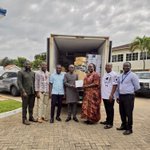
Thanks to @Pandemic_Fund, we have handed over 760 tablets to the @_GHSofficial.
The tablets will equip surveillance officers and frontline health workers with digital tools for real-time data collection, reporting and information sharing, improving early detection of public health threats and timely response to outbreaks.


Thanks to @Pandemic_Fund, we are supporting @AFENETAfrica to develop Public Health Emergency Management Fellowship Materials.
Once validated, these resources will be used to strengthen the capacity of frontline health workers across Ghana, enhancing the country's readiness to prevent, detect, and respond to public health emergencies.


This week, we welcomed Dr. Mesfin Tessema, Lead for the Lead Poisoning Prevention Initiative at @BloombergDotOrg, on a courtesy call.
Discussions focused on the project, @WHO’s role, key partnerships, implementation challenges and recommendations to strengthen delivery and ensure sustainability.


As part of the country joint mission on the Diabetes & Cardiovascular Diseases (D-CARD) Initiative, we visited the Diabetes Centre at @KBTH_GH and @UnivofGh School of Public Health to observe the operationalisation of the #NCD e-Registry and learn how implementation research is addressing inequalities among people living with #NCDs.
These efforts are strengthening #NCD surveillance and informing more equitable, evidence-based care.


Together with @NBSGhana, we are convening stakeholders to validate findings from a gender and equity analysis of blood-related policies, strategies and plans.
The discussions will inform actions to make blood services more inclusive, equitable and responsive to the diverse needs of everyone.


WHO Ghana retweeted

We’re still celebrating UN Month!
On 24 October, we marked the 81st anniversary of the United Nations. In this short clip, our RC, @ZiaChoudhury captures the spirit of the day as he joins Model UN activities & attends the national flag-raising ceremony.
Watch the highlights! 🇺🇳
We conclude our D-CARD field mission with visits to Holy Family Hospital and Kutabom CHPS Compound in the Bono East Region.
Here, the #NCD e-Tracker is helping generate critical data on diabetes and hypertension that was previously difficult to access.
This data supports evidence-based decisions, strengthens #NCD surveillance and helps improve access to quality care where it is needed most.


The @mohgovgh and @WHOGhana knowledge generation workshop concludes with an engaging panel discussion.
Representatives from six participating agencies reflect on what works, barriers to gender integration, and practical actions to advance gender equality in health.
These discussions will shape evidence-informed policies and programmes that address gender inequalities and promote more equitable health outcomes for all.


On Day 3 of @mohgovgh & @WHOGhana knowledge generation training, participants are turning learning into action, applying their skills to draft knowledge products that address gender based inequalities in health.
The aim is to turn evidence into actionable insights that advance gender equity and strengthen health systems for all.


With the continued threat of Ebola, heightened vigilance and readiness is essential.
Today, we joined the Minister for Health, Hon. @KMAkandoh, at Accra International Airport to re-assess the readiness of Port Health Services to detect and respond to potential Ebola cases.
The walkthrough highlighted key preparedness measures, including functional infrared temperature scanners and electronic health declaration forms developed and being deployed for travellers to facilitate screening.


Lead exposure can be invisible, but its effects can last a lifetime, especially for children.
Today, we join @mohgovgh and partners to launch Lead Poisoning Prevention Awareness Week, calling for stronger action to identify and eliminate sources of exposure and protect communities from its harmful effects.
From detection to prevention, every action counts.


Strong emergency response starts with a skilled and coordinated workforce.
Thanks to @Pandemic_Fund, we are working with @_GHSofficial and @AFENETAfrica to train over 80 multisectoral professionals in emergency preparedness, response and recovery, strengthening collaboration to protect lives during public health emergencies and humanitarian crises.


Our joint field mission on the Diabetes & Cardiovascular Diseases (D-CARD) Initiative is underway.
Today, we visited Bomso Church of Christ Hospital and Abuakwa Polyclinic to assess diabetes and hypertension management, explore the use of the #NCD e-tracker, and identify implementation challenges and lessons to improve patient outcomes.


WHO Ghana retweeted
Ghana and the UN family marked the 81st #UNDay with a flag raising at the Ministry of Foreign Affairs, led by Deputy Minister James Gyakye Quayson and Resident Coordinator Zia Choudhury.
We reaffirmed our commitment to peace, development and multilateralism. #UNinGhana #UN81 – at Aire-sur-l'Adour, France


Anticipating public health threats before they escalate can save lives.
With support from @Pandemic_Fund, we join @AFENETAfrica and stakeholders for a capacity-building training on advanced spatial epidemiology and AI-assisted predictive modelling.
The training aims to strengthen Ghana’s ability to predict disease outbreaks, identify hotspots and guide timely public health action.


The National Action Plan for Health Security (NAPHS) is a country-owned plan to strengthen health emergency preparedness under the International Health Regulations (IHR).
This week, we are supporting Namibia to cost its NAPHS, which outlines priority actions and resources needed to prevent, detect and rapidly respond to public health emergencies, minimize their impact and protect communities.


At the end of Day 1 of the @mohgovgh & @WHOGhana knowledge generation workshop, participants explored⬇️
🔹 Why gender matters for #UHC
🔹 How to conduct gender analysis
🔹 Turning evidence into policy
The next step is to turn these learnings into evidence-based products that inform policy and address gender-based health inequities.


