Yellowstone National Park (@YellowstoneNPS) header
Yellowstone National Park (@YellowstoneNPS) profile picture

The official feed of Yellowstone National Park.

Yellowstone National Park
Joined June 2009
Photo by Yellowstone National Park (@YellowstoneNPS)Photo by Yellowstone National Park (@YellowstoneNPS)Photo by Yellowstone National Park (@YellowstoneNPS)Photo by Yellowstone National Park (@YellowstoneNPS)Photo by Yellowstone National Park (@YellowstoneNPS)Photo by Yellowstone National Park (@YellowstoneNPS)Photo by Yellowstone National Park (@YellowstoneNPS)Photo by Yellowstone National Park (@YellowstoneNPS)Photo by Yellowstone National Park (@YellowstoneNPS)Photo by Yellowstone National Park (@YellowstoneNPS)
And that's a wrap! Another peak season has come to an end. Most park roads are now closed to vehicles as we prepare for the upcoming winter season. Interior roads will open to snowmobiles and snowcoaches on Dec. 15! go.nps.gov/YELLseasons
53
179
17
2,071
128,073
Do you know which species of Yellowstone waterfowl is the largest in North America? The trumpeter swan! Trumpeter swans can weigh more than 25 pounds and have a wingspan up to 8 feet. 🤯 Because of their size and weight, they need at least 100 yards (91 meters) of open water and a running start to get airborne. 👉 Learn more about trumpeter swans at: go.nps.gov/YELLtrumpeterswan Photo (NPS / Jacob W. Frank): A trumpeter swan on the Firehole River.
6
80
5
584
11,390
Let it snow, let it snow, let it snow ❄️ Snow is in the weather forecast, so make sure you're prepared if you're planning to visit us soon! It's currently the off season here in Yellowstone, which means the only road open to vehicles is the road between the North and Northeast entrances. Temporary road closures can occur due to hazardous conditions, so always check current road status before venturing into the park: 🚙 Check our road status map: go.nps.gov/YELLroads, 🚙 Call (307) 344-2117 for recorded information, or 🚙 Sign up to receive Yellowstone road alerts on your mobile phone by texting 82190 to 888-777 (an automatic text reply will confirm receipt and provide instructions)
6
65
4
788
14,733
(News Release) Yellowstone hosted 345,383 recreation visits in October 2026, up 10% from October 2025, when the park recorded 313,959 recreation visits. Learn more at: go.nps.gov/26027
7
23
1
311
13,372
A bighorn sheep's face when someone says, "Nice antlers!" *bighorn sheep sigh* 😑 So, what's the difference between antlers and horns, anyway? Horns are a two-part structure. An interior portion of bone (which is an extension of the skull) is covered by an exterior sheath grown by specialized hair follicles (similar to human fingernails). Horns are usually found on both males and females of pronghorn, bison, and bighorn sheep. Antlers grow as an extension of the animal's skull. They are true bone, a single structure, and generally found only on males of the deer family. Antlers are also shed and re-grown each year, while horns are usually never shed and continue to grow throughout an animal's life. One exception to this rule is the pronghorn, which sheds and re-grows its horn sheath each year. Photo (NPS / Jacob W. Frank): 1. Bighorn sheep ram with large, curved horns. 2. Bull elk with large antlers. 3. Pronghorn buck with horns.
15
55
4
520
14,753
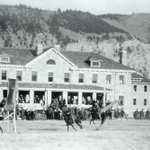
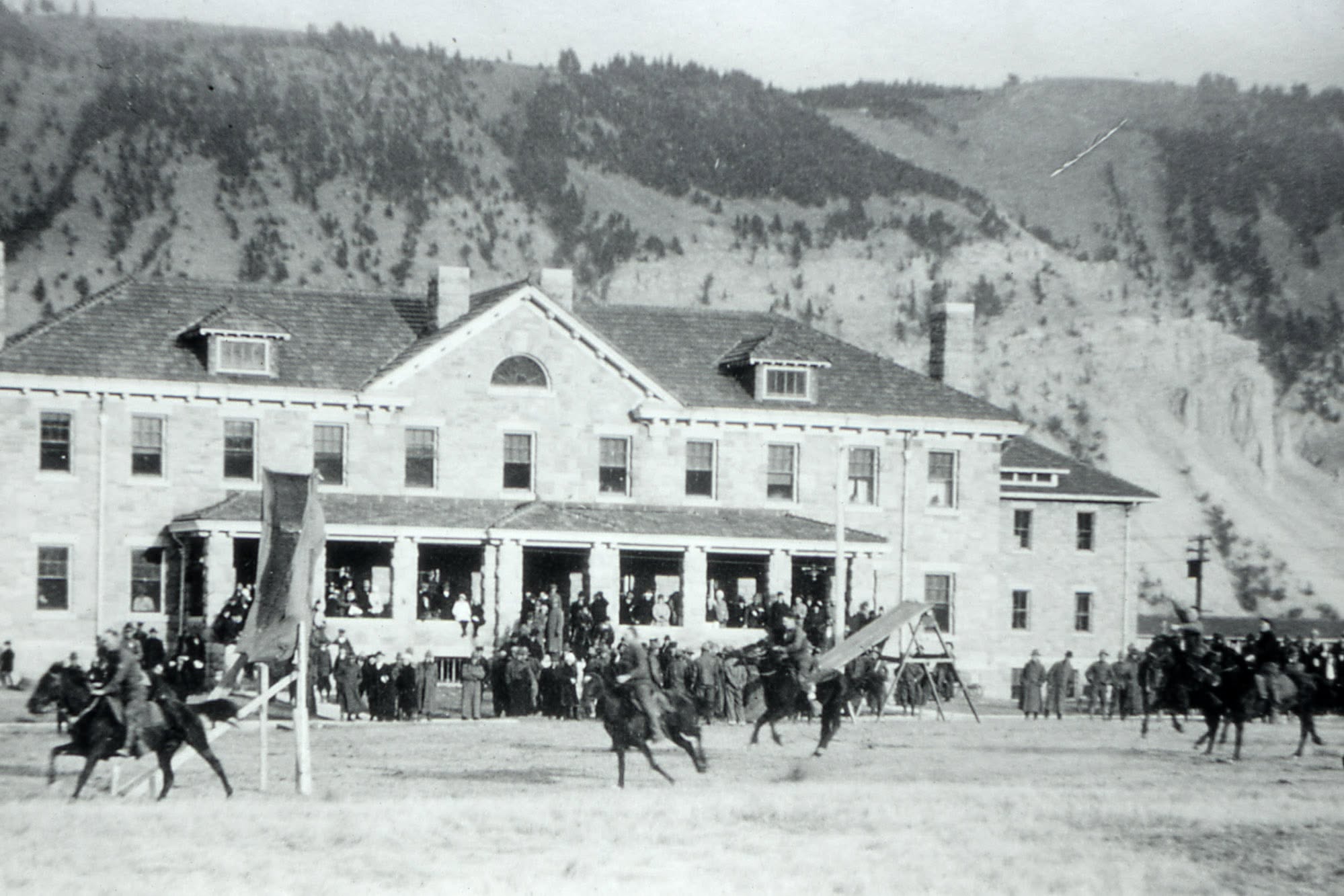
When Yellowstone was established in 1872, the National Park Service did not yet exist (and wouldn't until 1916). The park's first civilian superintendents lacked experience, funds, and a workforce to protect the park from exploitation. Eventually, Company M, First U.S. Cavalry of Ft. Custer, Montana Territory, answered the call to come to Yellowstone in 1886. This started the 30+ years of military protection of Yellowstone National Park. From the beginnings of Yellowstone to modern day, and all the time in between, we thank those who have served in the U.S. Armed Forces and continue to serve in the in a different uniform for the NPS. #VeteransDay Take a walking tour of the Fort Yellowstone Historic District or check out our virtual tour to learn more: nps.gov/thingstodo/yell-tour… Photos (from the NPS Historical Archive and Jacob W. Frank): 1. Mounted cavalry drill on Fort Yellowstone's Parade Ground in Mammoth Hot Springs (c. 1910) 2. View of buildings and roads of Fort Yellowstone in Mammoth Hot Springs (c. 1910) 3. NPS rangers speak to visitors at the Albright Visitor Center in Mammoth Hot Springs
12
56
1
486
18,992
It's #NationalBisonDay, and we've got some bison facts! 1️⃣ Bison are the largest land mammal in North America 2️⃣ Bison may be big, but they're also fast and can run up to 30 mph! 3️⃣ When a bison's tail hangs down and swishes naturally, the bison is usually calm. If the tail is standing straight up, watch out! It may be ready to charge. 4️⃣ Bison love a good salad and are typically foraging for grasses, weeds, and leafy plants for 9–11 hours a day. 5️⃣ Called wallowing, bison roll in the dirt to deter biting flies and help shed fur. 6️⃣ Yellowstone is the only place in the U.S. where bison have lived continuously since prehistoric times. 7️⃣ Bison have been integral to Tribal culture, providing them with food, clothing, fuel, tools, shelter and spiritual value. The InterTribal Buffalo Council, established in 1992, works with the NPS to transfer bison from national park lands to Tribal lands. #NativeAmericanHeritageMonth
56
278
26
1,895
26,004
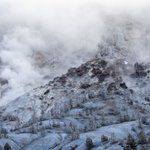
You've likely heard of geysers and hot springs, but what about fumaroles? Fumaroles (or steam vents) are the hottest hydrothermal features in Yellowstone, with temperatures up to 280 F (138 C)! 🔥 Because they are so hot and contain very little water, the water boils away before reaching the surface. Then, steam and other gases emerge from the feature's vent, sometimes making hissing or whistling sounds. Roaring Mountain is a wonderful place to enjoy the sights and sounds of fumaroles, especially on cooler days! 👉 Learn more about fumaroles at: go.nps.gov/YELLhydrothermalf… Photo (NPS / Ashton Hooker): Roaring Mountain on a chilly winter day.
14
49
4
488
13,900
Have you ever wondered how birds stay warm during winter? Chickadees grow feathers that can keep them up to 100 degrees F warmer than the surrounding air temperature. Waterfowl exhibit counter-current heat exchange in their limbs, which enables them to stand in cold water. Other adaptations include roosting with heads tucked into back feathers to conserve heat and staying active by retrieving food stored during the autumn months. 👉 Learn more at: nps.gov/yell/learn/nature/wi… Photos (NPS / Jim Peaco & Jacob W. Frank): (1) Mountain chickadee (2) Mallards on Alum Creek
16
76
2
666
16,947
Yellowstone National Park retweeted
One of the densest concentrations of geysers in Yellowstone can be found in the remote Shoshone Geyser Basin, on the west side of Shoshone Lake. We visit the area in the latest Yellowstone Volcano Observatory monthly video update. youtube.com/watch?v=tLzsNOh6… Shoshone Geyser Basin is one of the most spectacular in all of Yellowstone National Park. Located deep in the backcountry along the west side of Shoshone Lake, the area has one of the densest concentrations of geysers, second only to the Upper Geyser Basin (where Old Faithful is located). There are over 100 geysers in this region and 40 or 50 might be active at any given time. A trail takes you right by Minute Man geyser (always at the ready!), so it is quite easy to watch the frequent eruptions there. During the month of October 2026, the University of Utah Seismograph Stations, which monitors and operates the Yellowstone seismic network, located 66 earthquakes. The largest was a Magnitude 2.0. Throughout 2026, there has been very little change in ground deformation—neither uplift nor subsidence. Steamboat Geyser had minor activity. Echinus Geyser erupted on October 26. Giant Geyser, in Upper Geyser Basin, erupted on October 5, 13, and 22. Yellowstone volcano remains at normal, background levels of activity. @YellowstoneNPS
4
11
1
84
18,828
When Halloween is over, look for Dracula in a hibernaculum! A hibernaculum is a place like a cave, den, or burrow, where animals seek shelter for the winter. At least 10 of Yellowstone’s 13 species of bats are winter hibernators. In the greater Yellowstone area, there are few known hibernacula, though researchers have identified some within the park. More surprising is that researchers have documented bat activity in Northern Yellowstone throughout the winter, despite little insect activity, and freezing cold temperatures. #BatWeek
12
45
2
282
10,771
In a place like Yellowstone that has over 400 miles of roads, 1,100 miles of trails, and millions of visitors each year, unexpected things are bound to happen. When people need help, our team of first responders are ready! #NationalFirstRespondersDay
13
32
1
282
14,296
It's pumpkin season! 🎃 If you're looking for some pumpkin-carving inspiration, check out these stencils from our friends at @ynpforever. Carve a bison, geyser, wolf, or bear - or make up your own Yellowstone-themed pumpkin. Be sure to share your creations with us! 👉 View and download more stencils at: yellowstone.org/pumpkin-sten… Photos (YF / Steve Hickman): Bison stencil and carved pumpkin
12
63
6
442
17,671
Yellowstone National Park retweeted
Is Giant Geyser back??? ▶️ Giant Geyser is the second tallest geyser in Yellowstone National Park (behind only Steamboat Geyser) ▶️ Located not far from Old Faithful in Upper Geyser Basin ▶️ It can go many years between eruptions but then enter a period of frequent eruptions ▶️ The boiling water and steam plume can go up to about 200 feet (60 meters) above it's cone ▶️ Was very active in 2018-2019, but there were only single, isolated eruptions in 2023 and 2025 Giant Geyser sprang to life in summer 2026, with an eruption on June 26, and then settled into a pattern of having eruptions every 1-2 weeks during August, September, and October (most recently on October 13). Hopefully the geyser continues to put on a show throughout the coming winter and into next summer! @YellowstoneNPS
5
49
339
13,543
While monitoring bat populations this summer, park biologists found the fungus Pseudogymnoascus destructans (Pd) on 28 little brown bats from two colonies in the northern area of the park. This was the first detection of Pd in Yellowstone since our bat population monitoring began in 2019 with support from @ynpforever. Pd is a fungus that causes white-nose syndrome (WNS), a disease that has been killing millions of bats across North America. WNS damages bats’ skin and disrupts hibernation, causing bats to wake more frequently and deplete their fat reserves needed to survive winter. Pd spreads mainly through physical contact between bats or contact with contaminated surfaces in their hibernation sites. Although the fungus does not harm humans, people can spread Pd from their clothing or gear after visiting affected caves. Park visitors can help Yellowstone bat populations by reporting any odd bat behavior to a park ranger and avoiding direct contact with bats since they can also carry diseases like rabies. Though rarely seen, bats play an important role in ecosystems by controlling insect populations, pollinating plants, and dispersing seeds. 👉 Learn more about bat monitoring in Yellowstone at: go.nps.gov/YELLbats Photos (NPS): (1) A bat sleeping on a building overhang in the park; (2) Damage to a bat tail membrane, which is characteristic of the WNS disease.
6
24
2
166
12,338
(News Release) Most Yellowstone National Park roads and entrances close Nov. 1 for winter season. Oct. 31 is final day for visitors to drive most park roads. Read more at: go.nps.gov/26026
17
72
5
816
25,096
The National Park Service, together with its official nonprofit and philanthropic partner, @ynpforever, and @Blackstone Infrastructure portfolio company Tallgrass, announces the establishment of a $105 million Conservation and Stewardship Fund, creating a permanent source of support for the long-term stewardship of the world’s first national park. This is the largest single private gift in National Park Service history. The fund will direct resources toward three priorities essential to Yellowstone’s long-term stewardship: advancing conservation and research to extend the reach and impact of the park’s scientific work; enhancing access and visitor experience through investments in infrastructure; and expanding opportunities for Wyoming students and community members to experience Yellowstone. This latter effort will include the establishment of the Tallgrass WYld Yellowstone Initiative, named for the long-time Wyoming energy infrastructure operator with more than a decade of operations in the Cowboy State. The National Park Service will retain full authority over park management decisions, and projects supported through the fund will be consistent with applicable laws, policies and park priorities. Photo credit: Blackstone
8
42
6
274
25,366
Yellowstone National Park retweeted
A two-fer! This morning visitors were treated to Beehive Geyser and Lion Geyser erupting at the same time.
3
34
3
348
10,100
Help us welcome our new acting superintendent, Barclay Trimble, and deputy superintendent, Kristen Kosick! 👉 Learn more about our new leadership team at: nps.gov/yell/learn/managemen…
9
18
385
17,423
Yellowstone National Park retweeted
We finished up another successful season at the Yellowstone Tribal Heritage Center having hosted 33 presenters from 19 associated Tribes of Yellowstone. Thank you to all presenters, partners, and visitors who stopped by this year! #IndigenousPeoplesDay youtu.be/tJGJOQbayzE
5
20
7,300