

Physician-Scientist | TIME100 Health
United States
Joined February 2009
- Tweets3.4K
- Following935
- Followers31.7K
- Likes5.6K


Pinned Tweet
What happens to the heart when people stop GLP-1 drugs?
The short answer: nothing good.
New from our team: a study of 330,000+ people in @BMJMedicine
🧵

The FDA just ordered a warning on all GLP-1 drugs like Ozempic, Wegovy and Zepbound about a potential risk of “eye stroke” (NAION), a rare condition that can cause permanent vision loss.
In @ConversationUS, I explain the evidence and what to watch for.
theconversation.com/glp-1-dr…

Can Ozempic prevent cancer? Several large studies suggest it might. But the excitement is running ahead of the evidence.
In @ConversationUS, I explain what the evidence actually shows and why these studies are so easy to misread.
theconversation.com/can-ozem…

Paper here: jamanetwork.com/journals/jam…

A thread detailing the study results here: teapaw.org/zalaly/status/20512931…


Do GLP-1 drugs increase the risk of vision loss?
Specifically, a condition called NAION: a sudden loss of blood flow to the optic nerve that can cause vision loss.
We looked at this in 588,000 people.
The answer, in our new @JAMANetworkOpen paper, is yes. 🧵
jamanetwork.com/journals/jam…
GLP-1 drugs are associated with a 35% higher risk of NAION, an eye condition that can cause sudden vision loss.
About 6 to 10 extra cases per 10,000 users over 3 years.
The association is specific to NAION. No other eye conditions were affected.

I am watching the hantavirus outbreak carefully.
The probability of human to human transmission is low, but it is unwise to rule it out.
The ship sailed from Argentina where Andes virus, the only hantavirus with documented human to human transmission, is endemic.

What this means clinically:
The absolute risk is low. But NAION can be serious. Patients starting GLP-1 drugs should know to seek urgent care for changes in vision.
Clinicians should counsel patients on this risk, especially those at high baseline risk of NAION.
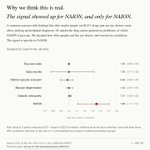
Why we think this is real, not a fluke.
Two alternative explanations to rule out:
1. People on GLP-1 drugs may see eye doctors more often and pick up incidental diagnoses.
2. GLP-1 drugs may cause general eye problems, with NAION just one of them.
We checked. Neither held up.
▸ Diabetic retinopathy: no difference
▸ Macular degeneration: no difference
▸ Retinal vascular occlusion: no difference
▸ Optic neuritis: no difference
▸ Eye-care visits: similar in both groups
The signal is specific to NAION.

But was the signal real, or just noise from the way we defined NAION?
We tested it three more ways:
▸ Diagnosed by an eye-care specialist: 8.7 extra cases per 10,000)
▸ Repeated NAION diagnoses: 6.4 extra cases per 10,000)
▸ Specialist-diagnosed plus repeated: 5.9 extra cases per 10,000)
Stricter definitions captured fewer cases, but the signal held up.
1
12
2,168
At 3 years, NAION was more frequent among people who started GLP-1 drugs:
▸ GLP-1 drugs: 39.1 cases per 10,000 persons
▸ SGLT2 inhibitors: 29.3 cases per 10,000 persons
That works out to 6 to 10 extra cases per 10,000. A 35% higher risk on GLP-1.

We used VA data to emulate a target trial.
588,168 adults with type 2 diabetes:
▸139,546 started a GLP-1 drug
▸ 448,622 started an SGLT2 inhibitor
▸ Followed for up to 3 years
3
12
3,620
Do GLP-1 drugs increase the risk of vision loss?
Specifically, a condition called NAION: a sudden loss of blood flow to the optic nerve that can cause vision loss.
We looked at this in 588,000 people.
The answer, in our new @JAMANetworkOpen paper, is yes. 🧵
jamanetwork.com/journals/jam…
Paper led by Yan Xie @Biostayan and Taeyoung Choi.
Full paper here:
bmjmedicine.bmj.com/content/…

For people prone to alcohol- or triglyceride-induced pancreatitis, GLP-1 drugs may actually reduce those risks.
What this means clinically:
The risk of drug-induced pancreatitis is real. It tends to happen in the first ~2 months of therapy.
Patients should be counseled. Clinicians should watch for it in the first few months after starting a patient on a GLP-1.
We also ran the analysis specifically for semaglutide (Ozempic), the most widely used GLP-1 globally.
Same pattern. No increase in all-cause pancreatitis at 1 year.
Higher risk of drug-induced and lower risks of alcohol- and triglyceride-related pancreatitis.
1
8
666
Timing matters too.
▸ Drug-induced risk is front-loaded; over 40% of the excess clusters in the first 3 months.
▸ Alcohol-related reduction is evident in months 4–6.
▸ Triglyceride-related reduction is strongest in months 10–12.
Risk early. Benefit later.
