

Partner @sequoia. Working w/ founders from idea to IPO & beyond: @airbnb @doordash @citsecurities @kalshi @clay @foundforbiz @Nominal_io @zipline
San Francisco, CA, USA
Joined March 2008
- Tweets3.7K
- Following354
- Followers152K
- Likes1.3K




Pinned Tweet
I have three posters behind my desk that guide my work. May they guide yours too.
NOBODY CARES, WORK HARDER.
Nobody cares how hard it feels or how unfair it seems. The world doesn’t pause for excuses or wait for perfect conditions. Progress comes from showing up when motivation is gone, putting in the work when no one is watching, and staying disciplined when quitting would be easier. Results aren’t built through attention or approval — they’re earned through consistency, effort, and patience. Keep working. Stay focused. Let your results speak louder than anything you could say.
DO HARD THINGS.
Hard things test you, shape you, and reveal what you’re made of. Growth doesn’t come from comfort — it comes from struggle, from showing up when it’s tough, and pushing past the point where most stop. Every time you take the harder path, you build strength, discipline, and belief in yourself. Keep going. The challenge is the path — and it’s where the best version of you is built.
1% BETTER EVERY DAY.
Small steps lead to big change. Each day is a chance to grow, improve, and move closer to your goals no matter how small the progress seems. Success isn’t about being perfect; it’s about showing up, staying consistent, and trusting in the power of steady effort. Over time, those 1% improvements add up to something extraordinary. Keep going, stay patient, and believe in the process — you’re building something remarkable, one step at a time.

Game theory helped AI beat top poker pros. But according to Noam Brown (@polynoamial), it isn't the path to general intelligence.
Noam built the first AI to beat top players at poker, and he still uses pokerbots to test new model releases. Libratus and Pluribus won with game theory. But when he turned to the more difficult game of Diplomacy, the AI had to learn how humans actually behave, and focus on thinking before acting.
I sat down with Noam at our No Limits pokerbot finals to talk about this and more, like how AI progress in games led to reasoning models, why today's models are jagged, and whether students should drop out in this AI wave.
And congrats again to Noam for winning the charity VIP poker tournament we hosted afterward. Fitting for the person who taught computers to beat humans like himself.
0:00 – Introduction
0:09 – Why poker: a perfect strategy nobody knew
2:12 – How Noam would build a pokerbot in 60 minutes
4:37 – From poker to Diplomacy: where game theory breaks on irrational humans
9:39 – A crisis of faith and the bet on reasoning over bigger pre-training
13:01 – The unlock: models that think before acting
14:59 – The centaur period, and what gamers and AI researchers share
18:13 – Audience Q&A: why models still can't build a great pokerbot alone
22:02 – Is chain of thought the right way to scale test-time compute?
23:42 – RSI and the case for dropping out to join the labs
27:54 – Lightning round: unsolved games and AI at the World Series of Poker


Alfred Lin retweeted

Things that have changed for CEOs in the AI era.
1 - Decisions have a shorter half-life, so you can’t punt.
2 - Your margin is the value you add on top of the tokens.
3 - The right person is worth their weight in gold. In this market, you find that person and you move fast.
4 - The founder has to steady the team through the euphoria and the panic. There is a lot right now.
Listen to the full episdoe with @dittycheria on his return to @MongoDB in the comments.
“The most powerful technology of our time should be built for the benefit of humankind.”
Congrats to the @anthropicai team on this milestone!
Technology is simply applied knowledge. Tools spread because they deliver real value: saving time, lowering costs, extending life, and expanding capability. Every solution creates new problems, but also new opportunities and new possibilities. We may not understand them for years or decades. But technology isn’t an external force acting on us. It’s an expression of human problem-solving.


Remarks from Anthropic CEO @DarioAmodei on our initial public offering:
My co-founders and I started Anthropic because we believe that the most powerful technology of our time should be built for the benefit of humankind.
Daniela and I lost our father to a disease that, just a few years later, became curable. I started my career in biology, hoping to help future cures come sooner. In the lab, I saw the vast thicket of complexity that scientists face when they’re trying to understand disease and develop new treatments.
So many of the scientific tools that can cut through that thicket—tools for gene editing, gene synthesis, controlling brain cells with light—started as pure ideas. In other words, they came from thinking. From intelligence.
Human intelligence has already made diseases like plague, smallpox, and polio history for most of the world. But progress on other diseases has been too slow for so many patients and their families. Going from a great idea to a treatment can take decades: it took many years from the first discovery of a strange repeating pattern in DNA to the approval of the first treatment for a disease using CRISPR.
Nature is full of these patterns. But we’ve had too little intelligence to decipher most of them; too few scientists, with too little time. Now we can build that intelligence. Whether it’s protein folding, drug design, cancer genetics, or clinical trial administration, scientists across many areas of biology and medicine are finding Claude can help them do their research in a fraction of the time it would’ve taken just a couple of years ago. I believe sufficiently powerful AI, working in concert with humans, could compress a century of scientific and medical progress into a decade.
I don’t want to get ahead of myself. At this point all we have are early results. Experiments and clinical trials will still take time. And although they involve slow and ponderous processes, I believe those processes can be substantially accelerated by AI. We hope that in the future fewer families miss a cure by just a few years.
Medicine is just a particularly vivid example, but there are many others. Our customers—the world’s most ambitious companies, nonprofits, and individual people—are already applying the intelligence we’ve built to stimulate economic growth; lift people out of poverty; protect democracy and free societies; even make everyday services like the DMV work better. We’re proud to work alongside them. And I’m extremely optimistic about what we can do together in the future.
At the same time, we have always been honest that this technology has very real risks. These range from misuse of the technology by individuals or nation-states, to economic disruption, to losing control of AI systems. We discuss these risks not because we think they are inevitable, but because we think they are avoidable.
Avoiding them depends on the choices made by the people building AI. There is a gigantic difference between how AI will go if we pay little attention to safety, versus how it will go if we are obsessed with safety. And an obsession with safety and with public benefit has been woven into Anthropic’s DNA from the start. From safeguards against biological and cyber risks, to alignment training and testing, to looking inside our models like an X-ray, Anthropic has pioneered methods for understanding and steering the behavior of AI systems.
There is much work still to be done, and the most difficult safety work lies ahead of us. The incredible talent of the company that has enabled us to build the most capable AI systems will need to be directed, even more so than it has already, towards double- and triple-checking that those AI systems are safe and secure.
And to state it unequivocally, we will pace the training and deployment of AI systems, taking as long as is necessary to have confidence that they are safe and will remain under human control. We will not bend to either business or political pressure. Today puts the company in a stronger financial position, and in doing so only strengthens our resolve to do the right thing.
If we can show it’s possible to make the right choices on safety and still build an incredibly successful company, others in our industry will be inspired to do the same. We call this a race to the top. When the race to the top is working properly, it doesn’t matter which company has the best models—everyone wins because everyone is building safely. The race to the top works best when driven from the front of the pack, and we fully hope and expect to do so, but the goal is to make the whole industry better, regardless of whether Anthropic is winning or losing at any given time.
The advent of machine intelligence is one of the seminal moments in human history, and we have a rare opportunity to shape it for the better.
This moment is bigger than any one company, or any one country. It will take all of us, working together, to ensure this technology goes well for us and the many generations to come. Starting today, we hope that you’ll join us on this mission.
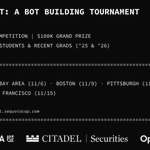
Incredible to see the creativity students brought to our pokerbot tournament. The future is bright. Congrats too to @polynoamial on showing that he's not only the best pokerbot builder, but also the best real world poker player at our charity cup after. Recap video below.

Bragging rights for best poker player in AI were on the line at the No Limit Charity Cup in SF.
An honor to have poker legends @JasonKoon and @Mister_Keating at the table.
Across from them: founders and competitors from @Etched, @Factory, @appliedcompute, @DoorDash, @fal, @trajectorylabs, @mercor, @getserval, @neros_tech, @hyperbolic_labs, @p0, @SableHQ, @simile_ai, @conwayinc, @OpenAI and @citsecurities.
Poetic that @polynoamial, the man behind the first superhuman pokerbots, took home the trophy.
All proceeds to @khanacademy. Thanks to all our competitors and partners. See you next year.
After setting a vision and inspiring others to join them, founders must then focus on setting an uncomfortably fast pace.
While it is an overgeneralization, the hull speed and standards of excellence do not improve from the first board meeting. The company's headcount grows, the business becomes more complex, processes creep, and coordination becomes a bottleneck.
Counteract it by:
1/ Running your weekly execution as speed workouts. Measure your inputs and outputs each week. Set the pace slightly faster each week.
2/ Breaking and reinventing processes. Process creep slows down companies. You complain about the long expense policy and employee handbooks; what processes have you created that are also guilty of this?
3/ Embracing and driving change. Think and act differently, and push your teams to achieve ambitious and near-impossible goals.


In the early days of Palantir, Garry asked Alex Karp why they were putting him up at the Mandarin Oriental. They were kids at a startup, Motel 6 would do.
Karp's answer: "you're going to go and talk to such and such general, or such and such VP of some Fortune 500. And you're going to show this incredible software you've built. Then as you go out the door, they're going to make small talk and ask how long you're in town. And if you say you're staying at the Motel 6, that says something about what Palantir is. And they're going to think this is Motel 6 software. And guess what: Palantir is not Motel 6 software. Palantir is Mandarin Oriental software."
Every detail tells the customer who and what you are. The best founders and operators know that and obsess over the details. If you're pitching Walmart or Costco, you should take a Greyhound bus and sleep on a friend's couch.
Garry covers a lot more in this episode, like Big Tech vs startups, how his upbringing made who he is today, and how agents evolve from here. Worth a listen.

Was a true honor to sit down with @WalterIsaacson for The Builders podcast out this morning
We are at an unusual inflection point in history and there are so many reasons to be excited for the future with superintelligence almost here

Think your company has the best poker players in tech? Come prove it this weekend. We have a few final seats for our charity poker event this Sunday, November 15. All proceeds go to @khanacademy. Thanks to our partners @OpenAI and @citsecurities.

Who’s the best poker player in AI?
We’re about to find out. The No Limit Charity Cup is Sunday, 11/15 in SF. $50K per seat.
Founders and top players from @Etched, @Factory, @appliedcompute, @DoorDash, @fal, @Profound, @getserval, @sailresearchco, @conwayinc and more go head to head, with proceeds going to @khanacademy.
Think you’ve got what it takes? We still have a few seats for partner companies to send a delegate to compete. Want to come watch? DM me. Bragging rights on the line.
Thanks to our partners: @citsecurities @OpenAI.

Alfred Lin retweeted

@crosbylegal has secured a $5m malpractice insurance policy for our agents. As far as we know, this is the first of its kind.
9 months ago we began to notice our agents were getting extremely capable. In some cases, they did better work than our lawyers.
We are a law firm. We needed to invent a safe way for our agents to do client-facing work without human oversight. It took a lot of work, but this is it.
As soon as the policy went into effect on Nov 3, we removed lawyer oversight from any task that doesn't legally require licensed attorney oversight - what we call "paralegal tasks."
This is ~20% of our work. It frees up our lawyers to focus on what they're best at: thinking, exercising judgment, advising our clients.
This is just the beginning. Once regulations change, we see no reason why our agents can't do excellent legal work too.
Read more in the NYT: nytimes.com/2026/11/07/busin…

Defense, space, energy, and robotics are all pulling hardware toward software-speed iteration. The teams winning in these markets ship in hours, days, and weeks, not the months and years hardware has traditionally taken.
Testing is where that pace breaks down. Test data lives in too many places and gets stitched together by hand. @nominal_io is the modern stack for this. They combine test automation, telemetry, and analysis in one place, from the first prototype through production and into operation.
Customers’ behavior is the best evidence. Nominal was recently selected for a $71M STRATFI, and won a delivery order award through PAE’s Rapid Capabilities Cell to speed up integration and testing of Castelion’s Blackbeard on the F/A-18. These are programs where test speed decides how fast a capability reaches the field.
Congrats to @CameronLMcCord, @jrshoch, @brycestrauss and the whole team on the Series C. We’re excited to keep partnering with them.

Nominal just raised $240M at a $3B valuation.
Engineers today are building some of the most ambitious machines humanity has ever seen. They should have AI that’s purpose-built for them.
We started Nominal with a simple observation, that hardware teams needed better ways to work with test data and make decisions from it. Over the past four years, we’ve built software that understands the complex realities of hardware development.
Now we’re building the Hardware Intelligence Platform that gives engineers increased visibility into complex physical systems, helps them make better decisions, and ultimately gets their products into the real world faster. It brings together the systems, data, intelligence, and applications hardware engineering requires to meet the AI moment.
Our Series C was led by @Lightspeedvp and co-led by @Insightpartners, with participation from Lux Capital, Sequoia, General Catalyst, Founders Fund, Avenir, Lockheed Martin Ventures, Salesforce Ventures, M13, DE Shaw Ventures, Deployment Capital, Avra, Red Glass Ventures, Carpenter Capital, Audacious, PSP, Overmatch Ventures, XYZ, Haystack, and Brave Capital.
Thank you to our customers, partners, team, and every hardware engineer building on Nominal.
Read more here → nominal.io/blog/series-c

The next decade won't reward tourists. It will reward people who combine audacity with discipline. Who understand that technology cycles come and go, but that building enduring companies requires clarity of purpose and consistency of execution.
Venture has always been about backing outliers. That hasn't changed. If anything, it matters more now.
Let's go! The shipping velocity at @Kalshi continues to impress.

Single stock perps (SSPs) are here. And they're a truly great product. You don’t need to pay rollover fees like with futures, they’re simpler to trade than options, and you can go short just as easy as you can go long.
This is one of the most consequential products we’ve launched and I couldn’t be more proud of the team that worked for over a year to bring them to life. Just this morning, since the stealth launch, our users traded over $300m.
Grateful to be the ones bringing these to America in a regulated way 💚

Prediction markets are truth machines.
"And when people consolidate their knowledge together, something remarkable happens: millions of individual perspectives become a signal that we all can learn from."

Last night, the power to decide what America sees changed hands.
I have spent a ton of time in DC over the last few months. The elites were certain the markets were off. I heard many variants of “no chance markets are right about X” and “I’ve been in politics for a decade. ‘These people’ don’t really know much.”
Last night, ‘these people’ beat the elites.
Prediction market favorites won 479 of the first 487 races. That’s 98%.
The elites live in a bubble. They theorize, write, ideate, and mistake credentials for an understanding of lives they’ve never lived. They don’t see and feel what the everyday man, on the ground, sees and feels.
Knowledge is not exclusive to the elites but scattered across millions of people.
Someone knows their hometown better than any national pundit. Someone has followed a local race passionately for months. Someone has followed a local race dispassionately for months. Someone notices a shift in their community before it makes the headlines. Someone is shaped by an incident at work. Someone is shaped by what’s getting harder or easier for their families.
Each holds a piece of the picture that no expert can see in full.
And for the longest time, that knowledge had no way to reach the rest of the world.
For generations, election night meant turning on the TV and waiting for a handful of people to tell you what happened.
Prediction markets change that.
You don't need a title, a large following, or an editor to publish you. All you need is a perspective and the conviction to back it.
That changes who holds power over information.
Anyone can see the market. Anyone can contribute to it. Anyone can question it. No title gives you the final word. No gatekeepers can filter your view.
Sometimes the signal can be wrong. But anyone can challenge the consensus and improve it.
And when people consolidate their knowledge together, something remarkable happens: millions of individual perspectives become a signal that we all can learn from.
Over the last few months, the people showed up on Kalshi to tell the world what they were going to do.
Last night, the megaphone was passed to them.



As an immigrant, Election Day is the day I am most proud to be an American.
Go vote and be counted. 🇺🇸