

We help companies get more valuable patents.
Joined March 2025
- Tweets77
- Following0
- Followers9
- Likes0




The USPTO has changed how examiners weigh Section 101 eligibility for AI inventions. More of these applications are now clearing the eligibility bar on the merits. The shift traces to Ex parte Desjardins, where the appeals panel cleared an AI training method under Section 101. The USPTO built new examiner guidance and training around that ruling this year. Here is what changed and where it stops short of the courtroom. What are you seeing on AI patents lately?
Read the full breakdown: na2.hubs.ly/H08lQyg0

We are at IPO Toronto next week, booth 316. If you are attending, we look forward to seeing you. Stop by and say hi!

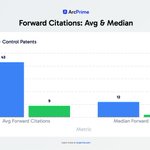
Asserted patents have shorter granted claims. But, do they also have shorter filed claims & fewer words added during prosecution? Turns out… yes, they have shorter filed claims (12 words shorter), and no, they add around the SAME number of words during prosecution!
The data shows people fought harder for asserted patents than non-asserted patents, but not for a long time. That is, asserted patents faced more Office Actions but 90% of both asserted and non-asserted patents finished within 4 Office Actions.
Another interesting finding: interviewed cases added MORE words than uninterviewed cases, yet asserted patents were interviewed more often.
So, if you want to mimic asserted patents, the takeaway is:
- Start with shorter filed claims
- Fight for claim scope but don't have too many Office Actions
We compared 4,000 asserted non-continuations with 4,000 control patents. Full report with more details here: na2.hubs.ly/H07M7jM0

Picking the chart that leads a negotiation takes a finer read than High, Medium or Low.
Every claim chart in ArcPrime now carries a 0 to 100 score next to its badge. The number is built from the logic behind each element mapping and the quality of the evidence found for it, weighted toward the claim language that carries the point of novelty.
Two charts that share a badge rarely share a score, and the order inside a band is the order assertion prep needs.
How the score is calculated: na2.hubs.ly/H07F3SZ0
Each new task that touches a patent starts by reestablishing its point of novelty.
ArcPrime's AI summaries now name the point of novelty and anchor it to the exact claim language. The finding travels with the patent across claim charts, family comparison, continuation recommendations and office action responses.
Reviewers can overwrite any element in their own words, and regeneration never touches an edited version.
How the extraction works: na2.hubs.ly/H07F3LW0
A filing recommendation that names a technology category answers a different question than the one a budget review asks.
Every ArcPrime account now carries a product taxonomy. The segments come from the company's own public filings, with product lines inside each and cited revenue on every node. The tree regenerates twice a year, so launches and divestitures show up on their own.
New disclosures get weighed against the product tree. Each recommendation states the product line the invention protects and that line's revenue, framed as core or adjacent to the business.
How it changes filing decisions: na2.hubs.ly/H07F3VV0
In August, we released several features that connect patent decisions more closely to business products, their revenue, and overall ROI.
🎯 Product Taxonomy — Connect filing decisions to revenue
See which products and revenue each invention could protect. ArcPrime builds and refreshes your product taxonomy from cited company sources, then uses it in filing recommendations.
🧠 Crucial Elements — Stop rereading claims from scratch
Every AI summary identifies the point of novelty and anchors it to the exact claim language. These elements carry across claim charts, family comparisons, continuation recommendations, and office action responses.
⭐ Claim Chart Scores — Rank your strongest enforcement opportunities
Every claim chart now has a score out of 100 based on its mapping logic, evidence quality, and coverage of crucial claim language.
💡 Continuation Scores — Compare continuation opportunities consistently
Every continuation recommendation now has a score out of 100 across claimable headroom, market coverage, and portfolio fit. Adjust the weights to match your filing strategy.
🔎 Portfolio Search — Find patents using business language
A new reranking system understands long, conceptual searches—even when your query does not use the words found in the patent. The same improvement powers portfolio chat.
⚖️ Patent Licenses — See encumbrances before any patent decision (license, sale, or pruning)
Store license agreements, grants, amendments, and terminations in ArcPrime. Each patent now shows its attached encumbrances and versioned agreement history.
⚙️ Trademark Status Sync — Keep records current automatically
Trademark statuses now refresh automatically from the USPTO and EUIPO, reducing outdated records between reviews.
See everything we’ve shipped: na2.hubs.ly/H07zsR80
Here's when you should not buy patent software. Including ours.
For a lot of solo counsel and small teams, a shared Sheet tracks a handful of matters just fine. Deadlines, statuses, a couple of annuities. If that's you, keep it. You don't need us yet.
The trouble starts in boring ways. Two people edit the same row and one person's changes get overwritten. A due date moves and the change never makes it into the Sheet. Six months later nobody can say who changed what, or why. None of it shows up until it costs you a date.
So we put the whole comparison in one place. Spreadsheet vs legacy patent management software vs ArcPrime, side by side, with the cases where the spreadsheet still wins left in. There are two short self scores you can run in about two minutes. If you come out fine, stay on the Sheet. We mean it.
ArcPrime is built for when the Sheet gives out. One shared source for the portfolio, deadlines that update themselves, and a record of every change, so a moved date or an edited row never goes missing.
Run the two minute self score here: na2.hubs.ly/H07s4Qp0
Five real patent claims went in front of their owners, and today you get to second guess every one of them.
That's the whole game in Renew or Adieu, the daily patent game from ArcPrime. All you get is the claim language and two calls: renew or say adieu. The owners already decided. You find out how often you agree with the people who paid the fees.
Agreeing with all five is harder than it sounds.
Same puzzle for everyone, no login, see how your reasoning stacks up in three minutes. Today's five are live at eu1.hubs.ly/H0xmF4h0

Every year, patent owners make thousands of keep or kill decisions nobody ever sees.
We think those are the most underappreciated judgment calls in IP. So we made them a daily game.
Renew or Adieu, from us at ArcPrime, puts five real patent claims in front of you each day and asks the only question that matters: renew, or say adieu. The owners already made their call. After you decide, you find out if you agree. Same puzzle for everyone, compare your reasoning to your friends, no log in required.
Play today's puzzle: eu1.hubs.ly/H0xmF2l0
In July we shipped 7 major updates, all geared to make in house counsel's day run smoother!
✂️ Keep Score for Pruning
🧠 Workspace Listener
🎯 Screen Your Portfolio Against Any Document
🏢 External Portfolio Analysis
🔍 Quick Research
✅ Notes on Office Action Responses
🛠️ Case Record Upgrades
Read more here: eu1.hubs.ly/H0xv7Hz0
A few things break most often when an IP portfolio moves systems, and they stay hidden until a deadline forces them into the open.
The first is patent family relationships. A portfolio is a web of parents, children, continuations, and priority claims, and much of the value lives in those links. A naive import can move every record across and still quietly sever the connections between them. Nothing looks missing until someone goes looking for a tie that is no longer there.
The second is everything around the records. Case statuses have to land exactly right, because a matter that imports as expired when it is really active can hide a live deadline. Along with workflows, and the logic that fires the right notification when you decide to file outside the US and keeps the trail of correspondence with outside counsel. Move the records without that logic and you have a database, not a docket.
The third is validation. Once the data is in, how does your team actually know it's correct? A clean looking record is not the same as an accurate one. The only real answer is to check the migrated data against an authoritative source. For US filings, that means the USPTO, not the export.
ArcPrime built its white glove migration so families stay intact and every record is validated against the USPTO or local authority for non US based filings before cutover.
Read the full teardown is here: eu1.hubs.ly/H0wG1jw0

Ever wonder how good you are at predicting the future? Try Hot or Not, patent edition: Renew or Adieu!
It's a Wordle-style game where you read a claim and guess whether that patent was useful enough to end up litigated, sold, or highly forward-cited. Everyone’s cheating a little, since every patent in there is at least a decade old, so you know more than the portfolio manager who had to make that same call when the maintenance fee came due. I still found it pretty hard, even with 10+ years of hindsight.
Real life is harder. As I’ve met more venture capitalists after starting a company, patent portfolio managers have quite a bit in common with them. We both have to bet on which technologies will be most valuable 5-10 years out, and those bets have power law outcomes. Only a small percentage of the portfolio will ever lead to litigation, licensing outcome, or some other tangible business use. There is almost no in-between victory.
You also don't find out whether you were right until years later. Not many jobs make you build that muscle, which makes it interesting, in a slow burn kind of way.
PS. definitely don’t use AI to find the easter-egg in the game!
eu1.hubs.ly/H0x9_Qt0
Portfolio size is not portfolio strength.
Our team studied five years of US patent litigation, more than 6,500 cases across district court and the Federal Circuit, and compared the asserted patents against a control group granted in the same priority windows.
From the ArcPrime data study featured in IAM's Q2 Special Report:
"Patent strategy has long been a discipline of accumulation. The data from the last five years suggests it is becoming, increasingly, a discipline of design."
Portfolio decisions get made top down: filing count, spend, geographic split. Licensing, deterrence and assertion get made bottom up, in the design of individual patents over a decade or more.
That gap, between how portfolios are run and where leverage actually comes from, is what the study is about.
eu1.hubs.ly/H0x2DjG0
Switching IP systems feels dangerous because of how often it goes wrong. But the failures are not random. They follow a pattern, which means the fix follows one too.
1. A migration done right is a known set of steps in the right order.
2. The data comes off the legacy system.
3. It gets reconciled so the fields and histories map correctly.
4. It gets validated against the USPTO so the check is against the registry and not the export.
5. Family relationships are confirmed to hold.
6. Only then does the team cut over.
Correctness is checked while there is still time to fix it, not discovered after the old system is gone.
ArcPrime built its migration exactly this way, and ArcPrime's own engineers run it for your team, free, as a full white glove migration. No migration fee, no heavy lifting on your side. Because the reconciliation and validation are built into the process, a team is usually live in weeks.
See how the whole thing works: eu1.hubs.ly/H0wBYx70
Our team studied five years of US patent litigation, more than 6,500 cases across district court and the Federal Circuit, and compared the asserted patents against a control group granted in the same priority windows.
NPE activity in healthcare has grown roughly 13% a year over the last five years. In telecom it is down 24%.
From the ArcPrime data study featured in IAM's Q2 Special Report:
"NPE activity in healthcare is growing at roughly 13% compound annual growth rate over the past five years; in financial services, around 9%."
Semiconductors are down 15% over the same period. Operating-company assertion is climbing about 25% a year in automotive and financial services, and falling 27% in pharma and 16% in biotech.
Most portfolios were built to defend the sectors where assertion is now shrinking. The five-year trend tells you more than the snapshot, and the snapshot is usually all a portfolio review looks at.
eu1.hubs.ly/H0x2Dqk0
A large portfolio only helps in a negotiation once you know which patents read on the product across the table. ArcPrime scores your assets by infringement likelihood against a target product, each with a rationale you can defend. eu1.hubs.ly/H0wL6980

Our team studied five years of US patent litigation, more than 6,500 cases across district court and the Federal Circuit, and compared the asserted patents against a control group granted in the same priority windows.
Individual inventors write the longest claims of any plaintiff group, at a 213-word median. Universities write the shortest, at 122.
From the ArcPrime data study featured in IAM's Q2 Special Report:
"The people who litigate most often write claims that are easier to map onto an accused product, not harder."
NPEs and operating companies both land around 150 words. Those are the two groups in court most often, and they drafted their way to the same habit from opposite directions.
Repeat litigants learn to write claims that read cleanly onto a product, because they see what happens when they don't. Groups that litigate once in a while never get that feedback.
eu1.hubs.ly/H0x2Drp0
Most in house patent teams are not staying on their legacy IPMS because they love it.
They stay because moving the data off it scares them more than the daily friction of using it. The objection is almost never price. It is migration. Everyone has heard the same story: a six month project, a vendor that went quiet, a portfolio that came out the other side with gaps nobody caught until a deadline slipped.
So the system your team has outgrown keeps running, because the fear of the move outweighs the pain of staying.
That fear is worth a second look. The parts that go wrong in a migration are not mysteries. They are a known set of failure modes, and every one of them is avoidable when the work is run in the right order by people who do it for a living.
ArcPrime's new teardown says the scary parts out loud, then walks through what a migration looks like when it is done properly.
Read it here: eu1.hubs.ly/H0wFYxK0
When the GC asks what the patent portfolio is worth, the honest answer often takes a spreadsheet rebuilt by hand the night before. With ArcPrime you ask in plain language and get board-ready reports and dashboards, with the portfolio mapped to revenue. eu1.hubs.ly/H0wL9LW0
