

Joined March 2019
- Tweets393
- Following537
- Followers3K
- Likes3.2K



Pinned Tweet
🚨 A paper for those interested in the intersection of trade and political economy
So happy 🥳


This figure captures an interesting finding in our paper:
Conventional trade credit is “deliver now, pay later.”
Yet for many deferred-payment transactions, *delivery 🚚 waits for full payment*
Embedding this in a business-cycle model turns liquidity shocks into payment-chain crises.


On this note; we have updated our paper on the local effects of data centers.
We now have a 🚨new instrument for data center development🚨 leveraging historical determinants of fiber connectivity and foreign growth in large scale facilities.
Effects are substantial, and qualitatively align with those of our earlier draft.
teapaw.org/nberpubs/status/205611…


A few (personal) thoughts on reading empirical AI papers on the economy.
Economists have gotten used to reading papers with super clean identification, arguing about the validity of an instrument, making sure parallel trend assumptions are satisfied. This is what gets you into a top journal, and it is *very* important research (no question here). But it also takes years and sometimes decades to get these types of papers right---people often don't find a good instrument to answer a specific causal question decades after the natural experiment. We will eventually have this type of research for AI as well, and it is absolutely necessary.
But right we also need signals *right now*, even if they are noisier than what we are used to. We need papers where we can trust that researchers did their best methodologically, while at the same time acknowledging that the space is moving way too fast to wait for perfect identification. This will allow us to accumulate enough signals, coming at the same question using different angles, for example, to say "yes, X is likely happening in the economy".
The AI exposure and early career hiring papers are a good example of this. There is no silver bullet paper with super clean identification. But at this point we have several independent teams reaching the same general conclusion, enough where we can say "there seems to be a slow down in AI-exposed, early career hiring."
🚨Send us your best work!🚨
Co-organized with Mark Aguiar and Manuel Amador
The conference will bring together work on emerging markets: trade policy, fragmentation, debt, FDI, k-flows, crises, x-rates, climate risk
And...it’s in Costa Rica in December🌴
Deadline Sept 8th

Open Call for Papers: Emerging Markets: Navigating a Fragmented Global Economy Conference, December 10–11, 2026 — San José, Costa Rica. Submissions due 11:59pm ET on Tuesday, September 8, 2026 nber.org/calls-papers-and-pr…
🚨 New NBER WP 🚨
We study how new product varieties enter markets.
When consumers discover and try new products via direct-to-consumer imports, does that information remain confined to those shoppers, or can it spread and ultimately reshape what is available locally?
1/N
Social ties spread demand for new products; retailers learn from early buyers and expand offerings, amplifying access to global varieties through local demand spillovers, from @dargente05, Esteban Méndez, and @dianavanpatten nber.org/papers/w35104

I greatly benefited from the program and strongly recommend it 💯

PhD students interested in trade (broadly construed): Come visit Dartmouth for a term next year! Applications for the '26-27 Globalization PhD Fellowship are now open. Apply here: globalization.dartmouth.edu/… @DartmouthEcon @dartmouth
13
2,987
Nice write-up on this paper: insight.kellogg.northwestern…
"Just how did companies like IKEA and Starbucks come to grow so much more quickly than their competitors? ...By reusing product parts, knowledge, and relationships across different product lines and locations"

Developing and testing a theory on firm size and scope, centered on standardization. Standardized firms have higher marginal returns to scale, making them responsive to demand shifts, from @dargente05, @sarapfmoreira, Ezra Oberfield, and Venky Venkateswaran nber.org/papers/w34160

In print @ScienceMagazine!

In 2021, El Salvador became the first country to make #bitcoin legal tender.
However, preference for cash and privacy fears deterred the widespread adoption of bitcoin as an everyday currency there, a new Science study finds. scim.ag/5kN

Using only a restaurant, tell us where you went to college.
@castrovincenzi @jpvasq @alonsoalfaro @Montrose1000


Welcome, @dargente05! :)

Introducing the nine new faculty, in marketing, economics, organizational behavior, finance, and operations management, who are joining #YaleSOM today. Welcome!
yalesom.io/3NALM6s

🚨Call for papers🚨send us your work on history, trade, and development!
Workshop: Towards Sustainable Growth @RIDGE_uy
Co-organized w/@M_Giorcelli @GChiovelli @felipev84

2023 RIDGE DECEMBER FORUM
Workshop on Towards Sustainable Growth
Submit your paper: ridge.org.uy/2023-december-f…

Thanks @andyvalencianoy for joining us; not everyday we have the privilege to have a former trade minister share his insights, experiences, and vision of the path forward with us! 🇨🇷

Grateful for the invitation to give a lecture at @YaleSOM!
I shared the lessons of how Costa Rica has been developing the skills and talent to attract foreign direct investment, diversify its exports, and transition towards a knowledge based economy. 1/2


*UPDATED* version of our paper: “Are Cryptocurrencies Currencies? Bitcoin as Legal Tender in El Salvador,” w/@alvafer64 and @dargente05.
This new version includes blockchain data on all Chivo transactions! #Bitcoin #Crypto
nber.org/papers/w29968

After today’s news about $UST losing its peg, this seems like a timely retweet.
Can cryptocurrencies be a medium of exchange?
@alvafer64 @dargente05
Bitcoin is legal tender in El Salvador and its adoption has been heavily subsidized, but only about 10% of households and firms use it, from Fernando E. Alvarez, @dargente05, and @dianavanpatten nber.org/papers/w29968

Also timely:
Discussion of the paper today in the Financial Times
@FT:
ft.com/content/88a1facd-bb37… #Bitcoin

Thank you very much, Steve! Happy to be part of the ITI program and looking forward to many fruitful interactions!
This Post is from an account that no longer exists. Learn more
2
32
Join us 🚨this Friday🚨 for @RIDGE_uy's "Towards Sustainable Growth" Workshop!
Exciting lineup w/papers on technology, mobility, institutions, conflict and displacement.
Keynote lecture by @D_A_Irwin on trade reforms and history!
Register: zoom.us/meeting/register/tJw…
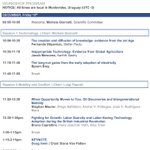
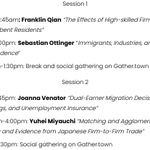
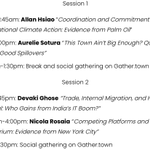
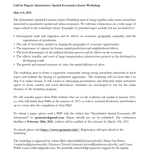
Program 👇


RIDGE Virtual Forum
You are invited to participate in the upcoming
Towards Sustainable Growth Workshop
Dec 10
Reg:
zoom.us/meeting/register/tJw…


Stelios also gives very thoughtful comments and is genuinely curious 👇

Why do governments that have recently defaulted pay higher yields on their debt than fundamentals indicate?
Stelios Fourakis, a UMN job market candidate, argues that governments that run up their debt before defaulting reveal them to be “irresponsible.”
steliosfourakis.com/home

Costa Rica has become the first country in the world to make Covid-19 vaccinations mandatory for children 🇨🇷

Costa Rica makes covid-19 vaccination mandatory for children aged 5-11 bbc.com/news/world-latin-ame…

23