

Agentic infra for the future $TRUTH NEW: Build your Future agent teams in beta
Joined February 2011
- Tweets446
- Following396
- Followers249K
- Likes80




Pinned Tweet
The first 100 users can start building their Novas...
buildyourfuture.app/


How a 43 forecast gets made.
1. Ontology: decide what kinds of entities and relationships matter.
2. Knowledge graph: extract them from the sources. House run: 42 entities, 24 relationships, 79 sources.
3. Agent profiles: every entity becomes an agent with its own knowledge and stance.
4. Simulation: they argue across rounds.
5. Synthesis: 24 vote. Probability, report, dissent.
Nowhere does it say "ask the model what it thinks".

Surowiecki's 4 conditions for a smart crowd: diversity, independence, decentralization, aggregation.
Markets break independence the second they show you the price. Everyone anchors.
A swarm can be independent by design. Then you aggregate.

One giant model: one prior, one blind spot, scaled.
42 agents: 42 priors, different sources, each holding its own stance.
Intelligence isn't the size of the brain. It's the quality of the argument.
Most AI "forecasting" is one model asked the same question 10 times.
That's not a crowd. It's an echo.
Consensus is an output, not an input. You earn it by letting agents disagree first.

Comment window on event contracts as swaps closes today.
Our comment, free: regulate the price all you want. Nobody's regulating whether the price means anything.
Utah wants Kalshi's founders in court. The CFTC wants Utah in court.
Everyone's fighting over who gets to run the table. Nobody's asking whether the odds are any good.
teapaw.org/WALLACHLEGAL/status/21…

BREAKING: Utah has filed felony and misdemeanor criminal charges against prediction-market platform Kalshi and two of its top executives, Tarek Mansour and Luana Lopes Lara. abc4.com/news/local-news/uta…

We score polymarket.com as a source like anyone else.
63% truth across 329 resolved claims. Reuters 75%. CNN 73%. Google News 64%.
No source gets trust for free. Not even the one everyone quotes.

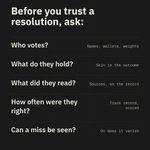
Before you trust a prediction market resolution, ask five questions.
1. Who votes? Names, wallets, weights. Bitquery found the top 9 UMA wallets hold 56.3% of the weight.
2. What do they hold? If voters have money on the outcome, it isn't a ruling. It's a position.
3. What did they read? A resolution with no sources is an opinion with a bond attached.
4. How often were they right? One wallet won 80 of 80 disputes in a month. Perfect records should worry you, not comfort you.
5. Can a miss be seen? Or does it get averaged into a "99.8% accurate" ad?
If the answer to any of these is "trust us", you don't have an oracle. You have a judge.
43 answers all five on every forecast: agents, stances, sources, track record, misses.

29 lawsuits over one Polymarket market. Now in federal court in Manhattan.
The token vote went 98.6% NO. The rules got a "qualification" after trading started.
When a resolution needs a lawyer, the oracle already failed.

A soldier allegedly put $400K on Polymarket using info about the Maduro capture. The court just let the case go ahead.
Markets don't only aggregate wisdom. They aggregate whoever knew first.
Ask where the number came from. Every time.
teapaw.org/BLaw/status/2117320884…

An anticipated trial against a US soldier accused of using classified information about the capture of Nicolás Maduro to reap $400,000 on Polymarket would probe how far prosecutors can go to crack down on insider trading in the skyrocketing industry. news.bloomberglaw.com/securi…

Top 9 UMA wallets: 56.3% of the vote weight. They agreed on 483 of 489 questions.
That isn't decentralized truth. It's a committee with a token.

4 wallets disputed 46 markets on one Montevideo Wanderers match. In 42 minutes. Lost every single one. Around $23K in bonds gone.
This is the machine that decides who gets paid.
One wallet. 80 Polymarket disputes. 80 wins. 72 of them ended as "too early".
A perfect record isn't a healthy oracle. It's a referee.

Simple test.
Does the platform make more when you understand the bet, or when you don't?
Answer that and you know what it is.
teapaw.org/guilleflorvs/status/21…

Kalshi's CEO was asked: "Why isn't Kalshi a casino in your pocket?"
Tarek Mansour, CEO of Kalshi, answered in three points:
1. When customers lose on Kalshi, they lose to other customers. Kalshi never takes the other side
2. Kalshi charges about 0.8% per trade, similar to the New York Stock Exchange
3. Nasdaq also wants more volume, and it doesn't sort users into winners and losers
That distinction is the whole legal fight. 44 states call prediction markets a new form of casino, and Utah just filed criminal charges against Kalshi and its founders.
Kalshi made the same case to Sequoia in 2020, starting from slide 1: "Trade on event outcomes."
Full breakdown here:
productmarketfit.tech/p/sequ…

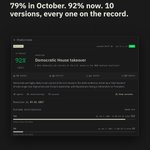
79% on Oct 14. 92% on Nov 3. 10 versions, every one dated.
The number moved because the evidence moved. 79 sources. 42 entities. 24 agents voting.
A market price tells you what people paid. This tells you why.

V2 adds Chainlink next to UMA. Fine. Two judges instead of one.
Still judges. Still deciding after the fact who was right.
The question nobody asks: who scores the judges?
teapaw.org/PolymarketDevs/status/…

