

We turn data into knowledge and create free subnational development indicators
Joined November 2015
- Tweets2.2K
- Following222
- Followers2K
- Likes1.6K






On 12 and 13 March, Radboud University hosted the 15th annual DuDe workshop, the Dutch Development Economics Network to bring together development economists from Dutch universities, to network and discuss recent research

2
104
New research from Smits & Huisman presents the Subnational GDL Vulnerability Index (SGVI) for 1,260 regions in 118 Low- & Middle-Income Countries mdpi.com/3551166 #SustainableDevelopment #ClimateResilience #DataForGood @MDPIOpenAccess

1
137


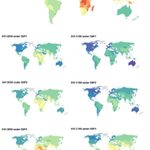
Our latest article “Projections of climate change vulnerability along the Shared Socioeconomic Pathways 2020–2100” has just been published in Nature Scientific Data. Explore it here: rdcu.be/eDpGq
@EUClimateAction @UNFCCC #climate

1
1
145
The GVI Projections Database, projections of socioeconomic vulnerability to climate change and natural disasters for 180 countries for 2020–2100, is freely available on globaldatalab.org/gvi

95
Congratulations to Lamar for publishing this article in the European Journal of Political Economy.
The Subnational Corruption Database developed by Lamar Crombach and Jeroen Smits can be found on the GDL website globaldatalab.org/governance…
#CORRUPTION @HDRUNDP @worldbankdata

Next up in the European Journal of Political Economy, a single-authored article titled "Electoral corruption cycles: Separating perceptions and experiences across households and experts".
In this article, I assess the electoral dynamics of corruption in a global panel of democracies. While existing research found that experts perceive more corruption (+67%) during election periods (e.g. to collect campaign contributions or, once chances are low, to maximize theft from the treasury), this article highlights that households perceive less corruption during election periods (-48%). This result is purely perceptions-based, as household petty corruption experiences are not sensitive to the electoral cycle.
These results imply that citizens in democracies perceive less corruption during the time period in which they choose new leaders, highlighting a potential accountability failure which weakens the democratic mechanism. Future research can explore why this perceptions-gap occurs, and potential explanations could be related to propaganda, identity voting, voter simplicity, or clientelism/patronage. Anti-corruption and pro-democracy organizations would do well to increase their efforts, such as information campaigns or the protection of journalists, specifically during election years.
This research was made possible by the CorruptionRadar Sub-National Corruption Database, which offers household-based petty experiences and grand perceptions corruption indices in 1,473 regions of 178 countries between 1995-2022.
Read the full article open-access here:
doi.org/10.1016/j.ejpoleco.2…
2
200
Global Data Lab retweeted

Next up in the European Journal of Political Economy, a single-authored article titled "Electoral corruption cycles: Separating perceptions and experiences across households and experts".
In this article, I assess the electoral dynamics of corruption in a global panel of democracies. While existing research found that experts perceive more corruption (+67%) during election periods (e.g. to collect campaign contributions or, once chances are low, to maximize theft from the treasury), this article highlights that households perceive less corruption during election periods (-48%). This result is purely perceptions-based, as household petty corruption experiences are not sensitive to the electoral cycle.
These results imply that citizens in democracies perceive less corruption during the time period in which they choose new leaders, highlighting a potential accountability failure which weakens the democratic mechanism. Future research can explore why this perceptions-gap occurs, and potential explanations could be related to propaganda, identity voting, voter simplicity, or clientelism/patronage. Anti-corruption and pro-democracy organizations would do well to increase their efforts, such as information campaigns or the protection of journalists, specifically during election years.
This research was made possible by the CorruptionRadar Sub-National Corruption Database, which offers household-based petty experiences and grand perceptions corruption indices in 1,473 regions of 178 countries between 1995-2022.
Read the full article open-access here:
doi.org/10.1016/j.ejpoleco.2…
Global Data Lab retweeted
🆕 #FAOSTAT Analytical Brief: Agricultural investments & capital stock. Global & regional trends (2013–23)
According to #FAOSTAT domain updates, 🌍 net capital stock in agriculture, 🌲 & 🎣 reached $6.5 trillion in 2023, up from $5.1 trillion in 2013
📘doi.org/10.4060/cd5393en

The Global Data Lab wants to congratulate Anne Lieke Ebbers who has been awarded the Christine Mohrmann stipend of Radboud University for her research on child exploitation. The EUR 6,000 stipend is awarded to promising female PhD researchers to invest in their academic career.

2
146
In the developing world the percentage of women in paid employment are highest in Middle African countries, Madagascar and Viet Nam. Check out these and other indicators for subnational regions on the Global Data Lab globaldatalab.org/education/… @HDRUNDP @UN_Women #SDGs #women

138
Subnational regions in Subsaharan Africa have the highest levels of inequality. Check out inequality in low and middle income countries on globaldatalab.org/wealth/tab…
@worldbankdata @WBG_Poverty @UNDPAfrica #poverty #inequality

In #Africa, the poorest households pay more in #taxes than they receive in transfers & subsidies.
Instead of reducing #inequality, fiscal policy often makes poverty worse.
Explore three shifts that could level the playing field ➡️ wrld.bg/xVbV50VijYF

181
At globaldatalab.org you can download subnational corruption data for 1,473 subnational areas of 178 countries for years 1995-2022 @WBG_Poverty @UNDataForum #Corruption


One of my favourite papers from this year:
A new global dataset measuring local government corruption.
Here's the breakdown and how to access it:

143
Global Data Lab retweeted

Join this year's UN Statistical Commission's side event hosted by UNDP: Beyond GDP: Leveraging Human Development Data and Statistics to Track Progress, 14 February 2025, 8am EST ✅RSVP: lnkd.in/e6Z-JbDy

Higher inequality is mainly found in African subnational regions and is correlated with lower levels of education and lower levels of wealth
@Data4SDGs @HDRUNDP @Data2X #SDGs #data
globaldatalab.org/areadata/c…

Inequality isn’t just a statistic—it’s a barrier to progress. Sub-Saharan Africa faces a 12x prosperity gap, needing incomes to rise drastically, while East Asia’s 30-year reduction proves it’s possible to tackle poverty and inequality simultaneously.
➡️ wrld.bg/gSyC50UKjwU

2
128
High fertility is related to poverty. Poor subnational regions in Africa have the highest fertility rates. Lunda Sul province in Angola, one of the poorest areas in the world, has the highest fertility rate at 8.95 globaldatalab.org/areadata/c… @Data4SDGs @HDRUNDP @UN_Women #SDGs


130

Global Data Lab retweeted

Looking for free and ready-to-use forecast charts on aerosols, carbon dioxide, methane, other pollutions and pollens?
Read our guide and learn how to monitor our atmosphere in near real time with our #CopernicusAtmosphere charts.
▶️atmosphere.copernicus.eu/gui…
