
Building industrial-scale science at @periodiclabs Past: VP of Post-Training @OpenAI; Google Brain
San Francisco, CA
Joined October 2012
- Tweets1.3K
- Following1.3K
- Followers41.6K
- Likes15.7K



Pinned Tweet
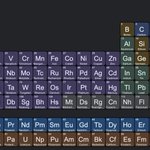
We built high-throughput materials labs in Menlo Park to create a loop between experiments and models. The labs generate fresh data, the models learn from it, and then help us decide what to try next.
Using only 1,300 H200s, plus months of our experimental data, we mid-trained and RL’d an open-source model to surpass GPT-6 Astra on our analysis benchmark. We call it Neon.
This is real footage from our lab. We’re focusing first on hard problems in materials science, including superconductors, magnets, and semiconductor materials.
Read our blog posts below.
Liam Fedus retweeted

Proud to welcome our newest sponsors to SGLang Summit.
In just one week since our public announcement, our sponsor lineup has grown from 11 to 36. Thank you to every sponsor helping bring this community together.
Join 2,000+ engineers, researchers, and builders from across the AI ecosystem for technical sessions, hands-on workshops, and the GPU Expo.
Hear from Lip-Bu Tan, Lilian Weng, Soumith Chintala, Aravind Srinivas, and more. Meet the teams building across AI hardware, infrastructure, models, and applications.
🗓️ November 12–13, 2026
🌉 Fort Mason, San Francisco
🎟️ Get your tickets: sglang.io/summit

Mirror Mirror built the licensing layer that lets people grant brands permission to use their likeness for AI generation. Be a model!
Now brands can digitally license with real people instead of using generic fake AI faces or deepfakes.
And there's no better person than @yusan_lin to build this. Her career has spanned both sides as a model and an AI researcher.

AI slop isn't just tacky and uninspired. It can get you sued.
Generating fake AI faces that resemble real people, or using someone's likeness without permission, is creating new legal and reputational risks for brands.
So we built @mirrormirror_ai as part of a16z @speedrun, a marketplace where brands can digitally book real models and creators to generate AI content using their likeness, with their permission.
Brands browse and book identity-verified talent, agree on usage rights, and generate content within those terms. Every approved image comes with a signed license and embedded provenance.
We're seeing brands produce lookbooks and campaign visuals up to 10x faster, with up to 90% cost savings. Meanwhile, models and creators can earn additional income from their digital likeness without having to show up for another shoot.
Everyone is racing to make AI generation faster, cheaper, and more realistic. But there's still a huge missing piece: how do you license the rights to the people appearing in AI-generated content at scale?
That's why I'm excited about what we're building. Not just another AI generator, but the licensing and rights infrastructure for AI-generated content.
mirrormirrorai.com/
ChatGPT’s success was thoroughly surprising (at least to me).
GPT-3.5, the backbone for ChatGPT, was already out for months ahead as a completion API, our internal usage didn’t have particularly high usage, and there was no commercially successful chatbot until that point.
Always enjoy my chats with @BrendanFoody. This one covers ChatGPT and my experiences across physics, ML and the intersection of both.

1/ ChatGPT had the internet. AI for science has no equivalent.
@LiamFedus helped create ChatGPT and went on to lead post-training at OpenAI. Now he’s building Periodic Labs because better models alone won’t get us to an AI scientist.
We talked about why Periodic is building physical labs and what Liam learned from being inside OpenAI as ChatGPT took off on today's episode of The Frontier.
Liam Fedus retweeted

yeah this checks out
my first few months at periodic, the weekly midtraining meeting was:
1. guy who trained the first trillion param LLM
2. guy who invented the attention mechanism
3. me
you learn very quickly surrounded by this density of talent. we're hiring btw.

I asked people which neolabs under $10B have the highest talent density:
32 votes: Core Automation (@MillionInt, @_arohan_)
26 votes: Periodic Labs (@LiamFedus, @ekindogus)
20 votes: Flapping Airplanes (@spectorb, @amspector100, @aidanmantine)
18 votes: Standard Intelligence (@G413N, @devanshpandey)
8 votes: Ricursive (@annadgoldie, @Azaliamirh)
5 votes each:
- Ineffable (David Silver)
- Mirendil (@bneyshabur, @HarshMeh1a, @shayan_, @tararezaeikh)
- Recursive (@RichardSocher, @_rockt, @timshi_ai, @josh_tobin_, @CaimingXiong, @jeffclune, @tydsh, Alexey Dosovitskiy)
3 votes each:
- Applied Compute (@ypatil125, @rhythmrg, @lindensli)
- Isara (@ezhang7423, @hegasz)
- Prime Intellect (@vincentweisser, @johannes_hage)
2 votes each:
- Elorian (@AndrewDai, @yinfeiy, @SethInternet)
- Goodfire (@eric_ho, @DanJBalsam, @banburismus_)
- Inherent (@tantumscollins, @edwardfhughes, @LouisKirschAI, @kallyaleksiev)
- Trajectory (@rronak_, @QuantumArjun, @MichaelElabd)
- World Labs (@drfeifei, @jcjohnss, @BenMildenhall, @chlassner)
People couldn't pick a company they work at or founded. Disclosure: I'm a small investor in Applied Compute, Factory, Standard Intelligence, Trajectory and Wafer. I didn't vote.
Continued:

Liam Fedus retweeted

If you are interested in working on science of scaling RL, please apply!
You'll be closely working with me

I asked people which neolabs under $10B have the highest talent density:
32 votes: Core Automation (@MillionInt, @_arohan_)
26 votes: Periodic Labs (@LiamFedus, @ekindogus)
20 votes: Flapping Airplanes (@spectorb, @amspector100, @aidanmantine)
18 votes: Standard Intelligence (@G413N, @devanshpandey)
8 votes: Ricursive (@annadgoldie, @Azaliamirh)
5 votes each:
- Ineffable (David Silver)
- Mirendil (@bneyshabur, @HarshMeh1a, @shayan_, @tararezaeikh)
- Recursive (@RichardSocher, @_rockt, @timshi_ai, @josh_tobin_, @CaimingXiong, @jeffclune, @tydsh, Alexey Dosovitskiy)
3 votes each:
- Applied Compute (@ypatil125, @rhythmrg, @lindensli)
- Isara (@ezhang7423, @hegasz)
- Prime Intellect (@vincentweisser, @johannes_hage)
2 votes each:
- Elorian (@AndrewDai, @yinfeiy, @SethInternet)
- Goodfire (@eric_ho, @DanJBalsam, @banburismus_)
- Inherent (@tantumscollins, @edwardfhughes, @LouisKirschAI, @kallyaleksiev)
- Trajectory (@rronak_, @QuantumArjun, @MichaelElabd)
- World Labs (@drfeifei, @jcjohnss, @BenMildenhall, @chlassner)
People couldn't pick a company they work at or founded. Disclosure: I'm a small investor in Applied Compute, Factory, Standard Intelligence, Trajectory and Wafer. I didn't vote.
Continued:
Decision-making under uncertainty and partial observability is harder for AI, but in the long run, it will ultimately be more impactful.
We talk about taking those steps beyond the comfortable world of games, code, and math.

"A system that can literally engineer matter is going to be of key importance to everybody."
@LiamFedus and @ekindogus are the co-founders of @periodiclabs, a San Francisco-based startup building AI systems and autonomous laboratories to discover new materials, starting with a higher-temperature superconductor. Fedus previously helped build ChatGPT and ran post-training at OpenAI; Cubuk led materials and chemistry research at Google DeepMind.
(3:14) What it takes to build a synthetic superintelligence
(16:44) Dogus and Liam's path to AI
(23:28) Lessons from launching ChatGPT
(35:10) What AI learns across experiments
(49:23) The difference in LLM performance on math vs. science
(54:09) The competitive landscape
(55:39) Final meditations
With Periodic Neon and Gemini Argon now taken, the race is afoot for Krypton
Congrats, Google and the team, on the impressive model and rejoining the frontier! The ongoing intelligence explosion is creating massive consumer surplus for users and startups. PhD on demand, pennies to run.


Lots of discussion out there about our next model(!), so I wanted to give an early look as soon as possible. Introducing Gemini 4 Argon!
It shows frontier performance in complex workflows, cyber defense and software engineering. Teams are using it extensively at Google, from coding to quantum computing, great feedback.
Here’s a look at the benchmarks:

Periodic 🤝 SGLang to further improve open-source software

Happy to contribute a fast and correct RL sampling mask from @periodiclabs, developed jointly with @nanjiangwill @agarwl_ and now running in our production RL pipeline!
Liam Fedus retweeted

💯All roads for AI science lead to real labs.
Most of science is observation-limited! AI will need to run experiments if we want to learn faster in the world of atoms.


Equal token counts don’t mean equal work.
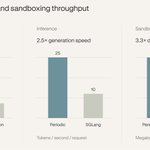
Our scheduler uses estimated compute cost to balance work across DP workers and PP microbatches. Within a sequence, later tokens attend to more preceding tokens, making them more expensive to process. Giving each GPU a mix of early and late chunks helps balance that work. This integrates nicely with the rest of our RL stack, including MoE routing replay and the vision encoder.

Neon’s scientific traces are long and vary widely in length. Training on them shouldn’t mean GPUs chewing through padding or waiting for each other.
Here’s how we pack sequences, balance the work, and distribute long contexts across GPUs at @periodiclabs 👇
periodic.com/news/ai-infrast…
Guaranteed to be a high-impact role

Also, my team is hiring! We research long-horizon agents and multi-agent. We’re hiring for alignment/safety because we want to develop new research with alignment/safety in mind during the whole process. We’re also hiring for human-AI interaction. openai.com/careers/research-…

Liam Fedus retweeted
Another Neon infra tidbit: @periodiclabs accelerated checkpoint conversion ~30x down to just 1 minute, helping us deploy faster to get rapid feedback from our labs.
Our models train in Megatron, but SGLang inference consumes weights in HuggingFace format. Traditionally, conversion ran serially:
1. rebuild the entire checkpoint from individual weight tensors
2. convert the checkpoint
3. reshard it to be inference-ready
This could take 30 min for a trillion parameter model!
Noticing that conversion shouldn't require materializing the full checkpoint, @hsu_byron introduced Fast Resharding:
1. parallelize conversion across Ray actors
2. convert expert chunks directly instead of assembling the full expert tensor in memory
We upstreamed Fast Resharding to Miles in PR #1371. Now even you can deploy trained models to production in a matter of minutes.
Ray Summit was a great deep-dive into the ML systems that power many of our favorite models. My talk is now online

The talk is on YouTube now. youtube.com/watch?v=ts19xgCD…

Liam Fedus retweeted

Excited to welcome @asadovsky as Harvey’s Chief Research Officer.
Before Harvey, Adam co-led post-training at Microsoft AI and Google DeepMind.
As a CVP at Microsoft AI, he helped build MAI-Thinking-1, Microsoft’s reasoning model.
As part of Gemini’s leadership team he helped train Gemini 1.0 through 2.5, including fine-tuning, RL, data, and evals.
His prior work as a Distinguished Engineer at Google spanned Assistant, Search Quality, and Search Infrastructure.
I met Adam three years ago when I sent him a cold LinkedIn DM and was surprised he responded.
At a time when most dismissed the application layer and legal, Adam was curious and generous with his time.
He quickly became someone I regularly turned to for advice on AI as we scaled Harvey over the past three years.
When we first met, we were too early to hire someone of his caliber and scale, but I always hoped we’d eventually work together.
As Winston and I got to know him better, what stood out even beyond his technical achievements was his character.
Despite his incredible technical career, he remains curious, humble, practical, and cares deeply about the teams he builds.
We couldn’t think of a better leader to help us build frontier intelligence for the professionals and institutions we serve.

We're excited to welcome @asadovsky as our Chief Research Officer.
Prior to Harvey, Adam co-led post-training at Microsoft AI and Google DeepMind.
As CVP at Microsoft AI, he led post-training of MAI-Thinking-1.
As a Distinguished Engineer at Google DeepMind, he led teams working on Gemini 1.0 through Gemini 2.5.
Earlier at Google, he led teams working on Assistant, Search Quality, and Search Infrastructure.
Liam Fedus retweeted
You saw the AI & science. Let's talk about the RL infra it took to build @periodiclabs Neon.
To minimize training-inference mismatch in RL, SGLang captures inference's MoE routing decisions for each rollout and we "replay" them while training.
In agentic (multiturn tool-use) settings, SGLang exports these router decisions in response to each decoding request, i.e. after each conversation turn.
So when *any* data-parallel rank finishes a conversation turn, *all* other ranks must wait until routing data finishes exporting. This slowdown is exacerbated because we export routing decisions from the *entire* conversation rather than just the most recent turn!
When @hsu_byron @vwxyzjn discovered this in our Kimi K2 RL setup, they introduced Delta Router Replay: cache previous turns' router decisions on the training client, so you can export only the delta (most recent turn's router decisions) upon each decoding request.
Delta Router Replay significantly speeds up our long-context agentic RL runs, and @hsu_byron upstreamed it to SGLang (#24851) a few months ago.

Liam Fedus retweeted

very much enjoy reading the team's AI infra blog. periodic.com/news/ai-infrast…
A super clear training-rollout-sandbox pipeline with many clear task-specific optimizations.
Better AI infra, better AGI

We built high-throughput materials labs in Menlo Park to create a loop between experiments and models. The labs generate fresh data, the models learn from it, and then help us decide what to try next.
Using only 1,300 H200s, plus months of our experimental data, we mid-trained and RL’d an open-source model to surpass GPT-6 Astra on our analysis benchmark. We call it Neon.
This is real footage from our lab. We’re focusing first on hard problems in materials science, including superconductors, magnets, and semiconductor materials.
Read our blog posts below.
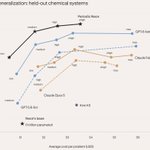
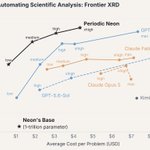
We check OOD generalization for @periodiclabs Neon and report optimal cost-performance here, too. This indicates useful generalization for our model.
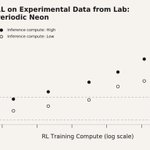
But our experimental data also opens up an interesting ML research program.
For example, RL tasks to directly predict experimental outcomes given all prior experimental data known up until that date. This is loosely analogous to the often-proposed ML experiment of training AI on all literature before 1905 and then evaluating whether it can derive the theory of relativity.
An AI that already knows the answer through pre-training can cheat on RL tasks like this (i.e., it can skip reasoning and simply output a memorized experimental result). A unique, complete, dated system of record makes this work possible and fruitful.

ALT We evaluate Neon’s generalization on 198 experimental XRD measurements using held-out chemical systems. Specifically, our lab data training split for both reinforcement learning and midtraining excludes these systems and any systems containing them, while smaller subsystems can appear in training. This benchmark tests generalization to held-out chemical systems, but is easier than FrontierXRD, which focuses on samples that are difficult to resolve even for human experts.
“What did we actually make?”
Answering this can take hours. Lab data + midtraining + RL took X-ray diffraction analysis success from 2.7% to 55.3% (~20×) on 134 difficult samples, scored by model judges calibrated against human experts. We see great scaling properties with respect to additional RL.
Read more about our research here.
periodic.com/news/nature-is-…

Liam Fedus retweeted

Incredible work, and very cool to see @periodiclabs using @raydistributed.
We built high-throughput materials labs in Menlo Park to create a loop between experiments and models. The labs generate fresh data, the models learn from it, and then help us decide what to try next.
Using only 1,300 H200s, plus months of our experimental data, we mid-trained and RL’d an open-source model to surpass GPT-6 Astra on our analysis benchmark. We call it Neon.
This is real footage from our lab. We’re focusing first on hard problems in materials science, including superconductors, magnets, and semiconductor materials.
Read our blog posts below.