
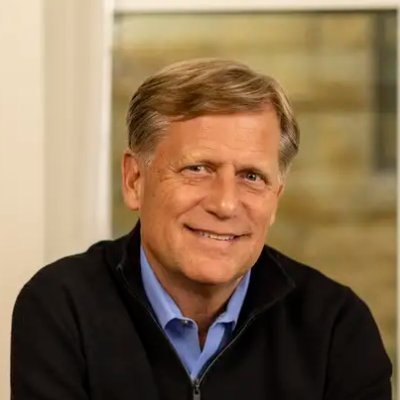
Professor of Political Science, Senior Fellow, Freeman Spogli Institute & Hoover Institution, all at Stanford University. U.S. Ambassador to Russia, 2012-2014.
Stanford, California
Joined January 2012
- Tweets145K
- Following2.5K
- Followers888K
- Likes46.1K







Pinned Tweet
OUT TODAY!
My new book, Autocrats vs. Democrats, looks at the challenges posed by autocratic Russia and China and explains how/why the U.S. must lead the democratic world in response.
Available in stores or online: harpercollins.com/products/a…
@HooverInst @FSIStanford @MarinerBooks @HarperCollins


I’ve spoken a lot about the troubling developments in Ukraine and democratic backsliding in the US. So, in my latest Substack, I wanted to focus on some good news for a change. Read more: michaelmcfaul.substack.com/p…

Michael McFaul retweeted

It would not be “censorship” for social media platforms to require that users be who they say they are. Integrity & transparency shouldn’t be too much to ask.


The fatalistic assumption that autocracy in the world is rising and democracy is declining was challenged forcefully in three different countries this past weekend.
It's a moment worth celebrating.
Read more: michaelmcfaul.substack.com/p…

Was on @Morning_Joe today with @EdwardGLuce when he said that Trump will not become a lame duck, but an "angry duck." That image has stuck with me.
"Nor are Europeans quitting on Ukraine. Although Putin hoped that the withdrawal of American military and economic aid early in Trump’s second term would lead to a quick Ukrainian collapse or capitulation, he did not anticipate how willing and capable European countries would be in filling the American void."
foreignaffairs.com/russia/pu…

Michael McFaul retweeted

My heart goes out to the brave soldiers of Ukraine who are manning the ramparts of liberty against aggression, rapacity and nihilism.
Poland will support free Ukraine until a just peace is achieved.
Michael McFaul retweeted

Astounding.

"U.S. policy could also change, especially after the midterm elections. American society does not support Trump’s embrace of Putin and abandonment of Ukraine, making it politically hard for the administration to maintain this policy pivot. If Democrats win control of one or both houses of Congress in midterm elections next week, they could very well use their new electoral mandate to investigate American-Russian business deals; introduce new legislation to restart American military and economic assistance to Ukraine and outlaw Starlink and Starshield disruptions; or deploy legislative action to enforce existing sanctions laws."
foreignaffairs.com/russia/pu…
Trump has returned to expressing open hostility [towards Zelensky], echoing Putin by proclaiming that it’s “time for Ukraine to get a new president.”
foreignaffairs.com/russia/pu…
"Trump’s support has bolstered Putin’s belief that time is on his side. In just the last few weeks, Trump and his allies have expanded his help to Moscow: suspending sanctions, buying Russian diesel, disrupting Ukraine’s access to Starlink and Starshield communications systems, and even insisting that Zelensky must go."
foreignaffairs.com/russia/pu…


Putin’s American friends ft.com/content/f2261796-20d1… via @ft


Michael McFaul retweeted
My latest:
Putin’s Strategy Is Working foreignaffairs.com/russia/pu… via @ForeignAffairs
Michael McFaul retweeted

🤦♂️Russian diesel heads to US aboard tanker under EU sanctions
pravda.com.ua/eng/news/2026/…

Michael McFaul retweeted

A new myth is born: "According to the Financial Times, Putin offered to withdraw most of his troops in early 2023. Zelenskyy rejected."
This is not really what the FT wrote, but we are going to hear this in talkshows and Bundestag debates for years.

Laut Financial Times bot Putin Anfang 2023 einen weitgehenden Truppenabzug an. Selenskyj lehnte ab. Ein ukrainischer Abgeordneter liefert nun brisante Details. berliner-zeitung.de/article/…

Michael McFaul retweeted

A lesson to us all

HOW STUDENTS DEFEATED VUČIĆ WITHOUT PLAYING HIS GAME
In yesterday's early parliamentary elections in Serbia, the Student List, a political movement initiated by university students in December 2024, defeated Aleksandar Vučić's Serbian Progressive Party by 51 percent to 39 percent.
The outcome presents an analytical puzzle. The incumbent commanded all the traditional instruments of political survival: public finances, state institutions, a nationwide patronage apparatus, and fourteen years of accumulated power. The students possessed neither financial resources nor clientelistic networks, no leader, and had no prior electoral experience. Yet they defeated the regime without adopting its methods. I explain this outcome in five points.
1. The Accumulation of Discontent
The students' victory did not come out of nowhere. They inherited more than a decade of growing discontent with Vučić, which had repeatedly erupted into public protests but had never produced political change.
Vučić assumed power in 2012 by mobilizing widespread resentment against post-communist transition reforms that took place in 2001-2012. Over time, this dissatisfaction inverted. By 2016, the former incumbents (now in opposition) had lost credibility, prompting voters to search for alternatives and new agents. This dynamic produced a sequence of political new agents whose electoral appeal consistently deteriorated. Each initially raised hopes of political change, but these hopes faded as some newcomers undermined themselves while others struggled to compete in an increasingly unequal political environment. Meanwhile, Vučić had transformed Serbia's already weak democracy into a hybrid regime with increasingly authoritarian features. Control over state institutions, public resources, and much of the media allowed him to compensate for declining popular support, weaken the opposition, and maintain his hold on power.
Simultaneously, anti-regime sentiment manifested in successive waves of street protests, recurring roughly every 18 months on average. Each wave mobilized more people than the previous one, but each eventually subsided without achieving political change. (Similar dynamics was seen previosuly in Poland in 2015-2023.) Growing mobilization was thus accompanied by growing disappointment. Dissatisfaction with Vučić continued to accumulate, while confidence in the possibility of removing him gradually declined. By 2024, many voters had also lost faith in traditional opposition parties, which they perceived as part of the same clientelistic system. Increasingly convinced that political change was impossible, many withdrew from electoral politics altogether.
2. Overcoming the Coordination Dilemma
Discontent alone is insufficient to defeat an incumbent. Voters must also believe that others will support a viable alternative. Before the students emerged, many dissatisfied citizens abstained because they considered Vučić unbeatable and the opposition incapable of replacing him. Their expectations reinforced the very outcome they feared.
Beginning with university occupations in December 2024, mobilization culminated on March 15, 2025, when roughly 300,000 people gathered in Belgrade, in what was arguably the city's largest political demonstration since its liberation from German occupation in 1944. The event revealed the scale of opposition and, more importantly, made it visible to everyone. For the first time, many voters saw an alternative capable of defeating Vučić. Whether they identified with the students' political views became secondary. What mattered was their shared opposition to the incumbent and their belief that others would support the same alternative. The students had become a focal point for electoral coordination.
3. Clean Hands, No Ambition for Office
The students differed from previous opposition movements in another crucial respect: they were politically clean. Many established opposition politicians were widely perceived as belonging to the very clientelist system they claimed to oppose. The students, by contrast, were simply too young to have developed or joined such networks. They had no history of political deals, public appointments, or access to state resources. In a system defined by patronage, their lack of political experience became their greatest strategic advantage.
What followed was even more remarkable. When in May 2025 the students demanded early parliamentary elections, they imposed an unusual condition: no student could appear on their electoral list. The implicit message was clear: we want to remove the incumbent without taking his place. It was not about privileges, but about the system itself. This was a striking departure from conventional party politics, where parties seek power primarily to secure office and spoils for their leaders. When the students finally submitted their list of 250 candidates, not a single one was a student, let alone a member of the student movement.
By refusing to seek office themselves, the students made their promise to change the system more credible. This commitment appealed to voters on both the left and the right, including those disappointed by successive opposition failures and those who had withdrawn from electoral politics altogether. The breadth of this appeal was reflected in turnout of approximately 70 percent, with roughly 600,000 more people voting than in December 2023. Their self-denial did the trick.
4. Vučić Became Culturally Obsolete
The students' appeal was not simply that they were politically clean. They were also young, mostly in their late teens and early twenties. Like every generation, they had their own culture, their own values, and their own understanding of what was acceptable, desirable, or simply cool.
What Vučić (and not only him) represented did not belong in it. For them, Vučić was culturally obsolete. He represented a political world with which they no longer wanted to identify: patronage, clientelism, corruption, informal deals, and a system in which personal connections and political loyalty mattered more than education, competence, or merit. This was simply not their thing. The movement attracted and mobilized an extraordinary number of young people who saw Vučić as culturally irrelevant, in much the same way Vučić himself had mobilized voters resentful of post-communist transition reforms in 2012.
This attitude gradually spread beyond their generation. Older voters who had long grown dissatisfied with Vučić, but had repeatedly failed to find a credible alternative, began to identify with the students' rejection of his political culture. With this cultural innovation, the students changed the terms of political competition. Vučić could promise higher wages, offer young people subsidized apartments, or distribute cash benefits, but these traditional instruments had little effect on people who no longer wanted to belong to the political world he represented. It was precisely this system of corrupt clientelism and vote buying that they fought against.
5. It Wasn't the Economy, Stupid!
The explanations above emphasize what was unusual about the students' victory. But several more conventional factors also contributed to Vučić's defeat. Demographic change gradually weakened his electoral base, which relied heavily on pensioners, while younger voters constituted a core constituency of the student movement. Between the previous election and October 2026, approximately 270,000 people died, mostly elderly, while around 170,000 young people completed secondary school. The students also adopted a catch-all approach, attracting both pro-European liberals and nationally oriented conservatives who had previously supported different opposition parties.
The students also developed a different form of political organization. Instead of relying on patronage, financial incentives, and centralized party structures, they mobilized thousands of volunteers who contributed their time and energy without expecting personal rewards. Their motivation was arguably stronger than that of many members of Vučić's political machine. Political commitment thus became an alternative to the material incentives on which conventional party organizations depend.
Just as the students mobilized without material rewards, Vučić was defeated without an economic crisis. Authoritarian incumbents often become vulnerable when economic conditions worsen, as illustrated by Orbán's Hungary in April 2026. Ironically, Serbia was different. Over the preceding five years, the economy did well: living standards had risen, unemployment remained relatively low, real wages and pensions had increased, and the currency was stable.
6. Conclusion
Ultimately, the Serbian election was not merely a contest between political alternatives, but between two fundamentally different ways of organizing politics. The Serbian experience challenges conventional assumptions about the resources necessary to defeat an entrenched incumbent. The fact that a loosely organized, decentralized movement with meager financial resources, no leader (!), no clientelistic networks, and no political experience managed to defeat a powerful clientelistic political machine will become an important subject of scholarly research. The Serbian case will be taught at universities in comparative politics and political economy courses and discussed in academic articles and books.
My latest:
Putin’s Strategy Is Working foreignaffairs.com/russia/pu… via @ForeignAffairs