

Thousands of historical pictures, maps and documents about the Ottoman Empire | Devlet-i Aliyye.
Istanbul, Turkey
Joined January 2015
- Tweets18.7K
- Following18.6K
- Followers157K
- Likes15.5K




📷 General View of #Köprülü (#Veles) (#Macedonia), Late 19th Century
"In the late 1890s, Köprülü (Veles), under Ottoman rule, was an important district center (kaza) in the Sanjak of Üsküp (Skopje), within the Kosovo Vilayet. Situated on both banks of the Vardar River, the town was one of the region’s most active centers of trade and craftsmanship, thanks to its strategic location and railway connection.
The town center had an estimated population of 15,000–17,000, while the population of the entire district, including its villages, was approximately 50,000–55,000. Bulgarians (Macedonian Slavs) constituted the majority of the town’s population, accounting for an estimated 60–65% (approximately 9,500–10,500 people). Turks (Muslims) formed the second-largest group, representing around 30–35% (approximately 5,000–5,500 people), and were concentrated mainly in the neighborhoods on the eastern bank of the Vardar. The remaining population consisted of small numbers of Vlachs (Aromanians), Jews, and Roma."
(Colorized Photo)
🤖 Made with AI

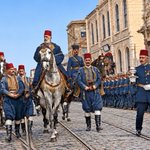
📷 The Saluting Procession (Selamlık Ceremony) of the Last Ottoman Caliph, Abdulmecid Efendi, Istanbul, 1922.
"Following the abolition of the Sultanate on 1 November 1922, Abdulmecid Efendi was elected as the new Caliph on 19 November 1922. However, since the Sultanate had been abolished, he served as a Caliph without the title of “Sultan” and without political authority for approximately one and a half years, and held this position until the abolition of the Caliphate on 3 March 1924, becoming the last person in history to bear the title of “Caliph.”"
(Colored Photograph)

Ottoman Imperial Archives retweeted
✏️ Portrait of Hasan Pasha of Algiers and His Lion. From Slavery to Grand Admiral of the Ottoman Empire. Nicknamed Ejder-i Bahrî (Dragon of the Sea), was an Ottoman Grand Admiral (1770–90), Grand Vizier (1790)


✏️ Portrait of Hasan Pasha of Algiers and His Lion. From Slavery to Grand Admiral of the Ottoman Empire. Nicknamed Ejder-i Bahrî (Dragon of the Sea), was an Ottoman Grand Admiral (1770–90), Grand Vizier (1790)

📷 Traditional Wooden Mansions in #Eskişehir, 1914 (Central Anatolia)

Ottoman Imperial Archives retweeted
✏️ View of #Athens, with an Artist Seated at the Foot of Mount Anchesmus Sketching the Cityscape and a Shepherd Grazing His Sheep Nearby (#Greece), 1813
"In 1800s, Ottoman Athens was a medium-sized provincial town. Approximately 10,000 people lived within the city walls (in 1,200–1,300 houses). Of this population, around 3,000 were Muslim Turks and Albanians, 3,000 were Greek Orthodox, and 4,000 were Christian Albanians. A small Ottoman garrison of approximately 100–150 soldiers was stationed at the Acropolis.
The local economy was largely based on agriculture and livestock farming. In Attica, approximately 100,000 goats, 60,000 sheep, and 3,000 oxen were raised. Olive oil, grain, and small livestock were the main sources of livelihood. As food was inexpensive, the city maintained a close economic interdependence with the surrounding villages."
(Restored Picture)
✏️ Osmanlı Dönemi Atina Manzarası ve Anchesmus Dağı'nın Eteğinde Oturup Şehir Manzarasının Eskizini Çizen Ressam ve Yanında Koyun Otlatan Bir Çoban, 1813.
"1800'lerde Osmanlı Atinası orta ölçekli bir taşra kasabasıydı. Şehir surları içinde yaklaşık 10.000 kişi yaşıyordu (1.200–1.300 ev). Nüfusun yaklaşık 3.000'i Müslüman Türk ve Arnavut, 3.000'i Ortodoks Rum ve 4.000'i Hristiyan Arnavut idi. Akropolis’te 100-150 civarı Osmanlı askerinden oluşan küçük bir garnizon bulunuyordu. Ekonomi büyük ölçüde tarım ve hayvancılığa dayalı idi. Attika’da yaklaşık 100.000 keçi, 60.000 koyun ve 3.000 öküz yetiştirilmekteydi. Zeytinyağı, tahıl ve küçükbaş hayvancılık temel geçim kaynaklarıydı. Gıda ucuz olduğundan şehir ile çevresindeki köyler arasında sıkı bir bağımlılık vardı."
🤖 Made with AI
📷 Keepsake Portrait of an #Armenian Family in Izmir (Western Anatolia), 1900s (Colorized Photo)


📷 Ottoman Government Building in #Gümülcine (#Komotini, Greece), c. 1900 (Colorized Photo)

📷 Portrait of Two Young Girls in Traditional Costume (Anatolia), c. 1900 (Colorized Photo)

1
36
2,925

📷 The march of #Christian volunteers through the streets of Istanbul in support of the Ottoman Empire, following the outbreak of unrest in the #Balkans before the Russian invasion, 1876 (Italian Weekly Magazine L'Illustrazione Italiana, 20 August 1876 (Colored Illustration)
