

Products for People.
Decentralized
Joined July 2013
- Tweets14.4K
- Following12
- Followers1.6M
- Likes9K






Pinned Tweet
dotUSD is live on Polkadot.
Today a handful of companies issue and control most of the world's stablecoins worth more than $250B.
Like banks, they decide who can hold them and who can’t.
dotUSD is based on a different premise. It has no issuing company and no single point of control.
The DOT DAO governs it through OpenGov.
Polkadot now has a stablecoin that belongs to its network.

We live in the information age, the age of the sovereign individual, but the services available to us are not aligned with that.
@gavofyork argues that Polkadot’s core technology is now ready to deliver the applications people will actually use in this new age.
Do you wear a smartwatch, use a voice assistant or own a smart TV?
A quick test by @web3foundation shows the data trail one ordinary day in a household like yours leaves behind and just how much small print you’ve agreed to along the way. 🧐
Try it out: web3.foundation/your-day-in-…


You might be surprised by how much your home knows about you. Your TV. Your car. Your smartwatch. Even your kids' devices.
Everyday technology can reveal more about your life than you realise.
Take our interactive Your Day in Data experience to see what this could look like in a household like yours.
🔒 No answers collected. No data stored.
Discover your day in data 👇
web3.foundation//your-day-in…
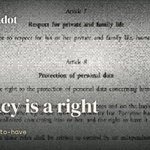
This 👉 Privacy needs to be part of these systems’ design, not just added to their security policies afterwards.
In Polkadot’s tools for people, privacy will be the first primitive.
Different organisations. Different systems. Different failures, but one question connects them all:
Why do we continue building systems where so much personal information can be collected, accessed and exposed without meaningful control by the people it belongs to?
Privacy needs to be part of these systems' design, not just their security policies.
Polkadot retweeted

Building for the Human Web3 means a layer that keeps working when one server, one region or one company doesn’t.
Apps served from the browser.
Chain data checked by a light client.
Signing that never hands keys to the app.
All open-source code, out in the open for anyone to build on.

BREAKING: Multiple online services are down or 'experiencing issues.'
Google Cloud has reported "issues" in its western Europe region affecting dozens of websites, including; Revolut, Royal Mail and HSBC.
Latest updates ➡️ trib.al/M16q5UZ
📺 Sky 501
Security Alert for Fearless Wallet
Fearless Wallet is a third-party application, built and maintained by an independent team.
Following an investigation by the Polkadot Technical Fellowship on behalf of the @PCF_org, it was found that the Fearless Wallet browser extension had been compromised and had been leaking users’ private keys since February 2025.
If you have used the Fearless Wallet browser extension, please create a new keypair with a different wallet and move your funds as soon as possible.
Remember to never share your private keys.
Beware of scams. Nobody legitimate will message you offering to recover your funds, and nobody needs your private keys. Polkadot does not have an X support account.
For staked funds, get help from PAPI Rescue: papirescue.now/#recovery-imp….

Read the full report here: forum.polkadot.network/t/sec…

The safest way to protect your DOT doesn’t require purchasing new hardware.
Dig out an old smartphone, wipe it, install Polkadot Vault, and never connect it to the internet again.
Now you can sign transactions by scanning a QR code while keeping your keys safe.
Learn more👇

Did you know you can turn an old smartphone into an offline crypto signing device? 📱🔓
The @paritytech Signer introduced this approach to the @Polkadot ecosystem back in 2018, keeping private keys offline and signing transactions via QR codes.
Today, the project lives on as Polkadot Vault, developed and maintained by @NovasamaTech.
Find out more 👇

It started over lunch.
Governor Raúl Jalil of Catamarca met @gavofyork and came away convinced blockchain could bring real social value to his province. Provincial Law 5923 gave that conviction an institutional footing.
@AcademyPolkadot then built the bridge to public institutions with Juan Pablo Dusso, Coordinator of Catamarca’s Unit for Strategic Affairs and State Reform.
The result of these efforts: Catamarca On-Chain.
More than 250 policymakers and public officials spent 5 days with PBA working on verifiable digital credentials and traceable social programmes, and ultimately exploring how blockchain could strengthen public institutions.

New on our blog: the story behind Catamarca On-Chain! 🏛️
After PBA brought together Argentina’s Norte Grande governors, a conversation with PBA founder Dr. @gavofyork sparked Catamarca’s interest in training its government. The result: more than 250 decision-makers trained by PBA faculty.
🔗 Read the full article:
polkadot.academy/catamarca-o…

Let’s build a different kind of web.
One that is open by default.
One that assumes you own your identity, your data and your money.
One that doesn’t make you jump through hoops.
No logins. No digital landlords and no learning curve.
Web2 user experience with Web3 values.
Ultimately, a human web.
That’s what we’re building on Polkadot.


Check out the full proposal here: polkadot.subsquare.io/refere…

Blockchain protocol engineering, as taught by @AcademyPolkadot, is now part of the formal curriculum of Universidad Tecnológica Nacional (UTN), Argentina’s largest public technological university 🇦🇷.
Congratulations to the @AcademyPolkadot team on collaborating with UTN, ultimately contributing to quality education in blockchain foundations and showing the next generation of engineers how to build resilient digital systems.
PBA's foundational expertise in blockchain protocol engineering is now part of the formal curriculum of Universidad Tecnológica Nacional (UTN), Argentina's largest public technological university. 🇦🇷
This is a milestone we're proud of: the knowledge at the heart of PBA is now taught within a public university degree, alongside UTN's faculty, to the engineers who will help shape Argentina's technological future.
This semester, final-year Information Systems Engineering students at UTN Facultad Regional Córdoba are studying how blockchains are designed and secured at their core: protocol architecture, advanced cryptography and zero-knowledge proofs, crypto-economics and interoperability. Building on the university's focus on smart contracts and applications, the content prepares students to design the systems they work with. 🎓💡
The collaboration is part of a framework agreement with UTN's national Rectorate to advance blockchain education across its campuses nationwide, and follows Dr. @gavofyork's masterclass at UTN in November 2025.
This is the kind of work we want to build with universities, and we look forward to expanding our long-term partnership with UTN in the year ahead.


Update for the Devs 💻
New Devnet builds are now available. 🙂↔️
What's new:
• Smarter search for contacts and accounts.
• Beautiful new coin visuals and clearer privacy indicators.
• And more.
Before you update: save your recovery phrase, you’ll need it to restore your account.
Developers, get started here and explore the latest Devnet builds to see what's new:
docs.polkadotcommunity.found…
The more we depend on systems we cannot inspect, the more we need ones we can verify.
@gavofyork explains that there is a fundamental difference in trust assumptions between AI and Web3.
Polkadot applications are built on the principle:
less trust, more truth.
“AI is, at its heart, less truth, more trust.”
In this interview, Gavin Wood argues that AI increasingly requires us to trust systems we cannot fully inspect: their training data, their models, or how they arrive at their answers.
He contrasts that with Web3, which he describes as “less trust, more truth”: systems where more of the underlying rules and activity can be independently verified.
That idea is relevant to Polkadot Products. The goal is not simply to build more infrastructure, but to create products where users can rely less on opaque intermediaries and have stronger guarantees about what is happening underneath.
As AI becomes more embedded in everyday life, the ability to verify the systems we depend on becomes increasingly important.