

We’re advancing quantum computing to solve the world’s most pressing challenges
Joined November 2021
- Tweets1.1K
- Following21
- Followers14.6K
- Likes68


“Quantum error correction can strongly suppress noise, but predicting whether a computation succeeds requires understanding not only how much effective noise persists after QEC, but what form that noise takes.”
That is the opening of our latest paper, co-authored with our colleagues at @SandiaLabs.
In the final experiment conducted on System Model H1, the team introduced logical gate set tomography, a new method for understanding how physical errors translate into logical errors - and how those errors affect computation.
The result provides our most detailed picture of logical errors to date, giving our teams a new tool to help design better processors and more reliable fault-tolerant systems.
This work was possible because our hardware always supports the complete QEC workflow, including mid-circuit measurement and real-time correction. Building fault-tolerant systems and developing rigorous ways to characterize them go hand in hand. Both are essential to turn logical qubits into reliable computation.
Read the paper: arxiv.org/pdf/2610.19034

It was incredible to join our partners at @Oracle on stage at AI World this week to explore what’s next for quantum computing and enterprise AI.
Our Chief Commercial Officer Larry Stack sat down with Mahesh Thiagarajan, President of Oracle Cloud Infrastructure (OCI), to discuss how quantum computing, AI and high-performance computing can work together to tackle some of the toughest business and research challenges. Larry also highlighted the momentum behind quantum adoption, with more than 200 organizations already working with Quantinuum on these problems.
That opportunity is at the heart of our partnership with Oracle. Through the OCI Quantum AI Compute Beta Program, selected organizations will gain early access to Quantinuum’s Helios quantum computer alongside OCI’s GPU and HPC infrastructure, opening a path to explore applications in drug discovery, materials science, optimization and more.
Josh Savory, our Senior Director of Offering Management, also joined Oracle’s Irfan Shahdad in a separate AI World session for a deeper look at how OCI customers can get started through the partnership.
Thank you to Mahesh, Irfan and the entire Oracle team for the conversations and a shared commitment to bringing these capabilities to enterprises.
Watch Larry’s AI World segment: lnkd.in/g5uaZt6y
Learn more about our partnership:
lnkd.in/grtZ6T4W

Introducing the judging panel for the Quantinuum SG Grand Challenge 2026!
Since the SG Grand Challenge launched in July, it has brought together more than 200 participants from around the world to explore how quantum computing can tackle challenges across science, AI and industry.
On November 19, our finalist teams will take the stage in Singapore to showcase their solutions and answer questions from a panel whose expertise spans quantum algorithms, research, software and innovation.
Thank you to our judges for contributing their time and expertise, and to every participant for the creativity and dedication that have brought us to this point.
🔹 Prof. Harry Buhrman, Quantinuum
🔹 Prof. Leong Chuan Kwek, Nanyang Technological University / Centre for Quantum Technologies
🔹 Dr. Ross Duncan, Quantinuum
🔹 Dr. Jayne Thompson, Nanyang Technological University
🔹 Dr. Angelina Frank, QAI Ventures
Supported by Singapore’s National Quantum Office and Aqora, the Challenge will culminate in a day of finalist presentations, industry insights and connections across Singapore’s quantum community.
We look forward to seeing you at the finale! Spaces are limited.
Register your interest: twistmedia.sg/events/sggrand…
#QuantumComputing #Quantinuum #SGGrandChallenge

Lighter generators. More compact motors. Power cables that carry more electricity. High-temperature superconductors could help make it possible. But first, we need to better understand the physics.
Quantinuum and @GEVernova's Advanced Research Center are teaming up to explore that challenge with quantum computing.
The collaboration combines access to our Helios quantum computer and full-stack capabilities with GE Vernova’s materials science and industrial expertise to study how interacting electrons give rise to superconductivity.
Read the full story: quantinuum.com/blog/quantinu…

Quantinuum is bringing quantum to SWITCH, Singapore’s flagship innovation and technology forum, where we will showcase how we’re working across the local ecosystem to strengthen Singapore’s global quantum leadership for the fault-tolerant era.
Through our partnership with the National Quantum Office, our local R&D and Operations Centre, and our upcoming Singapore deployment of Helios—the world’s most accurate quantum computer—we’re connecting local researchers and businesses with the advanced capabilities and expertise needed to put quantum to work.
At SWITCH, our CEO Dr. Rajeeb Hazra will join a main stage panel on Oct. 27 to explore what this all means for enterprises in Singapore. He’ll discuss our progress toward fault tolerance, how businesses can start building quantum readiness now, and how quantum and AI can work together to tackle complex problems.
We’ll carry that conversation into the broader agenda, including:
🔹 A keynote on Oct. 28 by Singapore Country Leader Marvin Lee, “Towards Reliable Quantum Computing,” that will discuss Quantinuum’s deep engagement in Singapore and how access to systems like Helios is helping grow the local ecosystem.
🔹 A Quantinuum workshop bringing together local collaborators and enterprises to share approaches to quantum readiness and how they’re using Helios to explore solutions to real-world problems.
See the full @SwitchSingapore agenda here: lnkd.in/gZV2MxiM

Oracle Cloud Infrastructure users can now access Quantinuum's Helios quantum computer through OCI's Quantum AI Compute beta program. It's time to explore what quantum can do for your business.
Tomorrow at @Oracle AI World, Quantinuum's Josh Savory and Oracle's Irfan Shahdad will discuss how integrating Helios directly into OCI gives organizations access to quantum hardware and open hybrid programming tools without specialized facilities or infrastructure.
They'll also explore built-in calibration for fault-tolerant protocols and what this approach could mean for enterprise adoption.
💻 Session Title: "Quantum Comes to the Enterprise Cloud"
📍 When and Where: Tuesday, Oct 27 | 2:15 PM - 3:00 PM PDT | Marco Polo 803, Level 1 at The Venetian Convention and Expo Center in Las Vegas, NV
Learn more: reg.rf.oracle.com/flow/oracl…

Quantum × drug discovery = a powerful new toolkit in the making.
If you're headed to the AI Drug Discovery & Development Summit in Boston next week, catch our workshop with @kvantify on October 27: Quantum Computing for Drug Discovery: Building the Path to Practical Applications.
Together with pharmaceutical industry experts, we’ll discuss where quantum can help accelerate your research, how the technology continues to evolve, and how your team can get started today.
You can also stop by our booth on October 28–29, where Quantinuum’s Mario Gattuso and Tanya Roussy can help you get smart on all things quantum.
Learn more and register for the summit: aidrivendrugdevelopment.com
See you in Boston!

Big milestone in our partnership with @Oracle. Organizations can now apply for early access to Quantinuum's Helios quantum computer through Oracle's Quantum AI Compute program.
This marks an important step forward in our collaboration and in advancing hybrid quantum-AI computing at enterprise scale, giving organizations new ways to explore how quantum computing, AI, and HPC can be combined to address some of the world's most computationally demanding challenges.
Next week at Oracle AI World, our Chief Commercial Officer Larry Stack joins Oracle Cloud Infrastructure President Mahesh Thiagarajan on the main stage to discuss what this progress means for customers and how these capabilities can accelerate discovery, simulation, optimization, and other high-value enterprise applications.
We're excited about what's ahead.
Read more here: quantinuum.com/blog/quantinu…

Two fault-tolerance milestones were announced over the past two weeks, one from Quantinuum and one from Google.
Because both results focus on improving fidelity and reducing errors, we've received a lot of questions about how they compare. The short answer: both are meaningful advances, but they measure different things.
This week, we announced that we had used our error-correction architecture to achieve a logical fidelity of 99.9995% on Helios, equivalent to just five errors per million operations. Our error rate represented a 100x reduction in errors compared to the best published result across any other modality, which was published by Google in 2024.
Last week, Google announced that it had achieved a fidelity of 99.99% as part of a study on magic states, which are resources used in certain fault-tolerant operations.
The distinction matters because different studies provide insight into different parts of the path to fault tolerance. Google's work measured the fidelity of a resource used in fault-tolerant operations. Our work measured the fidelity of the logical computation that consumes those resources.
In our latest blog, Quantinuum’s David Hayes takes a closer look at what each result measures, where direct comparisons can and cannot be made, and what they tell us about Quantinuum’s leadership on the path to practical fault-tolerant quantum computing.
Learn more here: quantinuum.com/blog/quantinu…

We are closing in on one million error-free operations!
Helios has achieved a logical fidelity of 99.9995%—equivalent to just five uncorrectable errors per million operations. Importantly, errors fell exponentially as we increased the strength of error correction. This is the behavior required to build fault-tolerant quantum computers: add more protection, and the computation becomes exponentially more reliable.
This result also highlights the resource advantages of our architecture. Based on demonstrated color-code scaling, a Quantinuum system could reach a target logical error rate using approximately 30 times fewer physical qubits than a comparable superconducting approach.
This result, using the color code, is coming hot off the heels of our September record with the Helix code. Our ability to run multiple codes at record breaking fidelities showcases our flexible logical architecture and highly accurate trapped-ion technology.
Ultimately, this result highlights the power of Helios in ‘pathfinder’ mode: results like this validate the hardware, error-correction architecture, decoding, and control capabilities that underpin our path to Apollo—our universal fault-tolerant quantum computer planned for 2029.
Read the full story on our blog: quantinuum.com/blog/quantinu…

Quantinuum has achieved a major industry breakthrough that solves a critical error-correction bottleneck and validates our path to delivering a fault-tolerant quantum computer by 2029.
We’ve announced a new world record for quantum error correction, achieving 99.9995% logical fidelity on our Helios commercial quantum computer using our error-correction architecture.
Equivalent to just five errors in a million operations, the result is 10× better than our previous record achieved just last month and 100× better than the best published result on any other hardware modality.
The study also demonstrated a record 12× reduction in logical errors as code distance increased, a critical step toward scalable fault tolerance.
These successive breakthroughs using different codes on the same commercial hardware demonstrate how Quantinuum's flexible error-correction architecture and highly accurate trapped-ion technology work together to enable exponential improvements in accuracy, with performance now within the target range for Apollo, our first universal fault-tolerant quantum computer planned for 2029.
Learn more: quantinuum.com/press-release…
Quantinuum, in partnership with @HQSQuantum, has delivered what we believe to be the most accurate large-scale quantum simulation of nuclear magnetic resonance (NMR) to date—advancing a powerful tool for computational chemistry.
NMR reveals molecular structures and chemical environments, making it essential to fields ranging from drug discovery to battery development. But interpreting NMR spectra requires simulations of interacting nuclear spins, and the cost of exact classical simulation grows exponentially with every additional particle.
Quantum computers offer a natural alternative. In this work, we reproduced the complete NMR computational pipeline:
• Constructing the nuclear spin Hamiltonian
• Compiling efficient quantum circuits
• Executing the simulation on quantum hardware
• Reconstructing the final proton NMR spectrum
The resulting spectrum closely matched emulator and classical-reference calculations while reproducing important spectroscopic features that previous quantum-hardware demonstrations did not capture.
This result was enabled by the defining strengths of Quantinuum’s trapped-ion systems: high-fidelity gates, all-to-all connectivity, and effective error suppression. Together, these capabilities preserved chemically meaningful features through the deep circuits required for large Hamiltonian simulation.
From identifying drug candidates to designing better battery materials, accurate NMR simulation could open valuable new paths for scientific discovery. Quantum computers are moving beyond isolated calculations—and toward complete scientific workflows.
Read more in our blogpost here: quantinuum.com/blog/simulati…

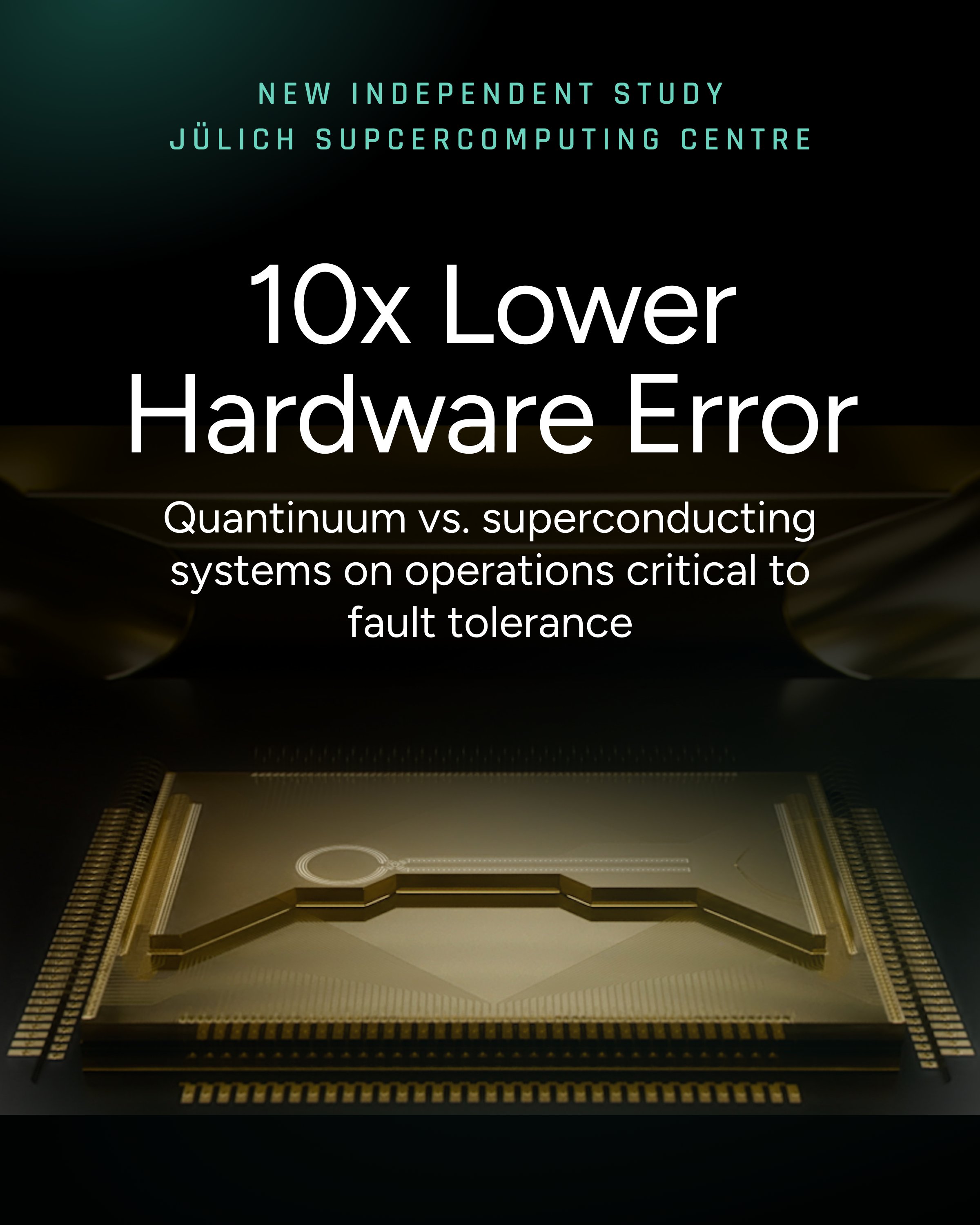
The demands of fault tolerance are bringing Quantinuum’s advantages into sharper focus. A new independent study from the Jülich Supercomputing Centre (JSC) found that Quantinuum's Helios system achieved approximately 10× lower effective hardware error than superconducting systems when evaluating fault-0tolerant operations.
This work builds on earlier independent research from Jülich that found Quantinuum’s systems led in physical-level performance. Now, that advantage is extending into the operations that will underpin fault-tolerant computation.
As we approach large-scale fault tolerance, the gap between quantum computing architectures is becoming increasingly clear.
This study provides further independent evidence that Quantinuum is building the architecture needed to meet that challenge and continuing to raise the performance bar.
Read our blog: quantinuum.com/blog/independ…
Big news: We've partnered with @uwanews to advance Australia's quantum capability, with a focus on developing the local workforce and accelerating the development of practical hybrid quantum-AI applications for the nation's most vital industries, such as critical minerals, energy, agriculture, and healthcare.
UWA researchers, students, and entrepreneurs will gain direct access to our world-class ecosystem, including Helios—the world’s most accurate commercial quantum computer—and our Nexus developer platform.
Together, we're also establishing a university-wide applications centre to combine advanced technology with hands-on training, expert support, and global partner networks to equip Australia for the next era of computing.
We're excited to work with UWA to help turn quantum potential into real-world applications that solve important challenges and create long-term economic value for Australia.
Read the full announcement: quantinuum.com/press-release…

What happens when quantum computing experts and computational chemists spend a week learning from one another?
At Quantinuum’s first InQuanto Summer School, 30 researchers came together in Cambridge for five days of lectures, workshops, and hands-on projects exploring the future of quantum chemistry.
The result was more than technical training. It was a chance to build a shared language, exchange ideas, and apply quantum computing concepts to real-world research problems.
Watch the highlights or read our recap: quantinuum.com/blog/from-the…
“This is not an experiment. This is not a simulation. This is real Helix results on a Helios quantum computer.”
As Quantinuum CEO Rajeeb Hazra said in his Quantum World Congress keynote, the race to fault tolerance isn’t about who can demonstrate a component in isolation or in a simulation. It's about who can make the entire fault tolerant architecture work together on real hardware.
Helix has already shown that path forward, delivering world-record logical performance beyond the physical layer today on the world’s most accurate commercial quantum computer.
While much of the industry is still validating individual building blocks, Quantinuum has integrated the full stack and shown it works together.
Watch the full keynote and read our full takeaways from #QWC2026 here: quantinuum.com/blog/quantum-…
The conversation at Quantum World Congress 2026 was clear: the next computing era requires more than a quantum computer, and progress must be measured by more than qubit counts and isolated technical achievements.
As our CEO Rajeeb Hazra shared in his QWC keynote, reaching utility scale requires progress across the full quantum stack: fault tolerance proven on real hardware, meaningful benchmarks, scalable and manufacturable systems, powerful developer tools, and applications creating real-world value for end users.
At the show, we saw encouraging signs of progress, but also reminders that individual milestones should not be mistaken for proof of scalable quantum computing.
1) 𝐅𝐚𝐮𝐥𝐭 𝐭𝐨𝐥𝐞𝐫𝐚𝐧𝐜𝐞 𝐫𝐞𝐪𝐮𝐢𝐫𝐞𝐬 𝐚 𝐜𝐨𝐦𝐩𝐥𝐞𝐭𝐞 𝐚𝐫𝐜𝐡𝐢𝐭𝐞𝐜𝐭𝐮𝐫𝐞. Demonstrating a simulated decoder, a logical-qubit milestone, or another individual building block is not the same as demonstrating fault tolerance. That requires an end-to-end architecture proven on real hardware that improves computational performance beyond the physical layer, like Quantinuum's Helix architecture.
2) 𝐐𝐔𝐎𝐏𝐒 𝐜𝐚𝐧 𝐡𝐞𝐥𝐩 𝐦𝐞𝐚𝐬𝐮𝐫𝐞 𝐫𝐞𝐚𝐥-𝐰𝐨𝐫𝐥𝐝 𝐜𝐨𝐦𝐩𝐮𝐭𝐚𝐭𝐢𝐨𝐧𝐚𝐥 𝐮𝐭𝐢𝐥𝐢𝐭𝐲. As quantum moves toward fault tolerance, customers need a transparent way to evaluate real computational capability. QUOPS, new from Sandia National Laboratories, can help shift the conversation from theoretical promises to measurable utility.
3) 𝐓𝐡𝐞 𝐢𝐧𝐝𝐮𝐬𝐭𝐫𝐢𝐚𝐥 𝐦𝐚𝐧𝐮𝐟𝐚𝐜𝐭𝐮𝐫𝐢𝐧𝐠 𝐫𝐚𝐜𝐞 𝐢𝐬 𝐨𝐧. Utility-scale quantum computing requires scalable designs and manufacturing and supply chain networks. The companies that lead the next era of computing will be those that can industrialize their innovations.
4) 𝐆𝐫𝐨𝐰𝐢𝐧𝐠 𝐭𝐡𝐞 𝐞𝐜𝐨𝐬𝐲𝐬𝐭𝐞𝐦 𝐫𝐞𝐪𝐮𝐢𝐫𝐞𝐬 𝐚 𝐩𝐨𝐰𝐞𝐫𝐟𝐮𝐥 𝐝𝐞𝐯𝐞𝐥𝐨𝐩𝐞𝐫 𝐩𝐥𝐚𝐭𝐟𝐨𝐫𝐦. Hardware is only part of the equation. Developers need software tools that make it easy to build quantum applications and integrate them into existing workflows. Nexus is already enabling more than 200 organizations and 1,000 developers to build, optimize, and manage hybrid workflows at scale.
5) 𝐑𝐞𝐚𝐥 𝐩𝐫𝐨𝐠𝐫𝐞𝐬𝐬 𝐢𝐬 𝐦𝐞𝐚𝐬𝐮𝐫𝐞𝐝 𝐢𝐧 𝐥𝐢𝐯𝐞 𝐝𝐞𝐩𝐥𝐨𝐲𝐦𝐞𝐧𝐭𝐬 𝐚𝐧𝐝 𝐫𝐞𝐚𝐥-𝐰𝐨𝐫𝐥𝐝 𝐫𝐞𝐬𝐞𝐚𝐫𝐜𝐡. The future of compute is quantum, AI, and HPC working together, so the true test of progress is deploying live hardware into production environments. Through collaborations with NVIDIA, Oracle, Pfizer, and others, Quantinuum is integrating quantum computing into the infrastructure and workflows where real value is created.
QWC reinforced an important reality: utility is not a promise. It's demonstrated capability.
Read our full key takeaways from #QWC2026: lnkd.in/giP9esat

This morning at Quantum World Congress, our CEO Rajeeb Hazra took the main stage with a simple message: the next era of compute is here.
It's an era defined by what becomes possible when quantum, AI, and classical systems work together to solve the world's hardest problems.
It starts with powerful quantum computers. Our industry-leading Helios system operates 24/7, powering real customer workloads and delivering a level of computational accuracy that would have been unfathomable for the industry even just a few years ago. And we have a plan to scale that capability to deliver the first fully fault-tolerant machine within the next three years.
But that future requires more than computational capability alone. It requires:
🟢 Developer accessibility: Empowering developers through platforms like Nexus, now used by 200 organizations, with annual job submissions growing 10x year-over-year.
🟢 Hybrid integration: Bringing quantum, AI, cloud, and HPC together in real production environments through deep integrations with leaders like NVIDIA, HPE, Oracle, and RIKEN.
🟢 Quantum + AI: Unlocking new possibilities by combining quantum and AI to accelerate discovery and solve complex real-world challenges.
We're excited to be building this next era of compute.
It was also great to connect with so many customers, partners, and industry leaders all week at QWC.
Stay tuned for our thoughts on the most important conversations from the show and the signals we believe separate real progress from promise.


