

The online magazine for critical conversation about the expanding art world. Our physical anthology of historic texts is available from @VetroEditions 📓
Joined January 2022
- Tweets11.1K
- Following605
- Followers10.1K
- Likes26.8K





Pinned Tweet
Welcome to the new Right Click Save.
Tired of the algorithm deciding what matters in art? We built something different.
A redesigned Magazine, a Forum for serious discussion, and an Index of the individuals, artworks & ideas defining digital culture.
rightclicksave.com

JUDGED BY INTENT, NOT MEDIUM | THE 2026 LUMEN PRIZE WINNERS
Gold to Kate Crawford and Vladan Joler. Plus Mimi Onuoha, Theo Triantafyllidis and Lauren Lee McCarthy.
By @knaack_nina:
rightclicksave.com/article/s…

Right Click Save retweeted

Thank you for having me ❤️☺️
There was so much to write of topic, yet so limited character amount 😄!
Personally I have neutral thought of every tool that exist, from digital and physical. I look into them without bias as I understand everything has their benefits and downfalls, also I like to study history and look deeply in topics. It's really about the point of views and how you use things.
If you like me to open more of what I speak of in the post and how I see the topic, here we go:
The past few years the wave of the anti-AI movement has risen. It began small when artists noticed big corporations had been using their work without consent, and has now reached the masses due to multiple reasons: from the data center battle ruining nature and livable environments, electricity cost rise, water pollution, lost jobs, to fatigue with AI-created content taking over all the platforms. In this text I will be just opening up big part what started the anti-AI movement, since it all started from the creative industry and copyright laws. It's not a whole story but tells where the unease got its wings and then grew.
What caused all this and how did it happen? What was before?
Early days of the invention of generative code, then evolving to the word AI when LLMs started to rise, AI was seen as a niche technology with potential to arrange and search information at a fast pace, and an experimental space for different mediums from music, tech and code to art. In visual art, AI started to raise its head for a bigger audience in the form of GAN (Generative Adversarial Network), then developing further into diffusion technology, which eventually brought it to the knowledge of a worldwide audience.
Before corporations noticed it and started to use it for financial gain, it was seen as a source of awe and fascination, "how is this possible?", as tech like this hadn't existed before. Early creators of this technology in the art world were playing by the same rules as all other artists and creators: They knew what copyright and IP are, what your usage rights are, and what is "Fair use". This is why artists and creators that didn't use AI had absolutely no issue with AI and what it represented; it was just a new innovation and a tool you could use in a creative way, and no one's original creations and data were used for gain.
Everything changed when corporations came into the picture and noticed they could abuse "Fair use", a rule in US copyright law (Section 107 of the Copyright Act): Fair use lets someone use copyrighted work without permission in limited cases, such as commentary, teaching, or parody. Judges decide case by case, weighing why the work was used, what kind of work it is, how much was taken and whether the use harms the original creator's market. A use that turns the work into something new, called "transformative", leans toward being allowed.
AI companies argued that training their models on millions of artworks was exactly that: transformative. In their view, the AI wasn't copying art, it was "learning" from it, the way a human student studies other artists.
Midjourney and Stable Diffusion launched in 2022, trained on billions of scraped images including living artists works, without consent or payment. People could even type an artist's name to copy their style or existing work. This meant the copyright law "Fair use" turned against itself: a law that was meant to protect creative freedom and creators themselves turned against itself, giving corporations and businesses all rights to access all data. Even if style cannot be copyrighted what is fed in the machines are, which causes the issue of illegal infringement.
Creatives and creators started to notice this, which then led to the first lawsuits at the beginning of 2023, with allegations of corporations using artists works without consent or compensation to build training sets. It's 2026 and the majority of these lawsuits are still not decided. It's been three years, and how it has affected the creative industry has been massive, and very unfair for small creators: How do you fight alone against a Goliath that created billions from your work and the work of all the other creatives around the world, when they can afford to destroy you just with the fees that one lawsuit causes?
In the USA, the first rulings in June 2025 went in the AI corporations favour on training, though those cases were about books, not images. Since then the picture has stayed unsettled: an appeals court ruled in September 2026 that training a competing AI tool was not fair use, and the US Copyright Office has stated that some training is fair use and some is not. Using pirated material has also proven costly, as Anthropic settled for $1.5 billion over pirated training data.
In short, about the ongoing law and what fired up the creators despise against AI:
- Work was taken without asking creatives, at massive scale
- Companies claimed it was legal under "Fair Use"
- Early rulings have been mixed, with the first ones favouring the companies
- Artists' own cases have been dragged since 2023 with no ruling
These are big issues that need solving. To not have just take only one side, we also have to take in the other side of the "Fair use" argument, when it is used in a constructive way in development and creativity. Many scholars have argued how fair use has always allowed new technologies to learn from existing work: like when Google scanned all the books for research. Is it seen as a service for the public, or something created only for financial gain?
Some have also argued that AI is trained and learns like humans learn to read, which has been criticised with a hard hand, as humans do not learn by copying billions of works and then compete against their makers in the market at industrial speed.
Fair use was originally created so that knowledge and creativity could keep moving forward, but humans never needed it to learn, as looking, reading and studying style is not copying. AI training on the other hand copies the works themselves, which is why the companies had to turn to fair use in the first place. And when a machine can push out thousands of images based on a certain creator’s data, it doesn’t just learn from their art, it competes with it. The market floods with work in their style, prices drop, clients choose the cheaper copy, and the original creator becomes harder to find in a sea of imitations, losing income or even their whole livelihood, as many creatives already have. This is exactly the market harm fair use was meant to prevent.
The topic and cases have generated lots of heated discussion between people for and against AI the past years, as there are equally as many people benefitting as suffering from the technology and the changes in the creative industry. Both sides have good and bad arguments, as you can use all tools for good and bad. The issue is that as long as people are pointing fingers at one another and finding culprits in the users of these tools, the big corporations stay satisfied, because people are not focusing on the cause of the issue but on the result, and corporations can keep on going as they are without any need to take responsibility for their creations. When it comes to all technology, each and every one also has their own responsibility to do their own research and look into it without bias, no matter whether you are or are not using any of the new tech. Only that way can we measure and see the full picture.
As we have gone through the beginning in short, you can say this was the first leg that began the anti-AI movement on a big scale in 2022. I remember when I first found out what AI is and learned in depth how it works around late 2020, but I first stumbled across it around 2017 when the pix2pix generator came out, where you could draw a random outline and the generative engine would turn your sketch into a cat. (And of course, when you make the mistake of sharing it with very mature friend of yours, it causes a group chat to fill up with pictures of hairy penises looking like cats.)
Honestly, I loved the beginning when I discovered the tech around the end of 2020, as it was all new. When I was doing my research on AI and what it involves, I stumbled across a website called Aiartists.org. Through that site I found one after another more fascinating people who used code and AI in different forms and ways in creativity: one dude created a plant farm that turned biological electricity into mining bitcoin, artists created massive artworks using robotic hands, others used real biology to create new species that do not exist, and lots more. Through the site I also found the creator and artist Joel Simon, who created the Artbreeder website, where you can generate GAN-based random pictures and textures with its Splicer tool, which runs on the BigGAN model, and everything created on the site is released as CC0. I used this app literally nonstop for a few years, as I fell in love with the technology. It became a big part of my art practice at the time, and I learned a lot from it, about the tech and also about myself, and how you can combine technology with my history of traditional art and digital painting.
One creator who caught my eye was Scott Eaton. He became one of my favourite artists immediately: he is a traditional sculptor and coder who uses GAN technology to train on nude model photography he has taken, which he then combines with code. This allows him to draw shapes and outline figures on paper that resemble humans, and the GAN transforms those shapes to resemble human bodies in real time. I was mind-blown by this back then, as I had never before seen tech like that. It's beautiful and perfect because of how you can use the professionalism of sculpting and fine art and combine it with new technology to create something new that neither world could create alone. There's no battle between the two, but perfect balance and harmony, as the intent is aligned with both.
The research of everything I had seen started rotating the thought cogwheels in my head about what possibilities the technology would bring in the near future in creative industries: how this technology would adapt to 3D to generate shapes just from outlines and pictures, how it would be used in the film industry when you can fill in missing frames or mask things out of pictures, how you could use it in the animation industry in rigging, in-betweening or style transfer, and so much more. As I am writing this I am still as excited for all of it, and surprised that everything I thought back then has become reality, but never in a thousand years did I think of all the negative sides it all brought with it. I guess we artists and creatives are such optimists about possibilities that we forget to think of potential harms.
I wonder, how would the industry be if copyright laws and IP rights had been ruled from day one? What would it be like if no artist's creativity had been used or ripped off without consent, and corporations had been ruled to follow the same laws as all artists and creatives? Would artists and creatives be using all this new technology with a positive mindset when they know that no one is abusing their creative work for financial gain? Would we be in a happier world where there was no war against AI, and lawmakers made sure technology was made only for good?
There's always good and bad in everything, some things depend on point of view, and some how things are used or applied. Yet, I am always positive about a better future what is to come even if there's wrinkles on the way, as the classic goes: even if the cup is half empty, it's also always half full.


Newsletter | The Artists’ Take on Handmade Art
Read it ▼
rightclicksave.beehiiv.com/p…

Right Click Save retweeted

Thank you for including us in @RtClick_Save 🙌
Newsletter | The Artists’ Take on Handmade Art
Read it ▼
rightclicksave.beehiiv.com/p…
Newsletter | The Artists’ Take on Handmade Art
Read it ▼
rightclicksave.beehiiv.com/p…
COMPUTER ART PIONEER HOLDS FIRST SOLO SHOW AT 95 | LESLIE MEZEI
A Paris gallery spent ten years tracking him down. He talks to Georg Bak:
rightclicksave.com/article/c…

Right Click Save retweeted

Some great exhibitions to check out during Paris Photo
DIGITAL ART EXHIBITIONS TO SEE DURING PARIS PHOTO 2026
Photography turns 200 this week. Where to see digital art at @ParisPhotoFair from @solienne_ai at @automataisart, to Leslie Mezei's first solo show at 95.
rightclicksave.com/article/d…

In Brief | DATALAND'S FIRST ARTIST RESIDENTS TAKE AI AS TOOL AND AS A SUBJECT IN "PLUS ULTRA"
New work by @mayaonthenet, @luciarebolino, Penny Slinger, and Jess Starns, made in six-month residencies at the LA museum of AI arts. Free at The Grand LA from December 2.
rightclicksave.com/article/d…


In Brief | THE CULT ECO-DOCUMENTARY KOYAANISQATSI HAS BEEN REIMAGINED AS AN INTERACTIVE AI SCULPTURE
Techno Firma, by Godfrey Reggio and John Fitzgerald, is trained on Reggio and Philip Glass's archives and reacts as visitors approach. At @pamm from November 21.
rightclicksave.com/article/t…

DIGITAL ART EXHIBITIONS TO SEE DURING PARIS PHOTO 2026
Photography turns 200 this week. Where to see digital art at @ParisPhotoFair from @solienne_ai at @automataisart, to Leslie Mezei's first solo show at 95.
rightclicksave.com/article/d…
Written two years ago, and still profoundly relevant ↓
rightclicksave.com/article/i…

Right Click Save retweeted

Thank you for including an excerpt from my interview last month on WYSIWYG!
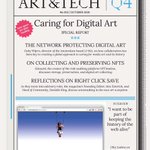
BREAKING NEWS: RIGHT CLICK SAVE RELEASES LATEST EDITION OF ART & TECH QUARTERLY
Read it here ↓
rightclicksave.com/article/r…

Right Click Save retweeted

Always a thrill to make it to @RtClick_Save!
This week: Our latest edition of Art & Tech Quarterly, Tokyo’s digital art scene, the future of media art, a $150k acquisition, and more.
Your weekly dispatch from the expanding art world ↓
rightclicksave.beehiiv.com/p…

This week: Our latest edition of Art & Tech Quarterly, Tokyo’s digital art scene, the future of media art, a $150k acquisition, and more.
Your weekly dispatch from the expanding art world ↓
rightclicksave.beehiiv.com/p…