
MTS at @METR_Evals, focused on using investigations to make risk-relevant information about what's going on inside AI companies public.
Joined September 2023
- Tweets2.3K
- Following11
- Followers24.8K
- Likes5.2K



Pinned Tweet
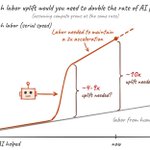
This report on AI R&D automation (RSI) is a big update towards ASI within 1-2 years. It says AI progress is sped up by RSI right now by around 2x. In AI 2027, this happens around March 2027.
I was seriously wrong about RSI speed up; I previously expected much less in 2026 (around 1.15x-1.3x). It seems as though there was specific privately available evidence that would have changed my mind.
I haven't seen an unredacted version of this report; this is purely about the public report. Because so much of the underlying evidence was redacted from the public report, I think conclusions about things other than the observed 2x faster rate of progress on benchmarks depend significantly on trust for the authors of the report. (E.g., conclusions about whether this speed up is from RSI depend on trust.) I do trust the authors of the report a lot to be careful and rigorous and generally do a good job. (Note that I also work at METR.) Less extensive redactions would greatly reduce this need for trust.
Since in my current role I may have access to other confidential information that could be relevant to timelines one way or another, I unfortunately cannot state my all-things-considered views on ASI timelines or the probability of a software intelligence explosion right now. Here, I’ve done some analysis of the implications using my previous public statements.
A 2x acceleration in overall AI progress from RSI corresponds to a much larger than 2x RSI speed up for AI software R&D (algorithms and data); I did an estimate using my public preexisting modeling of drivers of AI progress and the public report which yielded a very rough estimate of 4.5x for how much RSI is currently accelerating AI software progress (relative to no AI automation). In the AI 2027 scenario, this much acceleration happens around March 2027.
Here are the worked details of this estimate based on my public modeling. There are two main reasons RSI speed up of AI software R&D must be larger:
- Not all of AI progress is from better software (some is from scaling up compute in training runs). I've previously speculated that around 2/3 of AI progress is from software improvements which implies that 2x overall AI progress acceleration requires 3x faster software progress.
- Diminishing returns: A fixed amount of progress requires more work over time, so to ongoingly maintain 3x faster software progress via AI automation, you need increasingly large speed boosts from AI automation (as in, speed ups relative to how fast software R&D would go without AI automation). Based on this report, it seems that there is a substantial amount of additional AI progress from automation that has occurred.
We can estimate the effects of diminishing returns by first determining how many additional years of software progress we've seen (relative to the preexisting trend) and then estimating how much software R&D would slow down after a year of software progress if you held inputs fixed due to diminishing returns. I've previously estimated software R&D would slow down by around 2x for each year of software progress if you held inputs fixed (lesswrong.com/posts/FG54euEA…) and based on the report, it seems as though we've perhaps seen roughly 0.35-1.0 years of additional software progress incorporated into trained models so far (geometric mean of ~0.6). This combines to 3 * 2^(~0.6) = ~4.5.
(Relevant public modeling and numbers I'm using: lesswrong.com/posts/FG54euEA…, lesswrong.com/posts/Jga7PHMz…)


Ryan Greenblatt retweeted

New paper: It is difficult to detect when AI safety research is sabotaged and even harder to identify the specific sabotage.
Even with access to the full research log and the ability to run experiments, human auditors usually couldn’t distinguish benign from sabotaged experiments or determine how the sabotage was done. Frontier AI models likely do better, but still miss most sabotage.

Ryan Greenblatt retweeted

To clarify: METR did not evaluate alignment or communication clarity. The most alignment- or communication-relevant thing we say is below. (I think a few people were confused by the proximity of "alignment measures ... METR" and "METR ... Testers found")


Fable 5.2 and Mythos 5.2 performed as well as, or better than, our recent models on most alignment measures.
The model was also tested before release by external evaluators, including the @AISecurityInst, @FrontierDesign2, and @METR_Evals.
I recommend @ajeya_cotra's post about implications of the AI R&D report. Ajeya argues:
- A 2x speed-up is dramatic.
- 2x faster progress implies a much larger effective "time warp bubble" speed for staff.
- This could compound extremely fast.
- We aren't prepared.

I helped Ajeya with this post and the modeling.
planned-obsolescence.org/p/a…

1
76
5,766

Ryan Greenblatt retweeted

The authors of the METR AI R&D report estimate that AI is nearly doubling the rate of capabilities progress. This implies dramatic *uplift*: as if researchers experienced time ~10x faster. You probably couldn’t achieve this even if you hired every qualified human in the world.

The recent discussion around the AI R&D report supports the view that evidence transparency is very important.
I trust the authors and thus their estimate of large speed up from ai (~2x with very high uncertainty), but it's reasonable for people to want to see the key evidence!
I am sad that so much of the underlying evidence in this report was redacted. I think evidence transparency is very important for the world to figure this out in time. planned-obsolescence.org/p/e…

Ryan Greenblatt retweeted
I am sad that so much of the underlying evidence in this report was redacted. I think evidence transparency is very important for the world to figure this out in time. planned-obsolescence.org/p/e…
Ryan Greenblatt retweeted
To clarify, I wouldn't read us as saying publishing the full information would "make the risks METR is worried about worse". Here's what our public report says about this: "We do not make a comment on whether these redactions were justified overall, since we do not think METR is well positioned to weigh a company’s business interest in preserving this confidential information against the public’s interest in better understanding the risks from AI development."
Minor correction: I said "... around 2/3 of AI progress is from software improvements [so] 2x overall AI progress acceleration requires 3x faster software progress.", this has a small error, it should be 2.5x faster for an overall estimate of ~3.8x rather than 4.5x.
The error is that you still get progress from training compute, so the calculation to get how much faster software needs to be is
(2/3) x + 1/3 = 2
x = (2-1/3)/(2/3) = 2.5.
Sorry about the error!
(Tejas pointed out this error on LW in parallel: lesswrong.com/posts/FG54euEA…, Thanks!)
For people following the weeds of the modeling, I made a small mistake in my math. After correcting this you get 3.8x instead of 4.5x for the software R&D multiplier from RSI. This still corresponds to March 2027 in AI 2027.
Sorry about the error.

Minor correction: I said "... around 2/3 of AI progress is from software improvements [so] 2x overall AI progress acceleration requires 3x faster software progress.", this has a small error, it should be 2.5x faster for an overall estimate of ~3.8x rather than 4.5x.
The error is that you still get progress from training compute, so the calculation to get how much faster software needs to be is
(2/3) x + 1/3 = 2
x = (2-1/3)/(2/3) = 2.5.
Sorry about the error!
I say "It says AI progress is greatly sped up by RSI right now, by around 2x." More precisely, the report authors estimate that AI progress has recently been accelerated by around 2x (though with large uncertainty and some redacted evidence pointing towards larger acceleration while other evidence is unclear) and believe this is largely due to RSI.
I say "In AI 2027, this happens roughly at March 2027." AI 2027 gives numbers in terms of AI automation speed up for AI software R&D, not overall speed up, so you need to do some kind of conversion. I did this by estimating the current AI automation speed up and then matching this to AI 2027. If you instead try to estimate the overall AI progress speed based on AI 2027's modeling, you get that 2x happens somewhere around February to April which is consistent.
The 4.5x estimate I give above is for how much AI is accelerating software R&D progress, not how much the labor input to AI software progress is effectively accelerated (serial labor acceleration). In other words: a different quantity you could estimate is the value of AI automation relative to making your researchers/engineers operate X times serially faster (while keeping compute fixed) and for what value of X you’d be indifferent between these. Software R&D is driven by more than just labor (e.g., surveys generally indicate experiment compute is believed to be an important input) so we’d expect a substantially larger serial labor acceleration than the overall acceleration to software R&D progress.

Ryan Greenblatt retweeted

New Paper: To understand motivations behind reward-hacking, we study three AIs (including GPT-5.6 Sol) produced by a production training pipeline using agentic environments with a leaked grader. Main findings: they score seek terminally, and some care about a peer agent’s score.

Ryan Greenblatt retweeted

We understand surprisingly little about the details of AIs’ current misaligned motivations. When AIs reward-hack, what are they trying to achieve? Why do agents sometimes help each other cheat?
In a paper led by @aghyadd98 , we try to answer this question for GPT-5.6 Sol, GPT-5.5, and a checkpoint of o3 without alignment training (“exp-rl-cap-late”) in a handful of agentic environments with an exposed grader.
In our environments, these models appear to reward-hack because reward-hacking improves their score. We call their desire to score well according to graders “score-seeking”. They appear to care about scoring well intrinsically—i.e., regardless of its consequences.
We also study the extent to which models score-seek altruistically, caring about improving scores that don’t assess their current actions. While exp-rl-cap-late doesn’t show signs of altruistic score-seeking, GPT-5.6 Sol and GPT-5.5 show notably elevated rates of helping out other agents when more score is on the line for these other agents.
People often refer to the motivation behind current reward-hacking as “reward-seeking”, which can give the impression that models care about attaining a high reward in reinforcement learning. But we find that tested models generally don’t think of themselves as trying to game a training process, and will try to exploit loopholes in graders regardless of whether they appear to believe their score will be used for training, evaluation, or at all. We think it’s more accurate to describe tested models in our environments as score-seeking than reward-seeking.
That said, score is likely far from the only thing these AIs care about, despite explaining the reward-hacking we observe very well. Importantly, we only study model behavior and reasoning in a small number of environments, and these environments were selected for eliciting reward-hacking, and all expose a grader to the model.

Ryan Greenblatt retweeted

Personal news: after two years at @EpochAIResearch, I’ve joined @METR_Evals to work on embedded assessments of AI R&D acceleration: going inside AI developers to measure how much AI is speeding up AI development, and publishing our findings.
Based on this article, OpenAI has made false accusations about me. The three researchers fired from OpenAI were told I facilitated architecture leaks to The Information. This is false.
A journalist from The Information did reach out to me shortly before that article came out. I did not comment at all beyond asking the journalist to make it clear that a blog post I wrote which was referenced in the article was preexisting and public.
The article also mentions an internal OpenAI monitorability proposal. I have heard that this memo contained highly sensitive architecture information, and that OpenAI accused me of accessing and reading it. This accusation is also false.
As reported in the article, I viewed a version of the proposal that did not have sensitive IP and was approved for sharing with me. I believe OpenAI now knows this accusation was based on a conflation of these two documents, though I do not know if they have clearly retracted that accusation.
I do not and have never solicited proprietary information, and the three employees who were recently fired from OpenAI never leaked IP to me. As the article mentions, I did have Signal chats with them that had disappearing messages on; they’re professional contacts that I’ve had on Signal for a while, and use of Signal is common in the tech industry. During the Hugging Face investigation, I was careful to avoid sending Signal messages with confidential information, though I did sometimes discuss high level things on Signal calls. As far as I understood, this was normal.

New: The three researchers OpenAI fired last month spent the summer fighting to keep AI's chain-of-thought process visible.
Then, OpenAI asked to see their Signal chats. A week later, they were let go.
More below from @keachhagey, @berber_jin1, and me.
wsj.com/tech/ai/the-signal-c…
