







ALT Creating a molecular movie of penicillin biosynthesis: Researchers used ultrafast X-ray free-electron laser pulses to capture atomic snapshots of the enzyme as it reacted with oxygen. Combining these snapshots produced a molecular movie showing how nature builds the core structure of penicillin. (Greg Stewart/SLAC National Accelerator Laboratory)

ALT This image shows the orbital pathway of newly discovered dwarf planet candidate 2026 ED138 (ED138), as observed by NSF–DOE Vera C. Rubin Observatory. This image is a composite of multiple images captured by Rubin between 4 March and 11 July 2026 at intervals indicated by the teal circles. ED138 is visible at the center of each circle. (NSF–DOE Vera C. Rubin Observatory/NOIRLab/SLAC/AURA)

ALT A 3D abstract artwork featuring two layered grids with triangular peaks. The top grid is predominantly blue, and the bottom grid is mostly red. The grids' overlapping points create a dynamic, wave-like pattern on a black background.

ALT Inside the ICARUS detector. The detector uses liquid argon technology to detect charged particles created when a neutrino interacts inside it. (CERN)

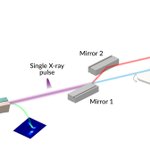
ALT Diagram illustrating an X-ray pulse setup with electron bunch entering an undulator. A single X-ray pulse is shown, passing through a series of mirrors labeled Mirror 1, Mirror 2, and Mirror 3, before splitting at Mirror 4 into two separate X-ray pulses. Credit: Greg Stewart/SLAC


ALT Composite photo with a background of dense stars and galaxies and a line tracing the orbital pathway of newly discovered dwarf planet candidate 2026 ED138 (ED138) on top of it. The line is a swooping blue line with small circles along it indicating where ED138 was when the photo was taken.

ALT A person inspects a large, complex machine, surrounded by numerous wires and equipment. The scene is brightly lit, showing intricate engineering and advanced technology. Data gathered from particle collider experiments using the BaBar detector at SLAC National Accelerator Laboratory, pictured here, were analyzed to search for traces of theorized dark matter particles known as dark photons. (Credit: SLAC National Accelerator Laboratory)


ALT Generate by AI Assist Dark abstract background with scattered glowing spots. Text reads: "Physics of the Universe" and "Invisible substance: how we are detecting dark matter." Credit: R Kaehler and Tom Abel/SLAC/KIPAC

ALT A graphic with large question marks and the text: "What is dark matter?" A text box explains: "An invisible form of matter that makes up 85% of all the matter in our universe. It interacts with gravity but doesn’t emit light." At the bottom, it asks, "So how do we find it?" The background features abstract wavy lines.

ALT A vibrant image showing cosmic rays as bright blue and orange streaks and spots against a dark background. Text overlay reads, "Fermi Large Area Telescope: A powerful instrument in space searching for excess high-energy gamma rays produced when dark matter particles annihilate or decay. Credit: NASA/DOE/Fermi LAT Collaboration

ALT An old-fashioned radio is set against a dark background with swirling lines and circles. Text boxes describe the Light Dark Matter eXperiment (LDMX) at SLAC, which aims to explore dark matter models, and a related experiment using superconducting devices to detect dark matter candidates.

ALT This graphic illustrates three proposed forms of magnetism reflected in three mirrors. The left mirror illustrates ferromagnetism, where all electronic spins point the same direction (up-up-up or down-down-down), creating an observable magnetic field. The right mirror illustrates antiferromagnetism, which has alternating electronic spins (up-down-up-down) that cancel each other out, producing no net magnetic effect. The center mirror illustrates the proposed form of altermagnetism, which exhibits properties of both ferromagnetism and antiferromagnetism. (Greg Stewart/SLAC National Accelerator Laboratory)