

Double Major in Physics and AI/ML (Minor in Math) | Building GraphDB at @hydra_db
Inside Equations
Joined August 2024
- Tweets2.5K
- Following706
- Followers25K
- Likes23.6K


Pinned Tweet
Big update to qwenFS: it can now hold 4x more files (128, up from 32) and persist them across chats.
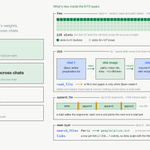
Every file gets a row in the model's own tables and each table now fills a full 128-row DeltaNet head. After every turn that changes something, the filesystem saves to a small disk image of about 3.5 bytes per token. A new chat mounts it and a file's text loads only when Qwen actually reads it, so nothing is lost when the context ends.
GitHub: github.com/vixhal-baraiya/qw…


First a CPU, then a GPU. A computer isn’t complete without storage.
Meet qwenFS: Qwen3.5-2B with a filesystem compiled directly into its weights. Nothing runs outside the model. It adds 8 layers in front of Qwen’s own 24, using attention to hold the files and Gated DeltaNet state to hold the tables.
Every save and read runs in the model’s own forward pass. A write stores its text in the copy layer’s attention log, keyed by file, version and offset. A read uses those same keys, so attention copies the text back exactly token by token.
vixhaℓ retweeted
Big update to qwenFS: it can now hold 4x more files (128, up from 32) and persist them across chats.
Every file gets a row in the model's own tables and each table now fills a full 128-row DeltaNet head. After every turn that changes something, the filesystem saves to a small disk image of about 3.5 bytes per token. A new chat mounts it and a file's text loads only when Qwen actually reads it, so nothing is lost when the context ends.
GitHub: github.com/vixhal-baraiya/qw…
First a CPU, then a GPU. A computer isn’t complete without storage.
Meet qwenFS: Qwen3.5-2B with a filesystem compiled directly into its weights. Nothing runs outside the model. It adds 8 layers in front of Qwen’s own 24, using attention to hold the files and Gated DeltaNet state to hold the tables.
Every save and read runs in the model’s own forward pass. A write stores its text in the copy layer’s attention log, keyed by file, version and offset. A read uses those same keys, so attention copies the text back exactly token by token.
vixhaℓ retweeted
First a CPU, then a GPU. A computer isn’t complete without storage.
Meet qwenFS: Qwen3.5-2B with a filesystem compiled directly into its weights. Nothing runs outside the model. It adds 8 layers in front of Qwen’s own 24, using attention to hold the files and Gated DeltaNet state to hold the tables.
Every save and read runs in the model’s own forward pass. A write stores its text in the copy layer’s attention log, keyed by file, version and offset. A read uses those same keys, so attention copies the text back exactly token by token.
Meet qwenGPU: Qwen3.5-2B with a SIMT GPU inside its weights, 45 compiled layers in front of Qwen’s own, using its Gated DeltaNet layers as registers and memory.
It runs real CUDA in its forward passes. The host compiles the kernel to PTX and loads it, then the model writes every step of the launch itself: every register, branch and memory write.
The GPU has 4-lane warps, a 4-stage pipeline, 15 registers per lane and 126 words of global memory, all held in DeltaNet state. Qwen generates each launch token by token, each record running one machine block for one warp.

vixhaℓ retweeted
Meet qwenGPU: Qwen3.5-2B with a SIMT GPU inside its weights, 45 compiled layers in front of Qwen’s own, using its Gated DeltaNet layers as registers and memory.
It runs real CUDA in its forward passes. The host compiles the kernel to PTX and loads it, then the model writes every step of the launch itself: every register, branch and memory write.
The GPU has 4-lane warps, a 4-stage pipeline, 15 registers per lane and 126 words of global memory, all held in DeltaNet state. Qwen generates each launch token by token, each record running one machine block for one warp.
Compiled a SIMT GPU and embedded it directly into Qwen3.5-2B’s weights. It’s not a plugin, an external tool, or an emulator.
None of the GPU’s weights are learned; every single one is computed by a compiler. It executes real CUDA code compiled to NVIDIA PTX directly inside the neural network.
Meet qwenGPU: Qwen3.5-2B with a SIMT GPU inside its weights, 45 compiled layers in front of Qwen’s own, using its Gated DeltaNet layers as registers and memory.
It runs real CUDA in its forward passes. The host compiles the kernel to PTX and loads it, then the model writes every step of the launch itself: every register, branch and memory write.
The GPU has 4-lane warps, a 4-stage pipeline, 15 registers per lane and 126 words of global memory, all held in DeltaNet state. Qwen generates each launch token by token, each record running one machine block for one warp.

Imagine this thing proving P = NP

The pace of AI progress in mathematics is getting ridiculous.
Just three years ago, we were impressed by GPT-4 solving school-level math. Then came IMO silver, IMO gold, progress on the Erdos conjecture, a claimed Navier–Stokes solution and 722 AI-written math manuscripts in a single release.
And now OpenAI says its AI has found a subexponential algorithm for 3-SAT.
Computer scientists have spent more than 20 years working under ETH, which says such an algorithm shouldn't exist. Hundreds of results about computational difficulty rely on that assumption.
I'm starting to wonder how many other things we've accepted as computational limits are going to be challenged in the next few years.
At this point, “P = NP next?”
If P = NP is proven, it technically means all digital security is fundamentally broken. If the proof is by contradiction, we wouldn't even have the fast algorithms to test our own defenses. We would be trapped in structural limbo: knowing our cybersecurity infrastructure is totally insecure in theory without knowing exactly how a malicious party could write the code to exploit it.
AI: I've proved P = NP
Also AI: Let's assume P ≠ NP

The pace of AI progress in mathematics is getting ridiculous.
Just three years ago, we were impressed by GPT-4 solving school-level math. Then came IMO silver, IMO gold, progress on the Erdos conjecture, a claimed Navier–Stokes solution and 722 AI-written math manuscripts in a single release.
And now OpenAI says its AI has found a subexponential algorithm for 3-SAT.
Computer scientists have spent more than 20 years working under ETH, which says such an algorithm shouldn't exist. Hundreds of results about computational difficulty rely on that assumption.
I'm starting to wonder how many other things we've accepted as computational limits are going to be challenged in the next few years.
At this point, “P = NP next?”
vixhaℓ retweeted
If AI proves that P = NP and we get algorithms that actually run in reasonable time. The whole structure of the economy would shift because so many of the coordination problems that currently require markets, prices and intermediate institutions would become direct computations instead.
One of the clearest places this shows up is in the basic question of whether any group of parties should exchange goods or services at all. Today that decision requires searching through an enormous space of possible reallocations.
For even a modest number of people and discrete items the number of ways bundles can move, coalitions can form and transfers can clear grows so fast that exhaustive search is impossible.
Checking a single candidate deal is easy once the valuations are written down but finding one that is mutually improving or stable is the hard part. Currency has always been a practical workaround for that hardness: a shared measuring stick that lets people price things locally and discover deals without anyone solving the full combinatorial problem.
With an efficient method for the search the parties can simply state their valuations, current holdings and constraints and receive a clearing allocation or the minimal transfers that make the exchange work.
The evaluation of whether the goods or services should move is then the output of the computation rather than something that depends on everyone already holding enough of a previously agreed unit.
Misreporting what you want and the usual problems of private information remain but the need for a circulating medium whose primary job is to make the existence of a multi-party reallocation discoverable in the first place largely disappears. Exchange then coordinates around the ability to solve the allocation problem directly.
If P = NP, money will no longer be necessary.
The pace of AI progress in mathematics is getting ridiculous.
Just three years ago, we were impressed by GPT-4 solving school-level math. Then came IMO silver, IMO gold, progress on the Erdos conjecture, a claimed Navier–Stokes solution and 722 AI-written math manuscripts in a single release.
And now OpenAI says its AI has found a subexponential algorithm for 3-SAT.
Computer scientists have spent more than 20 years working under ETH, which says such an algorithm shouldn't exist. Hundreds of results about computational difficulty rely on that assumption.
I'm starting to wonder how many other things we've accepted as computational limits are going to be challenged in the next few years.
At this point, “P = NP next?”
vixhaℓ retweeted

another development :)
my samsung TV loads a region specific convolutional neural network (LogoCNN.bin, cnn.mapping) which tracks your usage in app.
like in youtube it's looking for videos you watch, ads you skip, progress in a video, etc.
so glad they're interested in me.

At this point, "Yesterday was my last day at OpenAI/Anthropic" is basically the unofficial announcement of a new billion-dollar AI startup.

Yesterday was my last day at Anthropic.
I created Claude Code on desktop because I believe everyone can be a builder. Every feature request and bug report we got from this community was a gift that impacted millions of lives. I’m eternally grateful for those gifts, the product wouldn’t be what it is without you.
Anthropic is doing some of the most important work of our time. Contributing to that mission will forever be a career highlight for me. I never imagined I’d get to contribute to something so special in my lifetime.
Walking away from my best friends, a product I poured my heart into, and the mission was the hardest thing I’ve done in my career. But now I have some free time for GTA VI.
I'm already itching to get back to addressing all your feedback. I'll share what's next soon!
Auto mode default next week.
Translation: Fable 5.5 is good enough that Claude no longer needs your permission to not fuck up. You’re the liability now.
