

Head Coach at @rpgcoaching. Ex Pro Triathlete. 2x Asia Pacific, 3 x Australian Champion. 2016 Ironman 70.3 World Champion.
Byron Bay
Joined December 2009
- Tweets4.1K
- Following767
- Followers6.8K
- Likes6.2K



Triathletes that only breathe to one side while swimming often unknowingly end up with running and cycling injuries due to the bio-mechanical imbalances one sided breathing during swimming is causing.
Some common observations:
- When bike fitting athletes and I notice that a triathlete's pelvis is well out of alignment it's very typical that they also only breathe to one side in their swim training.
- Athletes who suffer a lot of foot and calf cramps down one side during the swim or lower back pain out of the swim and onto the bike, once they learn to race with bilateral breathing this can sometimes be alleviated. Breathing to one side can exacerbate S1 to S5 irritation commonly resulting in lower limb cramping. If it's your lower back causing these cramps and bi-lateral breathing doesn't help then there are other strategies that can help like cutting your wetsuit higher at the legs and learning to not hyperextend your spine so much especially while sighting.
- Bilateral breathing doesn't mean you have to be breathing every 3 or 5 strokes particularly with more intense swimming. Every 2 strokes is fine, you just have to learn to mix the sides. Ie- One lap breathe to your left, next lap breathe to your right.
Gradual progression is key.
1) Start adding in your non-dominant side with fins during your warm up and warm down. Once you can get the timing right with fins then move to step 2.
2) Include 25s or 50s alternating breathing side each lap. The 25s or 50s (depending on pool length) allow you to get a break between each lap and enjoy some momentum off the wall. Breathing to your non-dominant side is easier if you have some momentum so that the water is moving a little quicker away from your mouth as you take in a breathe.
3) Keep including 25s and 50s but also then add some longer intervals- 100, 200, 300s where you use paddles No pull buoy. You can either alternate breathing side each lap or do 1 x the interval length to one breathing side then alternate. The paddles again help you have some momentum to help the flow of water away from your mouth.
4) Start to implement getting closer to 50/50 left/right breathing throughout any zone 2 swimming or easier.
5) Zone 3 and above, start to implement short sections in intervals where you might do 3-4 breathes to your non-dominant side. Increase that number progressively as you get more comfortable with it.
While you'll probably drink your yearly dose of chlorine in the first few swims, stick with it and within 2-6 months, those that are consistent tend to become almost autonomous to the point they can hardly notice a difference in efficiency between sides.
🤖 Made with AI

2
10
817
If you're doing sweat testing via a sweat collection patch that gets sent off I would encourage you to do multiple tests to try and overcome the inconsistency and unreliability of the test results. Obvious dangers for both performance and long term health if you're building out a plan on very poor data.
Tests I've found to be consistently accurate when you test an athlete multiple times and cross check with another system.
- FLOWBIO sensor.
- Nix Hydration Bio sensor
- Precision Fuel and Hydration (uses pilocarpine iontophoresis with electrodes to stimulate local sweating on the forearm), a sweat collector, and a sweat analyzer to measure the sodium concentration)
1
5
726
Tubeless is great when it seals and Im told by many women that it rivals child birth when they don’t (not really) wishing you had just stuck to clinchers.
Enter Stan’s Tubeless Dart. This little baby will plug what would have been previously unpluggable punctures.
No affiliation with Stans. So you know that’s true- their sealant sucks. However go buy these plugs. Money well spent.

2
2
598
Having a set electrolyte target per hour in long endurance events that involve changing temperatures and terrain is one of the more common mistakes athletes make with their race nutrition and hydration.
Electrolyte needs vary with your sweat losses. If you lose 200ml of sweat in hour one and 2000ml of sweat in hour 6 the electrolyte needs should vary a large amount.
If you’re not losing a lot of electrolytes taking in a lot will make it very hard to digest and use your carb intake needs which typically remains relatively constant.
Visual demonstration of what I mean..

3
9
868
The paradox of fast swimming vs effort is always well demonstrated with my junior swim squad.
1- I have them swim their ‘best effort 50m or 100m.
2- Adequate rest.
3- Then repeat but at 90% effort.
Nearly all the kids swim faster at 90% effort.
4
19
1,424
Tim Reed retweeted

I could be wrong, but there’s something about lactate gels that I’m still trying to understand…
From my perspective as a chemical engineer and coach, I’m struggling to see how exogenous lactate supplementation could provide a meaningful advantage in athletic performance.
I understand the importance of lactate as a fuel and its role in energy metabolism. In fact, I find it fascinating how much we continue to learn about this molecule.
However, when I try to put things into numbers, a few questions come to mind.
For example, a gel containing 5 g of lactate provides roughly 18 kcal of potential energy. To put that into perspective, a 70 kg cyclist producing 300 W, assuming a mechanical efficiency of around 23%, may be expending approximately 19 kcal/minute.
Of course, the potential benefits may not be purely energetic. There could be effects on metabolic signaling, substrate utilization, or even specific applications during high-intensity efforts.
But this is where my main question comes in: if our bodies are already producing, transporting, and oxidizing substantial amounts of lactate during exercise, how much of an additional physiological impact can a relatively small exogenous dose really have?
And more importantly, would that impact be large enough to translate into a measurable performance improvement compared with a well-designed conventional fueling strategy?
I’m not saying these products don’t work, nor am I ruling out potentially interesting applications in specific competitive scenarios.
I simply think we should be careful when moving from an interesting physiological mechanism to conclusions about its practical benefits.
As a coach, I’m interested not only in whether something could work metabolically, but also in how much it actually improves performance, for whom, and under what circumstances.
And as a chemical engineer, I naturally find myself thinking about doses, concentrations, mass balances, kinetics, and the magnitude of the potential effect.
Maybe I’m missing something important, particularly from a metabolic signaling perspective. Perhaps the real value of exogenous lactate lies not in its energy contribution, but in its ability to trigger physiological responses that are not directly proportional to the amount ingested. That’s a possibility I’m genuinely interested in understanding better.
Because recognizing that lactate plays a fundamental role in athletic performance is one thing. Demonstrating that consuming it in gel form provides an additional performance advantage is another.
I’d genuinely love to hear from those researching this topic and better understand what the current evidence tells us.
At the end of the day, I think we’re all aiming for the same thing: a better understanding of physiology and better decisions based on evidence, rather than just promising mechanisms.
And one final thought: I genuinely believe we haven’t yet fully explored or exploited the potential of high-carbohydrate fueling strategies, particularly when it comes to optimizing carbohydrate availability, gut training, and individual tolerance.
Before looking for the next marginal gain through new substrates, I wonder how much performance we could still unlock by simply getting the fundamentals of carbohydrate fueling better.
Walking around Byron Bay and more cafes are shut then open when there are people everywhere. I’m assuming it’s because it’s not worth it given public hol wages are too outrageously high to pay?
1
4
298
All cyclists need to come to terms with the unavoidable risk. It’s not a matter of ‘if’ but ‘when’…
You ll cut your leg shaving.

3
362
For the majority of us some days you can play offence and some days it’s ok to just play defence.
6
441
Where many go wrong with dry land swim exercises..
Use ‘twittermafia30’ for an ongoing 30% off access to hundreds of hours of content for those hungry to learn, ask questions or politely debate any topics at less than cost of a Maurten gel per week.
Month to month option available. Cancel at any time to stop the next months debit.
rpg-coaching.circle.so/c/swi….

2
322
Australians and the political parties voice a lot of support for representation for gender and ethnicity and rightly so. Yet there is so little push for equal representation from politicians from the working class or for equal representation of age demographics. Less than 15% come from a working class background and average age of senators is 50.
Without fighting for more balanced representation on these two fronts the middle class, small business and younger Australians are going to continue to get screwed over.
3
318
Maybe farewell to one of my favourite bikes today 😭.
A bike Im so fond of this is almost an obituary.
My wife has a rule that if I haven’t ridden one of my bikes in my bike collection in six months I have to get rid of it. Of course I don’t get rid of any I just move them to my office where she can’t see them.
Yes, collecting bikes is a first world excess I partake in but I justify my habit with the reasoning that you could have 10 bikes, especially if you love older bikes like me and it’s far less expenditure than one expensive car.
The office is getting full so today I took my first road bike received when I signed with Trek in late 2015 out for a spin so I had a counter to my wife’s request to move it on. The 2015-16 Trek Emonda is from the tail end of the pro cycling era where the quite outstanding misbelief that aerodynamics was irrelevant for climbing stages.
Despite how delayed cycling has been to test basic things and being perpetually 5-10 years behind what pro triathlon is doing, I was still so stoked to own the last of the best non aero high end road bikes.
For sure it’s slower than the aero climber carbon steeds that I subsequently received but in terms of pure cycling joy due its feather like weight and feline responsiveness it’s a delight to be on board. No modern frame I ride or have ridden compares to that responsiveness.
Today’s training wheel pairing was a bog standard slow training rear wheel and tyre and the most underrated tech in cycling.. the Airhub front wheel. So yes I was forgoing the joy this Emonda can bring for safety in busy AM traffic with the Air Hub set at 2w/km penalty.
To further support my recent post that slowing down your bike in training is common sense in heavily trafficked areas, a car pulled out of a drive way without looking and hit me with enough force to give me a sore neck for the day and cracked my beloved Emonda. I was lucky. I’m just sad about the bike.
Without the Air Hub and slow set up the collision with the car would have been much higher impact.
Lessons from an aging but still not wise man.
1) Equip your bike to train slow, race fast.
2) You could probably buy a roadie like this Emonda in good condition for 700-800 bucks. Unless you’re racing at a high level please don’t think you need to fork out for a 10k bike to be able to stick with your friends on rides or simply enjoy cycling to get fit. Bikes are not cars. You the engine is the most important part of what will make it sing or not.


1
14
986

With how fast time trial bike set ups are getting I think it's very wise to run as slow a training set up as is practically possible.
The number one reason is safety. You have more time to react to the unexpected that appears in front of you.
There are also training benefits especially for the suburban/city based cyclist. You will end up spending less time at zero watts outdoors in training. You can pedal more of descents, you don’t have to free wheel or brake a long way off any potential hazard to trim the speed down and it's fun to come out on race day and shock the pants off all your training buddies who train on all their cycling bling.
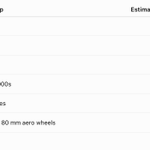
Some simple ideas to make 40/hr 100 watts harder below:
🤖 Made with AI


3
11
1,848
Top 3 jobs for anyone wanting to be a very high level amateur athlete*.
1) Firefighter
2) Teacher
3) NDIS Support worker.
Opinion based on 15 years of coaching and asking some of the other RPG coaches today for their opinion.
*in Australia at least. Can’t speak for the world.
1
7
407
Tim Reed retweeted

Most people assume rest fixes a painful tendon. It rarely does. Tendons need load to remodel. A tendon that is asked to do nothing does not repair itself; it deconditions further, and it comes back weaker the next time you ask something of it.
The full circle of cycling. My first real tri bike from 2010 ish.. and the Pog Machine. Supposedly 25 years of incredible aero innovation between the two bikes :)


1
5
382
As a fairly centre left fella it hurts me to say this but with the way small business in Australia gets penalised at ever corner I'll be recommending to my kids to never consider staring their own business and be an employee unless they're 100% sure they're idea is mega profitable.
Every government organisation is so inefficient and to start to balance the budget instead of fixing that low hanging fruit small business get smashed over the head again. A correction will be forced by voters and history shows we tend to overcorrect which is a shame but likely inevitable.
2
382