

Engineering @Uber, from practice to people. https://teapaw.org/t.co/iIenzuSNxH ✨
Global
Joined June 2014
- Tweets11.6K
- Following5.3K
- Followers72.2K
- Likes18.7K








Every tool an AI agent can use expands its capabilities and its attack surface. Even an authorized action can take an agent somewhere the user never intended.
Uber engineers are building protections across the agent lifecycle to keep actions aligned with user intent and session context. Making those controls effective in production means balancing security with latency, autonomy, and legitimate tasks.
See what we learned about designing and deploying agent security:


More than 200,000 CPU cores power Uber’s data lake ingestion. At that scale, every efficiency gain counts.
Making better use of that compute means examining how Spark executes queries, moves data, and writes to growing tables. Accelerating one stage can leave other bottlenecks untouched.
Uber engineers are improving production workloads with native vectorized execution and evaluating new ways to accelerate write-heavy pipelines.
Explore the engineering choices behind those efforts, where the benchmarks showed gains, and what remains to be optimized.

Technical talks, fresh perspectives, and a community ready to connect. Our mini GHC day at Uber had plenty to celebrate!
After the cancellation of GHC, the Uber community rallied to talk engineering and have some fun. We were especially excited to welcome @EricaLockheimer from HumanizeHer to share her experience and perspective.
Thanks to everyone who took the stage and joined the conversations!


One shared codebase. Multiple teams. A display ads deployment that could force unrelated rollbacks.
As Uber’s ads marketplace grew, teams needed independent deployments without splitting the platform into separate ad servers.
See how Uber Engineering used isolated production fleets to reduce deployment coupling, and why runtime failure isolation wasn’t enough: uber.com/us/en/blog/designin…

Over 1 million lines of dead code removed. 🧹
Meet AutoClean, Uber's AI-powered system that's cleaned up 16,000+ stale feature flags using AI agents, deterministic code transformations, and validation.

At Uber's scale, serving millions of translations per second makes memory efficiency critical.
We reworked how translations are stored and cached, cutting CPU usage by over 30% and reducing the initial cache memory footprint by over 90%, all while maintaining low latency.
🔗 uber.com/us/en/blog/translat…


New research from Uber Engineering 🔬
How do you keep AI agents focused on what they’re actually designed to do and block malicious attacks that attempt to manipulate agents into doing things they weren’t designed to do?
Our researchers explore exactly that with Persona Guardrail, a production-grade defense framework for agentic systems.
Congrats to the team behind the work! 👏
Read the paper: arxiv.org/abs/2610.03434

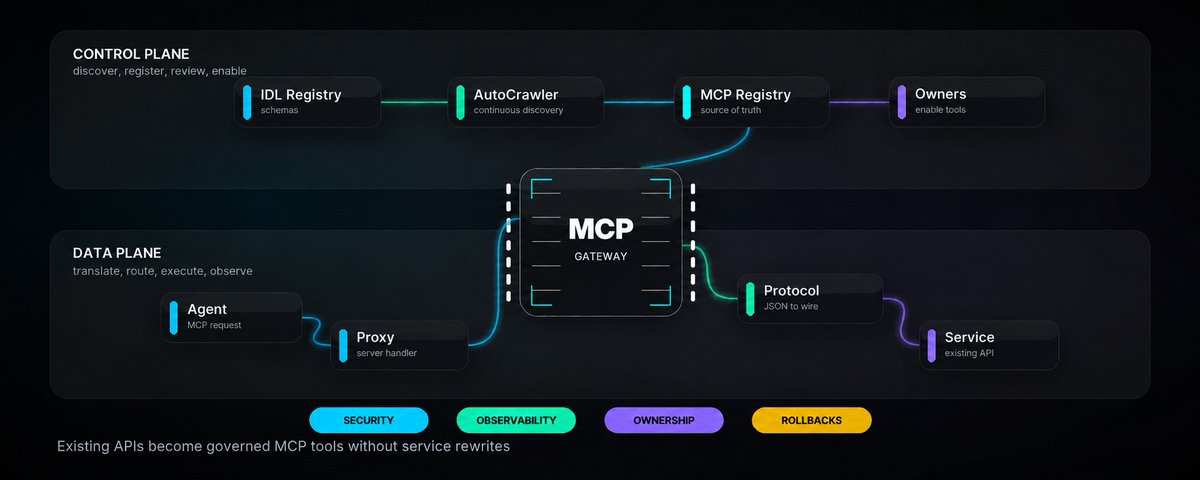
What does it take to scale MCP across Uber?
Our latest engineering deep dive traces Uber’s MCP journey. From early, community-driven adoption to building MCP Gateway, a centralized platform designed to make AI-powered developer workflows easier to discover, manage, and scale.
The team dives into how MCP Gateway brings together discovery, control, and proxy layers to connect AI agents with Uber’s existing backend systems.
Featuring work from several authors recently recognized in the @AgenticAIFdn newsletter, the team unpacks the architecture, challenges, and lessons behind building MCP Gateway.
And if you missed it, check out the team’s Agentic AI Foundation newsletter-featured blog, “How Uber Protects Against Retry Storms”
uber.com/us/en/blog/protecti…

What if a node failure didn’t have to ripple across your cluster?
M3DB’s subclustered placement algorithm creates smaller, self-contained failure domains—limiting shard migration impact, enabling safer parallel operations, and making large clusters easier to reason about. ⬇️
uber.com/us/en/blog/from-cha…
8
5,705
How do you keep ML features consistent at 8M QPS?
We built a feature logging framework that selectively captures the features used at inference for training, reducing training-serving skew without logging trillions of unnecessary rows.
See how it works. ⬇️
uber.com/us/en/blog/taming-m…
9.5M unnecessary requests. Stopped.
Uber’s error ownership system identifies where failures originate so retries happen where they can actually help, not repeatedly across the call chain.
The result: max retry storm radius dropped from up to 25 levels to 3.
uber.com/us/en/blog/protecti…
At Uber’s scale, tracing every failure across a complex service mesh isn’t practical.
So we built a system that automatically maps how failures propagate across dependencies—helping us identify hard dependencies and strengthen reliability.
uber.com/us/en/blog/automate…

⚡ We cut Uber Eats search latency in half.
How? Measure. Identify. Fix. Validate. Repeat.
An AI coding agent helped us find bottlenecks, test fixes, and validate impact—turning optimization into a continuous feedback loop.
See how → uber.com/us/en/blog/uber-eat…

Across all agentic tools and all employees at Uber, weekly active users have grown 7x and weekly agent requests have grown 9.4x.
Despite that growth, total AI spend has relatively stabilized and cost per token has decreased.
In our latest blog, we break down the architecture and operational choices driving AI efficiency at scale, including better prompt caching, access to 1,000+ internal and third-party MCP servers through a single gateway, and an AI Context Graph spanning 30+ internal systems.
The result? Cost per 1,000 requests for a given frontier model has fallen 34% from its peak, and cost per session is down 52%.
Learn more ⬇️

A query can return few records and still scan years of data.
At Uber, we reduced the cost of these “needle in a haystack” export workloads by combining Apache Hudi column stats with predicate-column sorting for selective file pruning.
🔗 Read more: uber.com/us/en/blog/running-…
