

Payments, banks, AI, stablecoins. I follow the money and find who's taking a cut.
World
Joined May 2013
- Tweets7.8K
- Following578
- Followers945
- Likes11.2K



Pinned Tweet
This is going to be absolute chaos.
Nearly $500 billion is chasing an IPO initially sized at $64.4 billion.
Retail investors alone ordered almost $100 billion. Anthropic planned to give them no more than 20% of the deal.
A $1.4 trillion company is about to start trading with demand many times larger than the shares available.
Good luck finding a sane opening price.

BREAKING: Anthropic's IPO has now attracted nearly $500 billion in investor orders, per CNBC.
Institutional demand has reached ~$400 billion, while retail orders are approaching $100 billion.
The company is now considering expanding its IPO and pricing shares above $80, above the initial range of $70 to $78 per share.
Anthropic is also considering raising more than the initially planned $64.4 billion.
Bitcoin bounced back above $60,000. The S&P 500 just lost 8.6% in a week.
That green candle could be the beginning of the recovery everyone wants.
It could also be just enough hope to get people buying before the next leg down.
GDP and PCE land together Wednesday morning.

Key Events This Week:
1. November S&P Global Services PMI data - Monday
2. November S&P Global Manufacturing PMI data - Monday
3. November Consumer Confidence data - Tuesday
4. October PCE Inflation data - Wednesday
5. US Q3 2026 GDP data - Wednesday
6. October New Home Sales data - Wednesday
7. US Markets Closed, Happy Thanksgiving! - Thursday
A short but eventful week ahead.
1
4
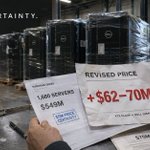
That’s some price certainty.
XTX Markets says it paid Dell an extra $5 million to lock in the price of an order for 1,680 servers.
The order was worth about $549 million.
Delivery slipped by two months. Then Dell said component costs had risen and demanded another $62 million to $70 million, according to XTX’s court filings.
XTX says Dell admitted it was “embarrassed” by the situation but wasn’t willing to lose tens of millions of dollars on the deal.
XTX sued in Ireland. Dell disputes the claims.
The servers were still being delivered when the case reached court in June.
By the hearing, XTX had placed around $70 million in escrow pending trial.

4
30
apollo440 | money retweeted
A Jewish family sold this Van Gogh for 68,000 Swiss francs in 1936.
Ninety years later, their heirs nearly stopped its $190.43 million sale.
Samuel Fischer had bought Châtaigniers en fleurs in 1909. It passed to his widow in 1934, then left the family through an Amsterdam gallery two years later.
His heirs claimed Nazi persecution had forced the sale. They wanted evidence that the family would have sold on the same terms without that pressure. Sotheby’s said its research had not established duress or a below-market price.
The Argentine Blaquier-Arrieta family had bought the painting in 1975. After 51 years of ownership, they were preparing to sell when the Fischer heirs asked Sotheby’s to withdraw it from the November 18 auction.
On November 17, the two families reached a confidential agreement. The painting would stay in the sale.
The next evening, three bidders competed for less than four minutes.
The hammer fell at $165 million.
With fees, the buyer’s bill reached $190.43 million. A new auction record for Van Gogh.
The price is public.
The terms that made the sale possible are not.

What an expensive change of mind.
Ben Chestnut and Dan Kurzius spent 20 years building Mailchimp before selling it to Intuit for about $12 billion in 2021.
Five years later, Intuit has agreed to sell it to Bending Spoons for $3.68 billion. The deal is expected to close in early 2027.
Intuit borrowed $4.7 billion to help fund the original purchase.
That acquisition loan alone was larger than the entire price Bending Spoons has now agreed to pay for Mailchimp.
And Intuit is making another bet on the way out.
It has agreed to put $368 million of the sale proceeds straight into shares of Bending Spoons.

A Jewish family sold this Van Gogh for 68,000 Swiss francs in 1936.
Ninety years later, their heirs nearly stopped its $190.43 million sale.
Samuel Fischer had bought Châtaigniers en fleurs in 1909. It passed to his widow in 1934, then left the family through an Amsterdam gallery two years later.
His heirs claimed Nazi persecution had forced the sale. They wanted evidence that the family would have sold on the same terms without that pressure. Sotheby’s said its research had not established duress or a below-market price.
The Argentine Blaquier-Arrieta family had bought the painting in 1975. After 51 years of ownership, they were preparing to sell when the Fischer heirs asked Sotheby’s to withdraw it from the November 18 auction.
On November 17, the two families reached a confidential agreement. The painting would stay in the sale.
The next evening, three bidders competed for less than four minutes.
The hammer fell at $165 million.
With fees, the buyer’s bill reached $190.43 million. A new auction record for Van Gogh.
The price is public.
The terms that made the sale possible are not.
apollo440 | money retweeted
Players bought 32.5 million copies of GTA VI before release day.
By the end of its first day, Rockstar estimated worldwide retail sales at $3.79 billion.
That is what 13 years of waiting looks like when it finally reaches a checkout.
But selling the game is only one layer of Take-Two’s business.
In its latest quarter, 81% of companywide net revenue came from virtual currency, add-ons, in-game purchases and advertising.
The launch answered whether millions of people would pay to enter GTA VI.
Now the financial question is how long they will keep paying once they are inside.

GTA 6 is not even fully live yet and PlayStation Network is already struggling.
Europe and the US are still hours away.
This launch is going to test every weak point in gaming infrastructure.
1
11
371
apollo440 | money retweeted
This is the part AI companies may be underestimating.
They are racing to remove every bit of friction from shopping. But 37% of Americans avoiding AI for holiday purchases say it removes the personal touch.
For gifts, the effort may be part of the product.

Americans are turning against AI for holiday shopping, even as tech companies race to build it.
72% of Americans don’t plan to use AI for holiday shopping this year, up from 49% last year, per a Bank of America survey reported by Fortune.
Why people say they’re skipping it:
- Personal or ethical reasons: 42%
- It takes the personal touch out of gift-giving: 37%
- They don’t trust AI recommendations: 26%
apollo440 | money retweeted
This is completely unhinged.
Masayoshi Son approached Wall Street firms about financing a possible $1 trillion buyout of SK Hynix.
That would have been nearly five times the value of Vodafone’s $203 billion takeover of Mannesmann, the largest deal on record.
He wasn’t trying to buy another AI app. SK Hynix makes the high-bandwidth memory used in advanced AI chips, including Nvidia’s.
The idea never reached an agreement. SoftBank says it is no longer under active consideration. SK Hynix says it had no knowledge of the plan. Any foreign acquisition would have required approval from the Korean government.
No announced bid. No agreement.
Wall Street still got the trillion-dollar question.

Players bought 32.5 million copies of GTA VI before release day.
By the end of its first day, Rockstar estimated worldwide retail sales at $3.79 billion.
That is what 13 years of waiting looks like when it finally reaches a checkout.
But selling the game is only one layer of Take-Two’s business.
In its latest quarter, 81% of companywide net revenue came from virtual currency, add-ons, in-game purchases and advertising.
The launch answered whether millions of people would pay to enter GTA VI.
Now the financial question is how long they will keep paying once they are inside.
GTA 6 is not even fully live yet and PlayStation Network is already struggling.
Europe and the US are still hours away.
This launch is going to test every weak point in gaming infrastructure.
1
11
371
apollo440 | money retweeted
This is a brutal ending for an airline.
Spirit Airlines shut down in May.
Now a bankruptcy judge has approved Google’s $10 million purchase of its internal business data for product development and AI training.
The archive includes material drawn from employee emails, Teams messages, spreadsheets, calendars and operating systems.
More than 120 lawmakers raised concerns.
Passenger data from 97 million customers was excluded. Employee medical information and other sensitive records were carved out. The remaining data must be de-identified.
But the core transaction survived.
Bankruptcy used to end with selling the planes.
Now the emails keep working for someone else.

This is the part AI companies may be underestimating.
They are racing to remove every bit of friction from shopping. But 37% of Americans avoiding AI for holiday purchases say it removes the personal touch.
For gifts, the effort may be part of the product.
Americans are turning against AI for holiday shopping, even as tech companies race to build it.
72% of Americans don’t plan to use AI for holiday shopping this year, up from 49% last year, per a Bank of America survey reported by Fortune.
Why people say they’re skipping it:
- Personal or ethical reasons: 42%
- It takes the personal touch out of gift-giving: 37%
- They don’t trust AI recommendations: 26%
This is completely unhinged.
Masayoshi Son approached Wall Street firms about financing a possible $1 trillion buyout of SK Hynix.
That would have been nearly five times the value of Vodafone’s $203 billion takeover of Mannesmann, the largest deal on record.
He wasn’t trying to buy another AI app. SK Hynix makes the high-bandwidth memory used in advanced AI chips, including Nvidia’s.
The idea never reached an agreement. SoftBank says it is no longer under active consideration. SK Hynix says it had no knowledge of the plan. Any foreign acquisition would have required approval from the Korean government.
No announced bid. No agreement.
Wall Street still got the trillion-dollar question.
This is a brutal ending for an airline.
Spirit Airlines shut down in May.
Now a bankruptcy judge has approved Google’s $10 million purchase of its internal business data for product development and AI training.
The archive includes material drawn from employee emails, Teams messages, spreadsheets, calendars and operating systems.
More than 120 lawmakers raised concerns.
Passenger data from 97 million customers was excluded. Employee medical information and other sensitive records were carved out. The remaining data must be de-identified.
But the core transaction survived.
Bankruptcy used to end with selling the planes.
Now the emails keep working for someone else.
apollo440 | money retweeted
This is an insane amount of blame to put on one IPO.
Anthropic entered a market already running for the exit. Now its IPO is being blamed for the stampede.
The S&P 500 peaked on October 6. Anthropic listed on November 19.
By then, quarterly Big Tech CapEx had reached a record $201.9 billion, the Fed was hiking, Nvidia had fallen 40%, AMD was facing China-chip allegations and hedge funds had posted their largest six-week tech outflow in over a decade.
And the reported $500 billion IPO order book was not $500 billion pulled out of the market.
The offering raised $81.3 billion. Most of the requested shares were never allocated.
Anthropic may have tightened liquidity for a session.
It did not erase $6 trillion over 45 days.
The selloff hit Anthropic. Anthropic did not create the selloff.

apollo440 | money retweeted
This got expensive very quickly.
Anthropic’s first public buyers paid $111.50.
Less than a day later, the stock is at $87.58. They are already down more than 21%.
IPO investors who paid $83 are still sitting on a gain.
Same stock. Two completely different IPOs.
BREAKING: Anthropic stock, $ANT, extends losses to -10% in premarket trading, now down -25% from its post-IPO high.
The stock is now 5% away from its IPO price of $83/share.

This is an insane amount of blame to put on one IPO.
Anthropic entered a market already running for the exit. Now its IPO is being blamed for the stampede.
The S&P 500 peaked on October 6. Anthropic listed on November 19.
By then, quarterly Big Tech CapEx had reached a record $201.9 billion, the Fed was hiking, Nvidia had fallen 40%, AMD was facing China-chip allegations and hedge funds had posted their largest six-week tech outflow in over a decade.
And the reported $500 billion IPO order book was not $500 billion pulled out of the market.
The offering raised $81.3 billion. Most of the requested shares were never allocated.
Anthropic may have tightened liquidity for a session.
It did not erase $6 trillion over 45 days.
The selloff hit Anthropic. Anthropic did not create the selloff.
apollo440 | money retweeted

Nikita Bier on How to Grow on X (A practical Guide)

ALT Nikita Bier on How to Grow on X (A practical Guide)


This got expensive very quickly.
Anthropic’s first public buyers paid $111.50.
Less than a day later, the stock is at $87.58. They are already down more than 21%.
IPO investors who paid $83 are still sitting on a gain.
Same stock. Two completely different IPOs.
BREAKING: Anthropic stock, $ANT, extends losses to -10% in premarket trading, now down -25% from its post-IPO high.
The stock is now 5% away from its IPO price of $83/share.
apollo440 | money retweeted
Anthropic’s founders just cashed out $1.96 billion.
Their promise to give away 80% can be revoked.
All seven sold roughly 3.4 million shares in the IPO, worth about $280 million each before fees and taxes.
The same prospectus says every founder pledged to dedicate 80% of their personal Anthropic equity to philanthropy.
Then comes the fine print: the pledges are voluntary, revocable and not legally binding. The timing, amount and recipients are all uncertain.
The IPO sale does not prove anyone abandoned the pledge.
It does show who holds the final decision.
Anthropic put public benefit in the prospectus.
Its founders kept the right to change their minds.

apollo440 | money retweeted
This is getting much worse for Nvidia.
Days after Jensen Huang resigned, California’s attorney general subpoenaed the company.
The state is investigating whether Nvidia or Huang’s actions resulted in advanced chips or confidential information reaching China, and whether Nvidia misled investors about that risk.
The subpoena follows reports that Huang had an affair with Chinese businesswoman Alice Huang. Some US officials reportedly suspect she may have intelligence ties. Her exact relationship remains unresolved, and there is no evidence Nvidia knew of any alleged connection.
No transfer, deception or legal violation has been established.
Huang is due for a transcribed interview before three House committees on December 1.
Nvidia’s general counsel follows on December 2.
