





Auron𒀭 retweeted

LLMs process text from left to right — each token can only look back at what came before it, never forward. This means that when you write a long prompt with context at the beginning and a question at the end, the model answers the question having "seen" the context, but the context tokens were generated without any awareness of what question was coming. This asymmetry is a basic structural property of how these models work.
The paper asks what happens if you just send the prompt twice in a row, so that every part of the input gets a second pass where it can attend to every other part. The answer is that accuracy goes up across seven different benchmarks and seven different models (from the Gemini, ChatGPT, Claude, and DeepSeek series of LLMs), with no increase in the length of the model's output and no meaningful increase in response time — because processing the input is done in parallel by the hardware anyway.
There are no new losses to compute, no finetuning, no clever prompt engineering beyond the repetition itself.
The gap between this technique and doing nothing is sometimes small, sometimes large (one model went from 21% to 97% on a task involving finding a name in a list). If you are thinking about how to get better results from these models without paying for longer outputs or slower responses, that's a fairly concrete and low-effort finding.
Read with AI tutor: chapterpal.com/s/1b15378b/pr…
Get the PDF: arxiv.org/pdf/2512.14982

Auron𒀭 retweeted

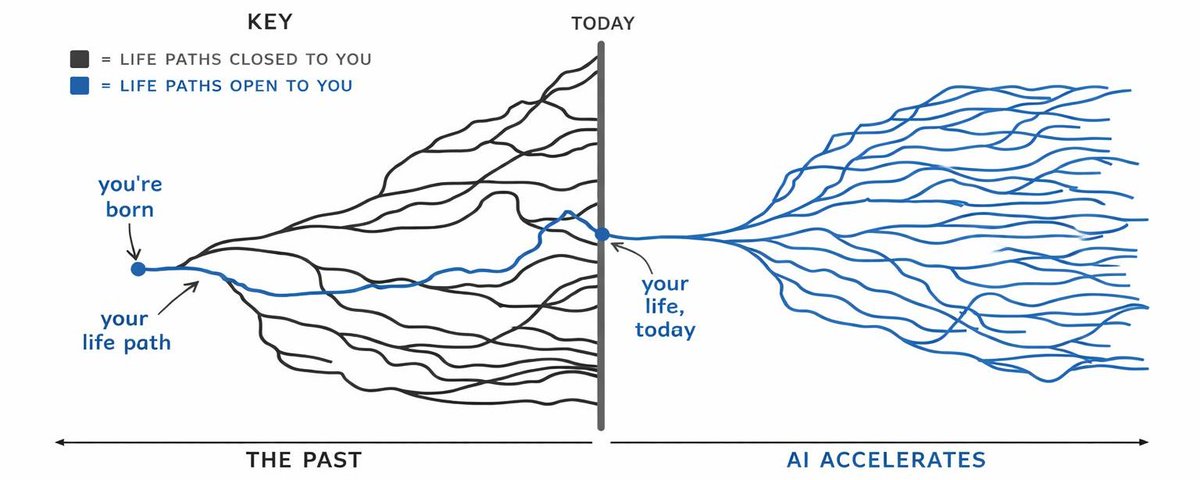
Readers added context they thought people might want to know
Chart is a blatant copy of Tim Urban's site without citing the author.
waitbutwhy.com
Auron𒀭 retweeted

Hard assets needed to build the future (rare earths, uranium, copper, gold) and companies that benefit from AI development (google, amazon)
Auron𒀭 retweeted

you wake up and reach for your phone before your eyes focus. scroll through a hundred thoughts that aren’t yours until your own voice sounds like someone you used to know and by noon you’ve consumed more information than your grandparents did in a year but can’t name a single thing that actually moved you. the feed keeps serving up other people’s lives and you keep swallowing them whole, mistaking the fullness for satisfaction when really you’re just bloated on nothing. you’ve become a processing unit instead of a person and the loneliest part is how normal it feels.


Yap early, yap only, yap often.
@_kaitoai is connecting AI, attention and capital with Yaps.
Just claimed my social card and I'm accumulating Yap points in real-time.
Claim yours 👉 yaps.kaito.ai/referral/13728…


Auron𒀭 retweeted

A question I’ve been asked a lot lately: Are memecoins here to stay as the dominant mindshare of the market? I've put together some thoughts on the topic and history on how we got here.
To start, I believe the following are the primary factors driving memecoin dominance:
1. Low amount of new innovation in the space despite consistent demand for new tokens (has crypto reached the limits of what it can do without introducing elements of centralization?)
2. Intentional removal of token utility means no limit to calculated valuations
3. Retail desire to put power back in their own hands
4. High user signup conversion on memecoin listings incentivizes exchanges to list many low quality tokens
To understand how long these factors are likely to last, let's dive into each of them with a bit of historical context.
Starting with some history on innovation in the space, we see an interesting progression of technical refinement which to some extent can be simplified to:
2016: Basic smart contract functionality; Eg., The DAO, Etherdelta
2017: Crypto For Everything. Eg., Tokens for dentists, tokens for taxis, etc.
2021: Crypto For Finance + NFTs. Eg., Lending, AMMs, DeFi, collectibles
2023: Infra. Eg., L1s, cheaper / faster txns, etc.
2024: Memes
At first this might all seem uncorrelated, but there’s actually a very clear progression of reduction in scope here. Over these years, the tech starts as a wild west where the possibilities are seen as endless, and with each cycle hones in on more and more specific utility, until it reaches a perceived limit of what can be done purely within the scope of a decentralized network without using non-decentralized elements. After this limit is somewhat reached in the 2021 cycle, we see a significant slowdown in interesting new dApps produced, and the market then begins focusing on improving the infrastructure instead. While infrastructure improvement can continue across many cycles, retail mindshare has a shorter attention span, and with no other innovation to be found it eventually defaults to memes. It's worth noting of course, that memes have always had significant attention; Doge for example, peaked at $80B market cap in 2021. The distinction though is of memes being the foremost trend focus.
This brings us to the second factor behind memecoin mindshare: theoretical valuations. It’s been a long running joke that the most valuable projects should never ship a real product, because then their valuation becomes immediately quantifiable. Except unfortunately, this isn’t even really a joke. DeFi in 2024 is a prime example of this: in an efficient market, investors will take less than 5 minutes to look at a project’s baseline, slap a 20x P/E on it, and decide it shouldn’t be worth a penny more. This is by far the largest reason that DeFi struggles to have a bull market again in the current cycle.
In 2021 we saw some projects cleverly design their tokenomics to be so complicated that few could tell what the real revenue actually was or whether the project was sustainable. This arguably led to some of the best ponzis of the cycle, but ultimately crashed hard enough that market appetite for opaque tokenomics hasn’t returned. So of course, for meme coins the solution is simple- throw utility out the window altogether, and the project is no longer quantifiable. Brilliant! Amusingly, memecoins this cycle that have attempted to add utility have often hurt their valuations by doing so.
The most straight-forward reason for memecoins dominating this cycle is of course the desire of retail investors to bring power back from VCs and institutions to the hands of the little guys. The reality of course, is that it’s only a slight shift in where the bulk of the profits end up going, and unfortunately it’s still not to retail. Instead, it’s a shift from VCs to “sharks” in the space. In essence, lean teams of incredibly efficient participants that understand how to corner the supply of a token, market it as organic, and repeat over and over. There are so many examples of this that I’m not even going to call out specific names.
A key component that makes this playbook so viable is that the market has unfortunately decided that market cap is a signal of legitimacy, which incentivizes cornering the supply of tokens to artificially prop valuations. Of course, the market goes back and forth in fighting this battle; solutions like Pump Fun were created to mitigate the ability to opaquely corner supply, which has led in turn to more sophisticated sniping and accumulation techniques being created, and the battle carries on. But ultimately, memecoins do end up putting a vast majority of profits in the hands of organized groups, while teasing the rare organic lottery wins to the average retail to keep the game appealing.
And finally, a discussion on exchange listings. I’m surprised I don’t see this talked about more, but exchanges are massively propelling the current memecoin craze due to the incentive structure they have in listing. In particular, listing teams want to list coins that will drive maximum user onboarding- ie., how many users will sign up and make their first deposit to the exchange as a result of a particular listing. Coins with wide distribution in new ecosystems do particularly well with this; for example, clicker games on TON were quoted to be bringing in several million new users per listing (a shockingly high number) in an in interview with Bybit’s CEO:
Popular memecoins tend to get wide distribution in small quantities since they’re easy to understand by casual retail; this results in high user signup /deposit conversion. But the incentives here are misaligned. For the listing teams it looks good- the numbers are high and it hits their OKR for a satisfactory performance review. But the reality is that many of these are low quality signups, and it often incentivizes listing low quality tokens to hit these numbers. Ultimately, it is very likely leading to a longterm degradation of listing quality and innovation in the space. I have some other thoughts on listing processes in general, but I’ll leave that for another post.
So with a better understanding of what brought us to this point, do I think the memecoin mindshare lasts? For at least the medium term, yes.
For memes to lose mindshare, we need to see an innovative new narrative that is truly crypto native (ie., not a centralized hybrid tech) with decent ponzinomics. And the unfortunate reality is that this is much harder to achieve now than it used to be. AI is the closest thing to this right now, but in most cases runs into the question of “why do we even need crypto for this?”. As mentioned in a previous post, I see there being a couple interesting bluechip exceptions to this. There are also a few DeFi projects in the pipeline that I consider to be interesting + innovative, and I have hopes could be the beginnings of a newer narrative down the line.
Cheers


Auron𒀭 retweeted
Worldcoin realistically might become the greatest transfer of wealth of this entire cycle. Unfortunately, this wealth transfer isn't in the form of universal basic income as their mission suggests, but instead to the pockets of the team and insiders. I’ve posted a bit on it before, but in addition to being a deceptive project with no real link to OpenAI as people assume, many are also still unaware of just how aggressively this coin is likely to be sold off as unlocks continue to ramp up in the coming months. Let me give you the raw numbers regarding its hyperinflation:
1. At its current $60 billion fully diluted valuation, right now it is being devalued by 0.6% a day from emissions of grant and operator claims (the majority of which are sold almost immediately based on onchain analytics).
2. The Worldcoin Foundation just announced they will be selling $200 million more worth tokens to trading firms; this is an additional 18% of the entire circulating supply being sold at discount to your counterparties. These $200M of tokens come from the deceptively named "Community" allocation of WLD token supply, yet are being sold to adversarial parties to benefit the foundation.
3. Most importantly, in just 70 days when VC and team unlocks begin vesting, WLD supply will begin inflating at 4% PER DAY from unlocks + emissions. That’s nearly $50 million a day of nonstop sell pressure on a coin insiders are hoping to cash out at $60 billion FDV.
Make no mistake- coins like this were designed from the start to have predatory tokenomics that benefit the team and early investors, and back in December the Foundation intentionally ended the market maker contract that was preventing the price from squeezing higher on low float. The manipulative low float / high FDV design is straight out of the SBF playbook, and directly enriches insiders as they hedge their locked allocations at high valuations pre-unlock via perps / OTC; yet retail somehow sadly still think they’re beating the system trying to push the price up.
Most retail buyers are likely not even aware that Sam Altman currently has no active involvement in Worldcoin and that it's a completely disjoint entity with no relation to OpenAI at all. With this in mind, it takes a questionable moral compass to encourage mom and pop retail who don’t understand FDV and inflation to buy a fake AI coin at $60 billion. Bear this in mind if you see a strategically timed announcements between now and insider unlocks in July- it's sadly not a new play in this industry, but serves to ensure exit liquidity for insiders at eye watering valuations.


Auron𒀭 retweeted

𒀭
It's happening.
Our uncensored LLM Eridu is here.
It's for all to use and explore, but first... let us walk you through it briefly.


Auron𒀭 retweeted

Let's say you were able to buy $AXS sub $1 last cycle
Here are all the successive drawdowns you had to go through until the top :
-52%
-48%
-49%
-70%
-51%
-28%
-48%
-28%
That's what you have to withstand if you want to catch a 100x-300x coin
"Hold spot and chill" but the chill part actually means being detached from the value and fluctuations of your position until you think the top is near


