

Husband. Father. A laboratory mouse involved in an elaborate scheme to take over the Earth—Ceph, Ubuntu Server, AWS. Cloud and Linux with a dab of Open Hardware
Boston, MA
Joined December 2008
- Tweets83.4K
- Following1.1K
- Followers16.8K
- Likes69.8K





F2 retweeted

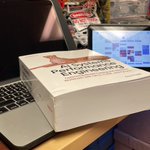
I’m adding new plugins for READYChat for C64 OS. You can now lookup book information by ISBN. Here’s a nice book. 📕👍🏻


F2 retweeted

Compute for 2027 is basically already gone
"If if today a customer is coming out and asking us for compute in 2027, that is incredibly difficult to do.
thats part of the reason even last year we went out and leased some short-term compute was to accommodate some customers and help them out."
- Sundar Pichai
----
Full video on "Alex Kantrowitz" YouTube channel, (link in comment)


F2 retweeted

The Internet goes on high alert after discovery of 8 compromised TLS certs arstechnica.com/security/202…

F2 retweeted

The Beep That Keyed the Transmitters
The short tone that cuts the recordings of Apollo voice loops is not a courtesy beep and not a signal that the speaker has finished.
It is a pair of pure sine waves generated in Houston and sent down the same voice circuit that carried the CapCom’s words.
One tone, 2,525 Hz for 250 milliseconds, told the remote ground station to key its high-power transmitter.
The second, 2,475 Hz for the same duration, told the station to release the key. Both tones rode inside the voice band so NASA did not have to lease a second long-haul circuit simply to switch the transmitters on and off.
CapCom sat in Houston and used a push-to-talk switch exactly as a pilot or a radio operator would. The switch did not connect directly to a transmitter. The active station might be in Australia, Spain, or California, chosen by the rotation of the Earth and the position of the spacecraft.
When CapCom pressed the button, the tone generator in the Mission Control voice system inserted the higher-frequency burst. Detectors at the distant station recognized the tone, closed a relay, and placed the uplink audio on the S-band transmitter aimed at the spacecraft.
When CapCom released the button, the lower-frequency burst arrived and the relay opened. The astronauts’ own transmissions needed no such tones; their microphones keyed local transmitters inside the spacecraft or on the lunar surface.
The equipment that generated and detected the tones was built by Quindar Electronics. The name stuck. The same arrangement had already been used on Gemini and remained in service on early Shuttle UHF voice circuits.
Full-duplex operation meant both ends could transmit at once on separate frequencies, so the tones did not mark the end of a transmission in the way a repeater’s courtesy tone does.
They simply marked the state of CapCom’s switch. Notch filters at the uplink sites removed most of the tones from the audio that reached the spacecraft, which is why the crews rarely heard them even though the tones are prominent on the ground recordings that were later released.
Frank Borman once noted that the intro tone could clip the first syllable if CapCom began speaking before the remote relay had closed. The fix was procedural: wait a fraction of a second after keying.
The system was never elegant. It was the cheapest reliable way to control transmitters scattered across the globe when every additional leased line carried a real cost.
The two beeps therefore did exactly the work a local microphone switch would have done had the transmitter been in the same building.

F2 retweeted

A MAJOR HTTPS COMPROMISE
eMudhra TLS intermediate certificates were found to be compromisable because they didn't bother to use random numbers.
Web browsers rely on TLS certificates for HTTPS traffic. Your web browser needs the intermediate certificate to verify that, when you connect to a domain, it's real and not someone spoofing it along the TCP/IP route from your computer, Wi-Fi, ISP, to the web server.
Intermediaries are trusted parties who are given the private keys to issue TLS certificates for domains.
If the certificate key is compromised, anyone can issue a fake TLS certificate, tap the traffic, and listen to your Internet traffic because it is no longer end-to-end encrypted. A malicious party can read your passwords, messages, and all your online life. For example, eMudhra, with its intermediary keys, can give a "facebook.com" domain certificate for anyone, and after this, the party can wiretap your Facebook traffic.
eMudhra is India’s largest Certifying Authority, employs about 600-850 staff and generates roughly $70M in annual revenue. Its main lines are enterprise identity and cybersecurity platforms, digital signature and trust services, and related consulting.
Each certificate's private key was a random number between 1 and 256. Yes 256. Not 256 bits but two hundred fifty.
Modern web browsers follow revocation lists and automatically stop trusting anything signed by eMudhra. But web browsers are only one part of Internet-connected software. Operating systems, development libraries, Internet of Things devices and generally anything with an Internet connection are all affected, unless its auto-updating authority has issued an emergency fix.

private keys from 8 intermediate CA certs have been compromised (eMudhra)
Happy "Update everything" day to all my pager-carrying friends
emudhra.we-have-a-problem.co…


F2 retweeted

Linux 7.3 is the biggest kernel ever and delivers faster storage and smarter scheduling opensourcewatch.beehiiv.com/… by @sjvn
The newest #Linux kernel, 7.3, brings faster filesystems, better graphics memory management, more flexible scheduling, & a new way of filesystem sandboxing.


F2 retweeted

Just one more week to submit your talk to #CephDaysChicago 2026!
Share your #Ceph technical insights or community story at this in-person Chicago event
CFP deadline: Friday, Oct 15
Event date: Monday, Nov 16
Submit here: t.ly/CDChicago26
#CFP #CephCommunity #Speakers

F2 retweeted
It's #CephalopodAwarenessWeek 🐙. An octopus gets things done with all eight arms working together. So does Ceph.
The 2026 #CephCommunity Survey is open. Tell us what you think about #Cephalocon, AI, and Foundation priorities.
🔗: t.ly/CephSurvey2026
#Ceph #OpenSource

F2 retweeted
The next #Ceph User + Dev #Meetup is this Wednesday, Oct. 21, at 7:00 AM PDT / 14:00 UTC.
Bring your questions and topics to help move Ceph conversations forward! 🚀
RSVP here: t.ly/Oct-Ceph-UersDev 🐙
#CephUsers #CephDevs #CephCommunity #OpenSource #CloudInfrastructure



Every primary metric (often volume- or quantity-based) should be paired with a counter-metric (often quality- or rate-based) that guards against the negative side effects of the first —Andy Grove
When a measure becomes a target, it ceases to be a good measure —Goodheart’s Law
#cls #allthingsopen