

DeFi builder chasing alpha in on-chain data. Datasets over opinions | prev @malda_xyz builder
Joined March 2023
- Tweets160
- Following139
- Followers836
- Likes252



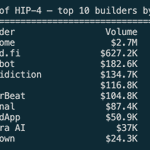
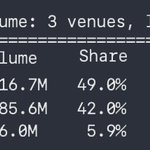


HIP-4 is two months old. $340M traded.
May: BTC dailies. $26M a week, flat.
Late June: football is 70% of all volume. $81M week, $15M peak day.
Zoom out. Prediction markets did $44.8B in June.
@Kalshi $31.5B
@Polymarket $13.3B
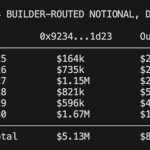
HIP-4: $219M
Half a percent of the field.
The World Cup final is July 19.
What's left when the football stops?
kalshi has the volume, but polymarket has the speed
I tracked matching markets on both since december. on actual news breaks, polymarket moved first 5 out of 6 times. median lead: 75 minutes
the only exception was starmer resigning, where kalshi beat PM by about an hour
on scheduled events like scotus, they move in the same minute. so it's not a lag issue. polymarket traders just hear things first

FIFA signed an "official prediction market partner" for the 2026 World Cup.
The partner is ADI Predictstreet, a Gibraltar-licensed company not approved to operate in the US.
So US users go through Fanatics Markets, which routes orders to Crypto com's CFTC-registered derivatives exchange. The contracts US users trade aren't even ADI's.
Polymarket and Kalshi have no FIFA deal.
Polymarket WC volume: $3.14B
Kalshi WC volume: $2.82B
FIFA's official partner: no volume disclosed.
FIFA sold a logo to a stack of intermediaries while the real trading happens elsewhere.
came across a CNN article that said sports betting is degrading Polymarket's accuracy by pulling in bettors instead of forecasters.
so I got curious and checked the data.
took thousands of high-volume resolved markets. looked at every market on Polymarket with 70–90% odds. then checked: did it actually happen?
Sports: yes, 99% of the time
Crypto: yes, 100% of the time
Politics + macro: yes, 100% of the time
Geopolitics: yes, 100% of the time
the volume is in sports because sports has the most resolvable questions. a 60% favorite losing 40% of the time isn't a broken market. that's the market doing its job.
47 days into HIP-4 on @HyperliquidX .
The World Cup gave it the biggest week so far. Weekly volume up 55%. WC markets did $12M on their own.
The product is alive.
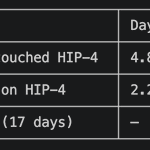
Of the 68,712 wallets that have ever traded both @Polymarket and Hyperliquid, only 5.5% have placed a
single HIP-4 fill.
17 days ago that number was 4.8%.
The whales aren't moving.
$4.45B of lifetime Polymarket volume still sits in wallets that haven't touched HIP-4 once.
My first article argued unified margin is the only thing that pulls them over. The data is starting to agree.

kentucky AG just sued kalshi and polymarket.
five days after their lobby sued kentucky over a new 14.25% tax on prediction markets.
kalshi is regulated by the CFTC. kentucky is saying that doesn't matter, state gambling law still applies.
~14th state going after these guys. CFTC has sued most of them back.
Polymarket's World Cup, one week in:
$2.8 billion traded lifetime across every WC market on Polymarket. $2.5B on the tournament-winner
futures alone.
Biggest single-match market so far: Spain vs Cape Verde at $32.5M.
Next four: France-Senegal $29M, Netherlands-Japan $28M, Brazil-Morocco $26M, Saudi-Uruguay $26M.
For comparison: Kalshi has 13,000+ WC markets and $1.7B in lifetime volume.
Polymarket runs 1.65x Kalshi's volume despite listing far fewer markets.
Polymarket priced Spain to beat Cape Verde at 92.5% an hour before kickoff. $21M of conviction.
Halftime, 0-0. Spain had 12 shots, 1.40 xG.
Polymarket: 80.5%.
70th minute, still 0-0. Polymarket: 79.5%.
The market barely moved across 50 minutes of scoreless football.
Then in the final 15min: 80 to 0.
The market did not reprice on evidence. It repriced on the clock running out.
been building a world cup odds aggregator. polymarket, kalshi, hip-4, all the major sportsbooks.
hip-4 keeps coming out cheapest on match markets.
margin baked into a 3-way match:
• Bet365 → 105.4%
• Kalshi → 101.9%
• Polymarket → 101.8%
• HIP-4 → 101.5%
• Betfair → 100.7%
betfair looks tightest but takes 5% off winnings. net that out, hip-4 is cheaper on 44 of 48 outcomes today.
not sure yet what's driving it. could be the same desks that price hl perps quoting these too, could be aggressive pricing to grab early share.
real test is whether the margin holds once size starts hitting it. for now hip-4 is the cheapest pred market on the board and i'm here for it.
live: 0xfleck.com/world-cup

If you bet on Japan this week on Hyperliquid, you paid 2x what the same bet costs on Betfair (traditional sport book). 2.8¢ vs 1.5¢. Same team, same trophy, double the price.
It's not just Japan. Netherlands costs 4.4¢ on Polymarket and 5.7¢ on Kalshi. A 25% gap on a top-8 team.
Nobody puts prediction markets, HIP-4 and the sportsbooks in one table. So I built it.
Live odds for all 48 teams and every match. Cheapest venue highlighted, updates every minute, free, no signup.
Bookmark it for the next 5 weeks, link in my bio

Polymarket's World Cup market just passed $2B in volume.
The most traded team? Uzbekistan. 0.05% to win, $60M traded. More than Spain, the actual favorite, at $38M.
Almost none of it is money at risk.
$2B has traded, but open positions across all 48 teams add up to about $30M right now. The rest is the same dollars churning through over and over.
Inside that $30M, one wallet worth watching. The #1 wallet from Euro 2024, up $798K, just dropped $142K on Argentina at 8.7¢.
Market has Argentina at 9%. Silver's PELE model has them at 10.5%. Biggest model vs market gap on the board.
$2B of noise. One sharp signal.
Is the market sleeping on Argentina?
BETA TESTERS WANTED
If you are a DeFi team doing team-led growth on X --> You are a good match
A good friend of mine is looking for a few teams to work closely with during its Beta release
I’ve started using it and it saves me quite a lot of time on content inspirations
A growth agent that lives in TG/Slack and hands each teammate their morning X plan: niche news, content ideas from relevant happenings, conversations worth jumping into
Its a great tool to cut “what do I post today” friction by a lot + keeps you up to date on relevant happenings in your niche
Beta perks:
* permanent free seats for beta testers (they’re paying real money for the X API to make this work)
* founder-level hands-on support
* features built around what your team actually needs
DM me for an intro
prediction markets and live election models disagree on the 2026 Senate.
- Polymarket: Dems 45.5%
- Kalshi: Dems 42.5%
- RacetotheWH model: Dems 51.8%
- The Economist model: Dems ~50%
both betting markets have Dems as underdogs. both models have them at roughly even odds.
and the gap is widening. PM peaked near a coin flip in April. it's drifted 8 points down since.
the strange part: fundamentals moved toward Dems over the same window. generic ballot went from D+6 to D+8. strong Dem recruits in NC, OH, AK. the models tracked that improvement. the markets faded anyway.
so it's not "markets caught news the models missed." they're looking at the same improving numbers and drawing opposite conclusions. either the market is fading the national mood, or it's pricing something the models can't see.
can a forecast model beat real money on the line?
we'll find out on November 3.
is the $1.7B World Cup market on Polymarket smarter than FIFA's ranking?
pulled both, plus traditional sportsbooks. 5 teams where PM and FIFA disagree:
on all 5, the sportsbooks match PM, not FIFA.
FIFA's the points system lags. overrates Argentina and Morocco, underrates Norway (Haaland), Portugal and Brazil.
the ranking does what it's designed to do. the market thinks it's the wrong design for this question. who's right?

states are banning Polymarket. the on-chain numbers don't show it.
Polymarket International TVL through the worst of it:
April avg: $458M
May avg: $460M
June so far: $465M
$467M on May 29, the day Nevada blocked PM
slightly higher, if anything. no trend break on any block date.
worth knowing: the state crackdown isn't really a Polymarket story to begin with. the cease-and-desist orders this year targeted Kalshi, Robinhood, and Crypto .com. PM got pulled into a fight that was already a year old.
the legal fight is loud. the economic signal, so far, is none.
do @Polymarket and @Kalshi agree on who wins the 2026 World Cup?
two separate venues, different crowds, prices set independently. here's where they have the top contenders:
Poly Kalshi
France 17.1¢ 16.8¢
Spain 16.0¢ 16.6¢
England 11.5¢ 10.8¢
Portugal 9.3¢ 9.4¢
Argentina 8.9¢ 9.1¢
Brazil 8.3¢ 8.4¢
biggest gap on any contender: 0.6¢.
add up all 48 teams and the two books are within 4 points of each other on total implied probability (Poly 102.9%, Kalshi 106.8%).
two venues, no shared book, landing on the same prices.
when two separate markets agree this tightly, it usually means the price is already right. so is there any money left to make here, or is the World Cup just too efficient to beat?
I found a paper asking something surprisingly under-checked:
Do prediction markets actually predict the future well, especially when they’re used to measure cause and effect?
The paper focuses on conditional markets.
Picture two markets:
“What happens to GDP if the Fed cuts rates?” vs.
“What happens to GDP if the Fed doesn’t cut rates?”
In theory, the gap between those two prices should tell you what the policy actually causes.
But the interesting part is that most people have basically assumed these markets work. This paper actually tries to test the assumption mathematically.
And one of the coolest angles: it treats on-chain transparency as a feature. Every wallet is visible, every trade is traceable, and that data can be used to understand whether the market is really measuring what it claims.
Who should care:
- people trading or building on Polymarket / Kalshi-
- anyone working with on-chain wallet data
- anyone who’s wondered whether prediction markets are actually measuring signal, or just crowd belief
The core problem is pretty intuitive. Traders don’t come in with isolated opinions. Their bets are shaped by their broader worldview.
A “dovish” trader might believe both that the Fed will cut rates and that growth will stay weak. Those two beliefs come from the same mental model.
the paper calls how tightly those beliefs move together χ
And that number matters a lot.
The stronger it gets, the more the price gap stops measuring “what the policy causes” and starts measuring “which type of trader showed up.”
So you think you’re reading signal.
But part of what you’re really reading is the crowd.
When that effect gets too strong, things start to break:
- prices get skewed by trader composition
- the same real-world setup can lead to totally different market prices
- liquidity piles into popular narratives while the other side goes dead
- and worst of all, the error can compound over time until the market starts generating the numbers it’s supposed to be discovering
The obvious fix sounds simple:
Just get more independent traders.
But that’s where the paper gets interesting.
Because everything is public on-chain, you can observe how traders behave across both markets. That shared worldview is not only a problem, it can also be used to clean up the signal.
So the fix isn't to "remove correlation completely." It's to keep it in a healthy range.
You don’t want zero shared belief.
You also don’t want too much.
The paper suggests there’s a sweet spot around χ = 0.30.
The bad news: Polymarket-style markets today may be running hotter than that, closer to 0.5–0.65.
At that level, the market can move past the safe zone. Once that happens, errors can snowball round after round. Push it far enough, and the market may give you a worse answer than just asking a small group of smart forecasters.
The builder takeaway is the best part:
This is actually measurable.
The paper shows how to estimate χ directly from wallet data. You need roughly 17–20k wallets, and major Polymarket events already clear that bar.
So this isn’t just theory. It’s something someone could build into market analytics today.
Important caveat: the exact numbers come from the author’s model, not hard real-world measurements. So take the thresholds with a pinch of salt.
But the bigger point: good traders aren't enough. How correlated their views are decides whether the market is measuring anything real, and on-chain you can finally see that number.

Deepened by research on wallets active on both @Polymarket and @HyperliquidX.
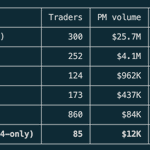
> Now focused on anyone with $1k+ traded on Polymarket lifetime.
> There is 44,962 of them.
Turns out:
> most aren’t prediction-market people who dabble in perps.
> they’re perps traders who occasionally touch prediction markets
> 77% of them also trade HL perps
> 12.5x as many trade perps as have tried HIP-4 (34,562 vs 2,757)
> only 6% have touched HIP-4 in its first 30 days on mainnet
The audience HIP-4 needs is already on actively on Hyperliquid. Just trading perps, not outcomes.
Which I would argue makes Polymarket’s perps beta interesting. HIP-4's pitch is “trade outcomes where you already trade perps.” PM can now run that same pitch in reverse: trade perps where you already trade outcomes.
Worth watching which direction traders take.
Events like today’s oracle dispute may speed up one direction or the other.