





𝗢𝗠𝗜𝗗 retweeted
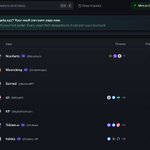
I checked the zETH auction directly on @Uniswap, and one thing caught my attention as it gets closer to closing.
The current clearing price is $0.000017, while bids are concentrated around $0.000023 - $0.000025. Total bid volume is just under $3K.
I wouldn't take that higher bid range as a sign of where the auction will finish. It shows where bids are currently concentrated, not the final clearing price.
What I'm curious to see in these last hours is whether that gap changes as more bids come in, and where the final price settles.
It's an interesting moment to watch @zerufinance's first activity market move toward its close.
$zETH
🤝 Paid partnership

𝗢𝗠𝗜𝗗 retweeted

Using your entire wallet balance for a memecoin entry is an easy mistake to make.
Especially when the amount looks small.
On Elysium, HYPE isn't just the asset you use to buy tokens. It's also what pays the network gas.
@Hypesium also charges a 1% platform fee on successful buys and sells, or 0.9% for referred users.
So the amount you want to trade isn't necessarily the amount you should fund your wallet with.
I'd keep some HYPE available for transaction costs and the eventual exit.
Getting into a position means little if you haven't planned how to get out.
hypesium.com

I checked the zETH auction directly on @Uniswap, and one thing caught my attention as it gets closer to closing.
The current clearing price is $0.000017, while bids are concentrated around $0.000023 - $0.000025. Total bid volume is just under $3K.
I wouldn't take that higher bid range as a sign of where the auction will finish. It shows where bids are currently concentrated, not the final clearing price.
What I'm curious to see in these last hours is whether that gap changes as more bids come in, and where the final price settles.
It's an interesting moment to watch @zerufinance's first activity market move toward its close.
$zETH
🤝 Paid partnership
𝗢𝗠𝗜𝗗 retweeted
Tokenizing an asset is the easy headline.
Proving what that token actually represents is the harder part.
@MMIX_io takes a different route from permissionless chains!
projects are reviewed before joining, while its on chain compliance registry checks verification status, kyc tiers and regional rules before value moves.
But approval alone doesn't guarantee an asset's quality. Transparency around issuers and the review process matters just as much.
I also find its wallet approach interesting:
bringing tokenized assets and MMIX coin together with payments and business rewards.
For RWA adoption, the real goal should be more than issuing tokens. It should be making ownership trustworthy and useful.
🤝 Paid partnership

Real-world assets are coming onchain.
On most chains, anyone can launch whatever they want.
On MMIX, every project is vetted before launch.
Clean assets for users. Clear standards for builders.
Join the first wave and earn rewards.
→ hub.mmix.io
𝗢𝗠𝗜𝗗 retweeted

A testnet going live is a good sign, but there’s more to proving a blockchain is ready than sending a few transactions.
I’ve been looking at Wire Network’s public testnet, and I think this is where things get more interesting.
It gives developers and users a chance to interact with the network, test its features and see how things work beyond what the documentation says.
But what should we be paying attention to?
Here are 4 things I would watch closely:
→ Functionality: Do transactions and network features work as expected?
→ Developer experience: Are the tools, SDKs and documentation good enough to help builders create applications?
→ Reliability: How does the network handle failed transactions, delays and unexpected issues?
→ Security: Are there proper audits and independent security checks?
A successful transaction is a good start, but it doesn’t tell the whole story.
What matters is how the network performs under different conditions and whether developers have what they need to build on it.
That’s what I’ll be watching as @WireNetwork moves closer to mainnet.
The real progress is in what people can build and how well the network holds up when more users start putting it to work.
𝗢𝗠𝗜𝗗 retweeted

There's a reason institutions haven't moved all their financial activity onto public blockchains yet.
transparency is useful but exposing every transaction, balance, and financial position isn't something a serious institution can comfortably accept.
that's what @primus_labs is working to address.
instead of asking financial applications to abandon existing onchain rails, primus adds a confidentiality and verification layer on top of them.
the idea is straightforward:
sensitive financial information stays protected, while the information that needs to be trusted can still be verified.
this distinction could make a real difference for institutional use cases such as:
> payroll
> private transfers
> financial operations.
onchain finance doesn't have to mean putting every detail on display.
Primus is working toward making privacy and verifiability coexist.
Epoch II for primus labs is live on Kaito studio. You can check it out here:
s.kaito.ai/40HUFCu

𝗢𝗠𝗜𝗗 retweeted
The leaderboard shows who performed well. But I think what happens before the rewards are paid matters just as much.
With the @tryaspenai competition by @zerufinance now over and rewards claimable, I took a closer look at Zaps' campaign settlement process.
One detail I find important is that results aren't finalized from a leaderboard snapshot alone. After trading ends and the chain settles, Zaps runs a final review to reconcile, filter and score the activity.
The final reward entitlements are then published in an onchain summary that anyone can check. There's also a mandatory delay before payments can go through, allowing incorrect results to be challenged before funds move.
For me, that's what makes a rewards system more transparent: being able to check your actual allocation onchain instead of simply trusting a leaderboard.

Tokenizing an asset is the easy headline.
Proving what that token actually represents is the harder part.
@MMIX_io takes a different route from permissionless chains!
projects are reviewed before joining, while its on chain compliance registry checks verification status, kyc tiers and regional rules before value moves.
But approval alone doesn't guarantee an asset's quality. Transparency around issuers and the review process matters just as much.
I also find its wallet approach interesting:
bringing tokenized assets and MMIX coin together with payments and business rewards.
For RWA adoption, the real goal should be more than issuing tokens. It should be making ownership trustworthy and useful.
🤝 Paid partnership
Real-world assets are coming onchain.
On most chains, anyone can launch whatever they want.
On MMIX, every project is vetted before launch.
Clean assets for users. Clear standards for builders.
Join the first wave and earn rewards.
→ hub.mmix.io
The leaderboard shows who performed well. But I think what happens before the rewards are paid matters just as much.
With the @tryaspenai competition by @zerufinance now over and rewards claimable, I took a closer look at Zaps' campaign settlement process.
One detail I find important is that results aren't finalized from a leaderboard snapshot alone. After trading ends and the chain settles, Zaps runs a final review to reconcile, filter and score the activity.
The final reward entitlements are then published in an onchain summary that anyone can check. There's also a mandatory delay before payments can go through, allowing incorrect results to be challenged before funds move.
For me, that's what makes a rewards system more transparent: being able to check your actual allocation onchain instead of simply trusting a leaderboard.
𝗢𝗠𝗜𝗗 retweeted
Good night CT
@MMIX_io is building more than just another blockchain.
Its permissioned layer 1 is designed for real world assets and businesses, with vetted projects and appointed validators across sectors like real estate, finance, eCommerce and DeFi.
One interesting part of this ecosystem is MMIX Districts: a collection of 3,000 isometric districts, free to mint on Ethereum.
What makes the concept different is the two stage reveal:
On Ethereum, you discover the size of your land.
On MMIX, you discover what gets built on it.
I like this approach because it gives the NFTs a connection to the ecosystem itself, rather than making them just another standalone collectible.
The interesting question is whether those districts will eventually represent meaningful businesses and activity on the network.
The Districts Reputation & Contribution campaign is now live on @NucleusCodes, giving the community a chance to earn WL for the free Ethereum mint.
🤝 Paid partnership

𝗢𝗠𝗜𝗗 retweeted

MMIX is running a reputation & contribution campaign on nucleus for its ethereum free mint WL.
@NucleusCodes has the board live
@MMIX_io is positioning as a chain for real world assets across energy, property and finance.
🤝 Paid partnership


MMIX Districts’ Reputation & Contribution campaign is LIVE!
Earn WL for @MMIX_io’s Ethereum free mint.
MMIX is building a blockchain for real-world assets, with vetted projects across energy, property and finance.
Secure your plot:
nucleus.codes/opportunities/…

𝗢𝗠𝗜𝗗 retweeted
Locking liquidity can ease some concerns, but the bigger question for me is whether zETH will actually trade differently from most newly launched tokens.
One detail I found interesting is that @zerufinance allocates 82% of the USDC raised in the auction to the uniswap v4 pool alongside zETH.
There's also a longer term mechanism: part of every trading fee goes to Miners who bid in the first window, while another part is used to buy back and burn zETH daily.
I like that the design looks beyond the initial launch. But these mechanisms still need real trading activity to prove their value.
What I'll be watching is whether the pool can handle meaningful trades without excessive slippage, and whether activity continues after the initial hype fades.
🤝 Paid partnership

Why does the zETH launch start with an auction?
Because a fixed price rewards speed, and speed rewards bots and insiders. An auction lets the market set the price.
How it works here:
- One price per block, shared by every bidder in that block
- The price only moves up
- No team tokens, no presale, no KOL tokens
- Pool liquidity is locked forever
Live until 21 Nov ↓
Good night CT
@MMIX_io is building more than just another blockchain.
Its permissioned layer 1 is designed for real world assets and businesses, with vetted projects and appointed validators across sectors like real estate, finance, eCommerce and DeFi.
One interesting part of this ecosystem is MMIX Districts: a collection of 3,000 isometric districts, free to mint on Ethereum.
What makes the concept different is the two stage reveal:
On Ethereum, you discover the size of your land.
On MMIX, you discover what gets built on it.
I like this approach because it gives the NFTs a connection to the ecosystem itself, rather than making them just another standalone collectible.
The interesting question is whether those districts will eventually represent meaningful businesses and activity on the network.
The Districts Reputation & Contribution campaign is now live on @NucleusCodes, giving the community a chance to earn WL for the free Ethereum mint.
🤝 Paid partnership
𝗢𝗠𝗜𝗗 retweeted

英伟达提前把未来几年的存储供应锁了,后面才来买的公司,成本会不会更高?
看完 $NVDA 这次财报,我觉得这件事对 $MU 美光的参考价值,可能比又一份上调目标价的研报更大。
英伟达披露,供应采购承诺从上季度的 2790 亿美元涨到 3900 亿美元,增量主要来自多年期存储采购。
先分清楚:3900 亿是供应采购承诺总额,不全是存储,也不代表钱已经全付出去了。
但有个细节挺直接:英伟达已经在为未来几年的交付锁关键零件了。其他公司想扩大 AI 业务,同样得买存储。大家要货的时间撞在一起,供应商就有了挑客户、谈价格的空间。
这也是我愿意继续研究美光的原因。
AI 模型谁领先,过几个月可能又变了。存储厂商能不能把产能提前卖出去、合同价格谈得怎么样,反而更容易看清楚。
不过,看到英伟达采购增加,就直接给美光算收入,太着急了。这份披露没说每家供应商分到多少。
我更想知道的是:美光接下来的长单,能不能让它少受点存储价格大起大落的折腾?
以前价格好,大家扩产;产能上来,价格又跌回去。如果这次客户愿意提前几年签约,扩产的钱有更明确的订单支撑,那我愿意给它的估值,就会和普通一轮存储涨价不一样。
未来 6 到 12 个月,这个方向我偏看好,但还没到凭这一笔采购就追价的程度。
合同到底锁了多少量、价格怎么定、客户能不能取消,这些条款得看到。
只锁供货、不锁收益,股东还是得跟着存储价格坐过山车。


𝗢𝗠𝗜𝗗 retweeted

I thought deploying to a decentralized network would take a weekend. It took about five steps.
Here’s the flow from the @Acurast docs:
→ npx acurast/cli new my app
→ bundle your code into one bundle.js
→ acurast init (creates acurast.json and .env)
→ grab test tokens from the faucet
→ acurast deploy
That’s it.
The tutorial example is just an Express server returning “Hello from Acurast!” matched to a phone somewhere in the world.
A phone running a server.
Watching the CLI feels like a kid waiting for a package: waiting for processors, acknowledgements, then it’s live.
Small app, big feeling.
Quick caveat: the docs say the default tunnel subdomain isn’t secure and shouldn’t be used in production it’s for testing. Good to know before shipping anything real.
But for a first run?
If you can write Node.js and use a terminal, you can do this tonight.
Stop reading threads about decentralized compute. Deploy one.

Your old phone is sitting in a drawer right now.
Dead weight? Not anymore.
Acurast turns idle smartphones into a decentralized cloud. No data centers. No AWS bills. Just phones across 140+ countries running real code.
It’s a serverless compute network built on hardware people already own.
As of early 2026: 225,000+ smartphones activated on Base, 401,000+ deployments, and 640M+ on-chain transactions.
Most “decentralized” apps still run their backend on centralized servers. Acurast closes that gap.
Phones are everywhere. Data centers aren’t.
Skeptical of big numbers? The docs let you deploy your own app and see it run.
Don’t trust the hype. Test the network.
Your next backend might be in that drawer.
@Acurast

Locking liquidity can ease some concerns, but the bigger question for me is whether zETH will actually trade differently from most newly launched tokens.
One detail I found interesting is that @zerufinance allocates 82% of the USDC raised in the auction to the uniswap v4 pool alongside zETH.
There's also a longer term mechanism: part of every trading fee goes to Miners who bid in the first window, while another part is used to buy back and burn zETH daily.
I like that the design looks beyond the initial launch. But these mechanisms still need real trading activity to prove their value.
What I'll be watching is whether the pool can handle meaningful trades without excessive slippage, and whether activity continues after the initial hype fades.
🤝 Paid partnership
Why does the zETH launch start with an auction?
Because a fixed price rewards speed, and speed rewards bots and insiders. An auction lets the market set the price.
How it works here:
- One price per block, shared by every bidder in that block
- The price only moves up
- No team tokens, no presale, no KOL tokens
- Pool liquidity is locked forever
Live until 21 Nov ↓
𝗢𝗠𝗜𝗗 retweeted
Now that the zETH auction is open to everyone, I wanted to be part of this phase too, even if only with a small bid.
I got my Race Pass 353 through the miner side of the launch, and now I'm curious to see how things look once the wider market joins in.
What I find interesting about @zerufinance's Activity Markets is that community participation can give people a role before a token reaches the public market.
But once the auction opens, there's a different question:
will that early involvement translate into genuine interest in owning the token?
At the time of my screenshot, only 7% of the supply had been sold. It's too early to draw conclusions, but that's one number I'll be watching as the auction progresses.
I'm keeping my own bid small for now. I want to see how this market develops beyond the initial Miner phase.
🤝 Paid partnership
