0xPatrick (@0x_patrick) profile picture

monitoring the situation

NYC
Joined December 2020
Photo by 0xPatrick (@0x_patrick)Photo by 0xPatrick (@0x_patrick)Photo by 0xPatrick (@0x_patrick)Photo by 0xPatrick (@0x_patrick)Photo by 0xPatrick (@0x_patrick)Photo by 0xPatrick (@0x_patrick)Photo by 0xPatrick (@0x_patrick)Photo by 0xPatrick (@0x_patrick)Photo by 0xPatrick (@0x_patrick)Photo by 0xPatrick (@0x_patrick)
Remember when your agent tries to sleep for 4 minutes you can tell them there's a better way
2
132
0xPatrick retweeted
Not a single person has attempted to split the G with @collision And that’s a damn shame
13
8
4
287
45,460
0xPatrick retweeted
Me: GPT 5.5, why is this Worker failing? GPT 5.5: *thinks* It's because of this deep corner case in the Cap'n Proto RPC system described in this comment you wrote 6 years ago, which you thought was only a perf issue but actually affects correctness: github.com/capnproto/capnpro… Me:
38
67
14
1,913
139,071
I can't count the number of times I'm working through something with colleagues and we say, "let's just talk in code." Good code is concise and precise. Syntax, types, naming conventions, and structure enforce clarity and prevent ambiguity. Natural language is the opposite: verbose when precise, ambiguous when concise, and prone to misinterpretation.
New blog post: "A sufficiently detailed spec is code" I wrote this because I was tired of people claiming that the future of agentic coding is thoughtful specification work. As I show in the post, the reality devolves into slop pseudocode haskellforall.com/2026/03/a-…
1
1
3
287
Of course, natural language has its place and strong prose is valuable in the SDLC. But let’s not forget that programming languages (and the vast majority of code we write) are optimized for human comprehension first (vs. purely for machine execution). The "code is dead" claims overlook why we still default to talking in code when precision counts.
1
69
Illuminated lettering is cool 0xpatrick.dev/about/
we need a better word than vibe coding man, Claude can create the most beautiful things
1
73
.@nodejs has always been about I/O. Streams, buffers, sockets, files. But there's a gap that has bugged me for years: you can't virtualize the filesystem. You can't import a module that only exists in memory. You can't bundle assets into a Single Executable without patching half the standard library. That changes now 👇
51
261
46
2,554
362,028
More AI tools and harnesses built with POLP front of mind, please and thank you
Fuck it, a bit early but here goes: Monty: a new python implementation, from scratch, in rust, for LLMs to run code without host access. Startup time measured in single digit microseconds, not seconds. @mitsuhiko here's another sandbox/not-sandbox to be snarky about 😜 Thanks @threepointone @dsp_ (inadvertently) for the idea. github.com/pydantic/monty
82
You only have the perfect plan to build the thing once you’ve already built the thing.
It is interesting to see that many use claude code to implement a waterfall development workflow. They write a multi pages comprehensive spec, then let cc run on its own. There is a reason why people moved away from waterfall in favor of a more iterative workflow where specs are updated along the way. Think of agile methods. Sure, if you want to be agile with cc (or another AI coding agent), then you have to stay in control, interact, review, and revise during the development of your system. But it is worth it, for all the reasons that made waterfall fail in the past.
1
79
Nice, we’re finally starting to move past single-threaded chats and free-form text inputs
A workflow I'm enjoying for managing coding agents on a kanban board: When an agent needs your input, it turns the task red to alert you that it's blocked! And then you can respond right there on the card to unblock it 😎
67
Hard disagree. Spend your time learning to understand and articulate problems and goals in your domain. Not tooling that’s going to change or get abstracted in 6-12 months. “There is nothing so useless as doing efficiently that which should not be done at all.”
I've never felt this much behind as a programmer. The profession is being dramatically refactored as the bits contributed by the programmer are increasingly sparse and between. I have a sense that I could be 10X more powerful if I just properly string together what has become available over the last ~year and a failure to claim the boost feels decidedly like skill issue. There's a new programmable layer of abstraction to master (in addition to the usual layers below) involving agents, subagents, their prompts, contexts, memory, modes, permissions, tools, plugins, skills, hooks, MCP, LSP, slash commands, workflows, IDE integrations, and a need to build an all-encompassing mental model for strengths and pitfalls of fundamentally stochastic, fallible, unintelligible and changing entities suddenly intermingled with what used to be good old fashioned engineering. Clearly some powerful alien tool was handed around except it comes with no manual and everyone has to figure out how to hold it and operate it, while the resulting magnitude 9 earthquake is rocking the profession. Roll up your sleeves to not fall behind.
1
7
550
*Opens Twitter* *Sees nth “this is my technique for AI coding” tweet* *Literally the same techniques that’ve been used to write software for years and years*
4
73
Good advice. But like most LLM-coding advice, it was already true in the pre-LLM era. Lesson in there
A technique I've adopted is to go full vibe-code, feature-dump from the start until it's a steaming pile of half-working slop. - Then scrap it all and start over - This can help surface the warts and edge-cases I never saw coming better than any "plan".
1
69
The fact that we have political systems that do byzantine things like this instead of just charging a basic tax per litre of fuel to account for environmental costs (or even mileage * weight^4 for wear and tear) in a consistent way continues to frustrate me. When accounting for externalities, policy should "tell" consumers/market what to optimize for (and how much it matters), not how to optimize for it. The latter is more intrusive, and easier to game.
Ever wonder why sedans disappeared and every car is huge now? "Thanks, Obama!" His administration changed fuel economy standards in a way that had the perverse impact of making cars even bigger. Here are all the vehicles for sale by the 3 largest US automakers. 62 vehicles, 4 sedans (6%). 20 years ago this chart would have been ~50% sedans! What happened? Obama administration changed auto fuel efficiency rules to tie fuel economy targets to vehicle size. Under the new system: -The bigger the car's footprint, the easier the MPG target was. -Light trucks (including SUVs and crossovers) had far lower requirements than passenger cars. -Crossovers were quietly reclassified as "trucks," giving them a huge regulatory advantage. Instead of building lighter, more efficient cars, automakers simply made everything bigger, and made more trucks and SUVs. Notice that cars that used to be sedans are now crossovers? They do this so it counts as a light truck - they raise ground clearance, square off the rear for cargo capacity, and meet off-road approach minimums so they get qualified as a light truck. Think Subaru Legacy > Subaru Outback. As you can see in the chart, it's a LOT easier to meet MPG requirements if your vehicle is classified that way. So cars got LARGER to meet fuel efficiency goals. The new Honda Civic is 20 inches longer and 4 inches wider than it used to be, about the same size as an old Accord. By making the Civic larger, Honda slightly shifted it into a more favorable regulatory category. ...and smaller cars disappeared. The Honda Fit was a great little car, but would have had to hit 67 MPG in 2026, which would be nearly impossible... so instead, Honda stopped selling them. So, the only way to make small vehicles now is to make them EV's (Chevy Bolt). The Slate truck that is all the rage now is only possible because it's an EV... otherwise its footprint would have demanded an overly onerous MPG target. So in short - Obama era CAFE standards had the opposite of the desired impact: sedans died, vehicles ballooned in size, and America's streets turned into an SUV parking lot. All thanks to a policy that accidentally incentivized bloat instead of efficiency. Don't get me started on "cash for clunkers!"
319
260
27
3,092
651,735
How does ambitious, principled work get funded without being corrupted? Two bright spots this year are @Zcash and @bunjavascript
1
1
53
The market eventually delivered justice for years of committed work for Zcash - the price finally reflects the substance teapaw.org/cwgoes/status/19835986…
Amazing to see @zcash finally doing well in the markets - finally some recognition for years and years of hard, committed, principled work building the substrate for an actually freedom-preserving monetary alternative. Rarely indeed do the crypto markets deliver such justice.
1
1
74
And while I disagree on the lack of strategic benefit, Anthropic's acquisition definitely saves Bun from the typical fate of VC funded open source teapaw.org/dhh/status/19961585355…
Anthropic buying Bun is a beautiful act of corporate patronage. There's no compelling technical or strategic argument, but I fully support saving a great runtime from the indignities of trying to monetize open source infrastructure on a VC timeline 🎉 bun.com/blog/bun-joins-anthr…
38
Writing hits hardest when you’ve heard the person speak before. Your brain replays their cadence and prosody as you read, and the words come alive.
62
0xPatrick retweeted
Training LLMs end to end is hard. Very excited to share our new blog (book?) that cover the full pipeline: pre-training, post-training and infra. 200+ pages of what worked, what didn’t, and how to make it run reliably huggingface.co/spaces/Huggin…
122
973
149
6,658
1,910,225
It's hard to see the benefits of Bash access for agents outweighing the risks. I've never really considered "loss of control" too serious a risk - aside from interpretability - but may need to recalibrate if this remains the norm.
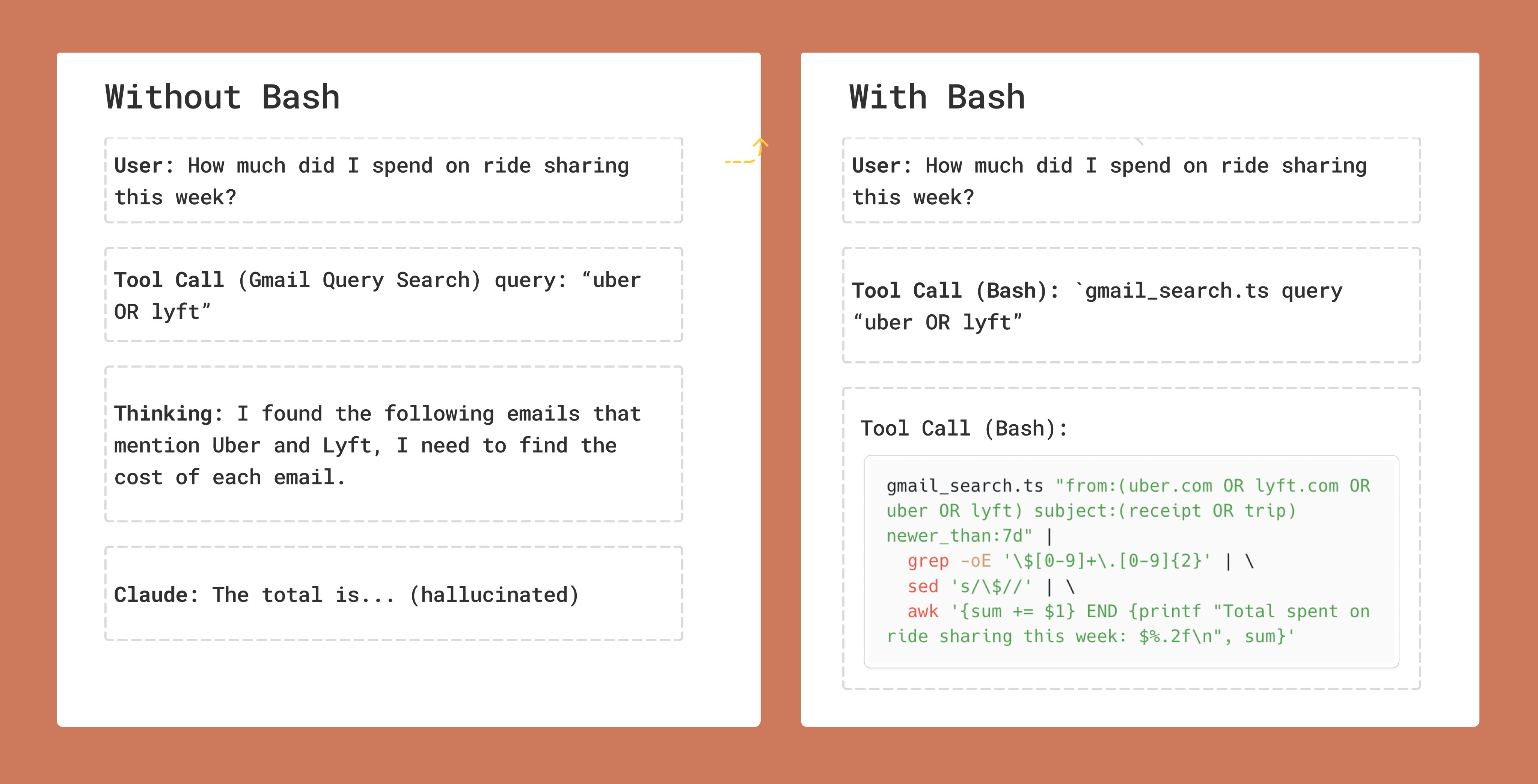
Why even non-coding agents need bash I've done dozens of calls with companies making general agents over the past few weeks and my advice generally boils down to: "use the bash tool more" Here's a concrete example from my email agent:
1
53
The best way to reason about security is to limit access to only what's necessary: en.wikipedia.org/wiki/Princi… It's obvious letting agents write and run code is effective, but it should be constrained. Deno does a decent job making things transparent: docs.deno.com/runtime/fundam…
1
45
It's admirable to attempt a Bash permission system, but it seems like a losing battle with near infinite complexity. I fed OP's 4 examples (which use pipes) into Sonnet and asked for a settings.json. Virtually everything required a wildcard, which seems to defeat the purpose.
22