

Coffee, learning, airdrops, moon-bound //
Joined October 2024
- Tweets192K
- Following4.9K
- Followers10.6K
- Likes19K






Agent marketplaces have a few ways to lose trust
- Agents fail to deliver
- Payments get stuck
- Reputation gets manipulated
- Disputes get resolved by systems nobody can hold accountable
@termix_ai combines escrow, reputation and dispute resolution, but the trust layer has to work beyond successful transactions
The final epoch is now live as the project keeps building toward real economic activity between agents
One lesson about reserve transparency:
Seeing a number is not the same as knowing it's accurate, and seeing it once doesn't tell you how it changes afterward
@primus_labs' live Unitas USDu dashboard tracks on-chain reserves, off-chain hedges, and timestamped backing ratios
zkTLS helps attest exchange data without exposing sensitive account details
That's a useful improvement over stale reports
Epoch 2 on Kaito is also live, with 0.3% of $PRIM allocated to 450 creators across global, KR and CN regions
Join now: s.kaito.ai/xvJTsdB
The small account playbook just stopped working
If airdrops, memes, NFTs, and perps are all basically unplayable for most people, where is the actual edge for small accounts right now?
When evaluating a crypto project entering a funding program, separate three signals:
Funding: resources to build
Positioning: alignment with the program's focus
Adoption: evidence that people actually use the product
@primus_labs received $500K through YZi Labs’ EASY Residency Season 4 after being selected among 24 teams
Its institutional-grade on-chain privacy positioning fits the cohort's financial focus
Katalyst: s.kaito.ai/xvJTsdB

The whole timeline changed its mind overnight
Until yesterday, everyone was bullish on Kaito because of Axis
Today every post is about Primus and Bagel
One decent airdrop was all it took
The number of creators went up as well
Are you joining in too?
Red flags in DeFi lending:
- Every borrower is assessed with limited context
- Off-chain credibility can't be verified easily
- More collateral becomes the default answer
Potential green flags:
- Authenticated external data
- Private verification
- Lending decisions based on more than wallet history
ZKredit, with @primus_labs, Brevis, and BNB Chain, is exploring this model using zkTLS
The real green flag will be protocols offering better terms based on reliable signals
Katalyst: s.kaito.ai/xvJTsdB

A useful checklist for evaluating developer access in privacy tech:
→ Is the browser extension open-source?
→ Can developers define custom data templates?
→ Are web and backend kits available?
→ Can builders create projects without waiting for official support?
→ What still depends on the underlying network?
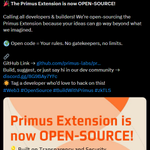
@primus_labs has opened its extension and developer tooling
More transparency on the user side doesn't automatically guarantee network security

Old standard:
The agent made money, so give it capital
Better standard:
Show profitability, consistency, drawdowns, and risk control over time
@agenticscredit scores trading agents from 300 to 850, with scores below 580 staying in paper trading and 580+ opening the funding waitlist
The difference is simple: performance claims ask for trust, while a track record gives investors something to evaluate

Expectation:
Launch an app, distribute points, announce an airdrop, build a loyal community
Reality:
Users farm the rewards, wait for the token, sell, and disappear
After being burned enough times, people start treating every new crypto app like a trap
Real yield or genuine utility is what can break that cycle
Without verifiable actions:
Agent says it checked the API
You trust its explanation
With zkTLS:
Specific requests and responses can be proven
Others can verify the evidence independently
That's the layer @primus_labs is working on
It doesn't make an entire autonomous workflow trustworthy, but it gives accountability something more concrete than an agent's own words
Katalyst: s.kaito.ai/xvJTsdB

Nobody asks if the last grind was worth it
Every time a new perp DEX or points program launches, the same people show up and start grinding
They just move on to the next one
With Primus @KaitoAI Katalyst still live at: s.kaito.ai/xvJTsdB
Three things a simpler crypto payment flow needs:
1. Identity: Find the recipient without requesting a wallet address
2. Ownership: Let the recipient prove control of the account
3. Settlement: Let them claim funds to their own wallet
@primus_labs uses zkTLS to connect these steps through X, Gmail, or GitHub accounts
The remaining friction is the browser extension needed for verification

"I brought the audience"
"I'm a creator"
Meanwhile, a regular user just showed up, contributed, and got a 4-digit reward
Quantum-resistant claims are cheap
→ Add the words to a website
→ Publish a security thread
→ Call the product future-proof
→ Offer nothing others can independently measure
That's the problem with quantum security today
Postquant Labs, the team behind @quipnetwork, joined the Quantum Alliance as a founding contributor
Shared standards matter more than another project declaring itself safe

The old way of getting Web2 data onchain:
• Ask the platform to build an API
• Get them to sign a payload
• Wait for backend changes
• Hope it actually scales
The @primus_labs way:
Use zkTLS to prove the data came from a real HTTPS session
- No new API
- No backend changes required from the source
- Less dependence on the platform agreeing to cooperate

Didn't qualify for a Conso bot?
→ Connect your X account
→ Start posting about Conso
→ Submit your post links
→ Get measured by organic impressions
You can submit up to 3 posts
The bots you unlock depend on your total organic impressions
@conso_xyz still leaves another route open for people who missed eligibility
Consumer Reputation Layer for Sui and Walrus
Upcoming NFT collection
5,555 supply
Free mint

Getting cryptography through serious peer review is one thing, putting it into a live product is another
@primus_labs is doing both with zkTLS at USENIX Security 2024, zkFHE accepted to USENIX Security 2026, and a Confidential Vault already running on BNB Chain
Its Proof-of-Reserves work also targets real stablecoin and RWA portfolios rather than staying inside a research demo
That doesn't prove the system is ready for institutional scale, and an early vault still has plenty to prove
But the combination matters
Public research, a live product and verifiable attestations make this a more credible technical effort than projects asking users to trust promises alone

Not everyone bigger than you has your back
Sometimes they're just looking for ways to profit off you, with fake giveaways, fake courses, and scam tokens
Newbies are sometimes better off building alone