









Pinned Tweet
DeFi is too complex for most people. I use first principles to identify unique yield opportunities and navigate complex risks by breaking down DeFi concepts into their fundamental components.
This approach was used by the philosopher Aristotle and is used now by Elon Musk and Charlie Munger. It allows them to cut through the fog of shoddy reasoning and inadequate analogies to see opportunities that others miss.
Thread 🧵👇

First @pendle_fi ecosystem vault on @Morpho
Let's deep dive with my AI pipeline.
🟡 GO — WITH CONDITIONS — Pendle Ecosystem USDC (Ethereum · Morpho Vault V2)
~7.71% net APY (5.47% organic) · TVL $22.78M
TL;DR: this is a leveraged Pendle PT carry desk, not stablecoin lending. You fund borrowers running ~10x leverage at health factors of 1.006–1.03, behind an oracle that marks collateral up on a fixed path to par and can never mark it down. 60% of the money ultimately rests on off-chain reinsurance credit. The tail is remote, but if it fires you get no price warning and no liquidation.
First, a correction 👇
0/ I nearly called this a hard NO-GO for the wrong reason.
The collateral is "PT-reUSD", and reUSD is also the ticker of Resupply's stablecoin, which was exploited in June 2025 and traded at $0.88–0.95 for all of Jan–Jun 2026, with a $0.8248 low on Apr 30. Behind a blind oracle at 91.5% LLTV that would be an instant 🔴.
Resolving the Pendle SY on-chain settled it: 0x5086bf35… is re.xyz reUSD, the senior tranche of a reinsurance stack, $186.2M and accreting. Two different tokens share one ticker, so check the address rather than the symbol. Verdict moved to 🟡.
WHY (conditions) 👇
1/ The oracle is depeg-blind by construction.
The Ojo PT feed prices PT-reUSD on a discount path to $1 par with no market feed on reUSD itself, so it only rises. The top borrower holds 14.84M PT worth $14.36M against $12.98M of debt, which means a 9.6% impairment puts them underwater and 12.3% does it for the whole $60.4M book. Neither fires a single liquidation.
2/ Reserve coverage has slipped ~10pp in three weeks, and it's the number that moved.
Attested off-chain reserves are $179.61M against $205.25M of tokenized claims, or 87.5% coverage, down from 97.4% on 2026-07-20. The senior grew 13.8% ($163.6M → $186.2M) while attested reserves grew 0.27%.
The likely explanation is benign: new deposits that haven't been drawn into reinsurance contracts yet, sitting in the on-chain buffer. But nobody has ever located that buffer contract, so none of it is verifiable. Recompute it before you deposit.
3/ The buffer below you is thick, and getting thinner.
Below the senior sits $19.01M of reUSDe mezzanine on-chain plus $77M of reinsurer equity from the docs, which is $96.01M, or 51.6% of the senior. Three weeks ago it was ~56.0%: the senior grew 13.8% while mezzanine tokens shrank 6.2%. Only the $19.01M (10.2%) can be verified on-chain.
On the other side, NAV is monotonic at +6.44% annualized with no impairment booked.
4/ Borrowers run ~10x leverage at health factors of 1.006–1.03.
Aggregate LTV is 87.7% against a 91.5% LLTV, and the top three borrowers hold 56.2% of the debt, liquidating on moves of 1.2%, 0.6% and 2.8%. What keeps them alive is the carry: 10.75% PT implied against 8.17% borrow. If utilization pushes the borrow rate above the implied yield, the whole levered book starts decaying toward liquidation at once, into a Pendle pool holding roughly $3.2M of sellable PT against a $60M book.
5/ The "31.5% instant liquidity" is shared, and the yield is melting.
The $7.18M you can withdraw is the same free liquidity that Smokehouse and Clearstar's $46.5M draw on, and the top three depositors (42.1%, $9.6M) between them exceed the entire buffer.
Rewards are a fixed 7,500 PENDLE per week spread over growing TVL, so the headline went from 14.08% net at $15M on Aug 4 to 7.71% at $22.8M today, nearly halving in nine days from dilution alone. Organic is 5.47%. Price it at 5.5%, not 14%.
6/ The vault is nine days old.
It launched Aug 4 at 99.7% PT-reUSD and now sits at 59.9/37.1/3.1. The curator is Armitage, Wintermute's curation arm, which is credible but unproven here, and zero loss days across nine days proves nothing — for NAV-priced RWA it proves little ever. Three config changes are queued and unnamed in the API, and every market matures by 10 Dec 2026.
ENTER ONLY IF (else not for you):
• You accept that a NAV write-down means bad debt with no liquidation — verify subordination via reUSDe supply on-chain and PoR feed 0xc79a…f607
• Reserve coverage isn't falling further — recompute before you deposit
• It's money you don't need on demand — size to fit after the top three depositors exit
• You've read the three queued V2 changes in the Morpho UI
• You're pricing it at 5.47% organic rather than the headline
👁 WHAT TO WATCH
1. Reserve coverage (PoR 0xc79a…f607 against reUSD+reUSDe supply × NAV), now 87.5% versus 97.4% on Jul 20. A further slide is your exit.
2. Borrow APY against PT implied (8.17% vs 10.75%). Crossing unwinds the levered book, and it moves before anything else breaks.

Deep dive into another @Morpho pool with my AI pipeline.
🟡 GO WITH CONDITIONS — Grove x Steakhouse AUSD (Ethereum · Morpho Vault V2)
~7.78% net APY (100% organic) · TVL $12.31M
TL;DR: this vault lists 11 markets. Ten of them hold $1,025 combined. It's 99.2% a single leveraged bet on Maple's loan book, sitting behind an oracle that cannot fire a liquidation on ANY depeg and the borrowers funding your 7.78% are losing ~15%/yr to hold the trade. Not "safe stablecoin yield." Risk capital only.
WHY (conditions) 👇
1/ ⚠️ The oracle has zero price feeds. Literally.
Pulled the construction on-chain: MorphoChainlinkOracleV2 at 0xea87…09bc, with BASE_VAULT = syrupUSDC and BASE_FEED_1 / BASE_FEED_2 / QUOTE_FEED_1 / QUOTE_VAULT all set to address(0). Price = syrupUSDC.convertToAssets() and nothing else — 1.177804, verified identical on the oracle and the token at the same block. USDC assumed $1. AUSD assumed $1. It moves only when Maple marks its own book down, and it moves as a JUMP, not a slide. Which means "bad debt = 0" and "0 loss days" prove much less here than they look like they do.
2/ The entire borrower book is stacked on the liquidation line.
Top-3 borrowers = 89.5% of all debt, at HF 1.053 / 1.079 / 1.013 — liquidatable on a 5.1% / 7.4% / 1.2% NAV drop. Effective leverage ~7.6x (LTV 86.9% against a 91.5% LLTV). The 2.62% liquidation incentive leaves ~8.5% of collateral headroom for the whole market. One impairment bigger than that skips liquidation entirely and lands straight on suppliers — there is no gradual liquidation when the price only moves in steps.
3/ 7.8% of the vault is withdrawable, and it's the same $966k.
Instant liquidity: $966,227. The market's total free liquidity: 966,932 AUSD. Same money — there's no idle buffer stacked on top. Force-deallocatable adds $5,784. The vault is 86.3% of that market's entire supply, so it can't leave without borrowers repaying first.
4/ Your co-depositor holds 99.2% of the vault and it isn't retail.
0x491E…3A44E is Grove's ALMProxy (Grove Liquidity Layer / Sky ecosystem), $12,216,165. Every other depositor combined: ~$98k. Cuts both ways — Grove ran institutional DD and sits pari passu with you, but if Grove moves first the whole buffer is gone before you reach it.
5/ Nobody is paying you a reward. The borrowers are paying you at a loss.
Zero incentives on either side of this market (Morpho's API returns an empty rewards array). Borrow cost: 8.32%. syrupUSDC's own yield: +5.34% over 12 months, read on-chain, monotonic, never marked down. That's roughly −15%/yr carry on borrower equity. Either they unwind — utilization falls and your 7.78% compresses toward ~5% or they're deploying the borrowed AUSD into something I couldn't trace. Either way the yield is a spread running on someone else's clock, not a structural rate.
WHAT'S ACTUALLY GOOD (why this isn't a NO-GO):
• 0 loss days across 201 days, share price $1.017173
• Maple's loan book over-collateralized at 146.2% right now
• syrupUSDC NAV has never marked down across 12 months of archive reads
• Steakhouse curating (2-of-7 Safe), 0% performance fee, 100% organic yield
• TVL +23.2%, nothing queued behind governance
• Liquidators can redeem syrupUSDC at Maple instead of dumping into the $6.66M DEX pool — that's the real exit, not the depth ratio
ENTER ONLY IF (else not for you):
• You can leave it for weeks — 7.8% liquid against 93.2% utilization.
• You check Maple's collateralRatio before entering and weekly after (146.2% today). Maple runs NO first-loss capital — its own docs say the reserved-liquidity feature "isn't used."
• You size it as Maple credit at 7.6x borrower leverage, not as a stablecoin deposit.
• You accept being a minority passenger in Grove's facility.
👁 WATCH
1. Maple's collateralRatio (146.2%) + any impairment announcement. It's the one number that turns this position bad, and the oracle won't warn you first.
2. Utilization (93.2%) — simultaneously your exit and your yield.
One more thing: the top borrower here, 0x7bee…0FAb, is also the top borrower in the syrupUSDC/PYUSD market I scanned last week (71.6% of that book). Same wallet, two large syrupUSDC positions, one shared $6.66M DEX pool. Per-vault scans don't show you that.

For carry trade degens, here are the cheapest borrowing rates this week.
▸ $vbWBTC → $vbUSDC 1.7% 86% LTV @MorphoLabs · @katana
▸ $WETH → $GHO 2.2% 81% LTV @aave v3 · @monad
▸ $XAUT → $USDT 4.9% 77% LTV @MorphoLabs · Ethereum
The ETH row is the one to look at twice. It costs 50bp more than BTC and carries $8M of depth against $2M on the Katana markets — the gap between a loan you can actually take and a number on a screener.
And 86% LTV puts liquidation about 14% of price away.

Deep dive into another @Morpho pool with my AI pipeline.
🟡 GO — WITH CONDITIONS — Paypal USD Main (Ethereum · Morpho Vault V2)
~6.01% net APY (1.93% organic) · TVL $301.99M
TL;DR: 6% looks clean — zero bad debt in 231 days, TVL +57% in 6 months. But 68% of that yield is PYUSD incentives, not lending income, and 61% of the deposit sits behind oracles that literally cannot see if the wrapped BTC/ETH backing it de-pegs. Not a "safe stablecoin yield" vault — a leveraged BTC/ETH-wrapper credit book wearing a PYUSD costume.
WHY (conditions) 👇
1/ ⚠️ 61.2% of the vault can't be liquidated on a pure wrapper de-peg.
Pulled description() on-chain from every oracle feed. $kBTC/PYUSD (34.6% of vault) uses raw Chainlink "BTC/USD" — there's no kBTC-specific feed at all, the oracle just assumes 1 kBTC = 1 BTC forever. $LBTC (16.6%) uses RedStone's self-reported Proof-of-Reserves ratio. $weETH (10.0%) uses Chainlink's documented LST exchange-rate feed. None price the wrapper's market rate. A Kraken custody issue, a Lombard/Babylon slashing event, or an EtherFi contract bug wouldn't trigger liquidation — bad debt builds silently instead.
2/ syrupUSDC's top borrower has a 5.2% cushion — the thinnest in the vault.
One wallet (0x7bee…0FAb) is 71.6% of that market's $73.2M debt, HF 1.054. On-chain it's an automated cross-chain bot (CCIP + LayerZero calls every ~10-15 min), not a retail whale. Sellable DEX depth covers only 12% of its $54M collateral — Maple's own $200M+ instant-redemption buffer probably helps, but that's unverified live and shared with every other Maple withdrawer.
3/ Only 5.5% of the vault is instantly withdrawable.
$16.5M instant, +$29.5M with penalty (15.2% combined) vs 88-90% utilization across the top markets. The top depositor (30%, $90.7M) is a verified smart contract — automated quant-desk infra, not a sticky PayPal/Paxos treasury seed. This capital moves fast if the incentive-driven APY compresses.
4/ LBTC's thin exit isn't backstopped like kBTC's.
Only $7.3M DEX depth across 3 LBTC/WBTC basket pools vs a $25.7M top position. kBTC redeems 1:1 for BTC anytime at Kraken custody (real mitigant — though see #1, the oracle wouldn't catch a de-peg in the first place). LBTC's own redemption takes 9-10 days — too slow mid-cascade.
5/ No named guardian.
Curator is a standard Gnosis Safe multisig, no red flags there — but no guardian exists and no single timelock is visible (V2 per-function sentinels instead). Nothing queued right now.
ENTER ONLY IF (else not for you):
• You treat the 6% as incentive-subsidized, not organic — expect it to compress.
• You accept 61% of the book is blind to a wrapper-specific de-peg, only reacts to BTC/ETH spot price.
• You size assuming the 30% depositor exits before you do.
• You're fine holding wrapped/custodied BTC and LST exposure as the real backstop.
👁 WATCH
1. syrupUSDC top borrower HF (now 1.054) vs the ~5.2% liquidation trigger.
2. Any Kraken/Lombard/EtherFi-specific incident — the oracles won't flag it for you.
231 days, zero bad debt, real growth — but the yield is a rewards subsidy and the risk model has a real blind spot. Not reckless, not "safe stable yield" either.

CBDC will change banks' business models completely.
Central banks are about to become the safest place to hold digital money, with no bank in between.
That single fact rewires 300 years of banking.
What breaks:
• Deposit franchise: cheap, sticky deposits funded lending for centuries. A CBDC gives depositors a risk-free digital alternative one tap away, and even a small outflow raises funding costs across the board.
• Payment monopoly: banks and card networks earned a toll on every transaction. A CBDC settles peer-to-peer through central bank rails, and that toll shrinks.
• Bank run speed: in 2008 people queued at ATMs. With CBDC, moving your balance to safety takes one tap, any time, with no queue and no friction, so panic now moves at app speed.
• Margin: deposits are cheap funding, but wholesale markets aren't, so credit gets pricier for everyone downstream.
I've watched this same fight play out in DeFi already, where stablecoins compete with lending protocols over the same question: why hold risk on an intermediary when you can hold a claim on the source directly? Banks are now on the losing side of that question for the first time.
What survives, even grows:
• Distribution: most real CBDC designs (digital euro, e-CNY, digital pound) route through banks for onboarding, KYC, and wallets, because central banks don't want to run retail infrastructure themselves.
• Credit intermediation: a CBDC gives you money, and someone still has to underwrite risk and originate credit on top of it. That's still banks.
• New product surface: programmable settlement, embedded compliance, and business banking layered on top of CBDC rails give banks new things to sell.
Banks survive this. They stop owning the default resting place for money and start earning every basis point of margin they used to collect for free.
The banks building the wallet layer, the compliance layer, the credit business around CBDC now get to define what banking looks like on the other side. Everyone else finds out the hard way, in a bank run that moves at app speed.
What's your read: does retail CBDC actually launch at scale where you are, or does bank lobbying quietly kill it first?

Deep dive into another @Morpho pool with my AI pipeline.
🟡 GO — WITH CONDITIONS — Steakhouse Prime USDC (Base · Morpho Vault V2)
~5.16% net APY · TVL $573.8M
TL;DR: the 5.16% is real — fully organic, zero rewards, zero loss days in 275 days. That's not the risk. The risk is that "diversified USDC vault" is a costume: 99.5% sits in ONE cbBTC/USDC market, and the exit liquidity for that
market is thinner than the largest position in it.
WHY (conditions) 👇
1/ 99.5% concentration — the vault IS one market.
$570.7M of $573.8M sits in cbBTC/USDC (0x9103…9183). The other four markets combined are 0.5% — WETH, cbETH ×2, wstETH. There's no real diversification to fall back on.
2/ ⚠️ Top borrower liquidates on a ~19.6% BTC drop, and exit depth is tight. 0xE84f… holds $52.25M collateral, HF 1.244 → liquidates at −19.6%. Sellable
DEX depth on Base for cbBTC is $44.1M — depth ratio 0.84. Several more positions cluster in the −21% to −30% zone. A fast, broad BTC crash could push combined liquidations past what the market can actually sell into.
3/ Top depositor alone exceeds the instant-liquidity buffer. One depositor holds $204.2M (35.6% of TVL) — more than the vault's entire $136M instant-liquidity buffer (23.7%). If they exit first, your withdrawal
waits on borrower repayments, not the buffer.
4/ Your collateral is Coinbase-custodied wrapped BTC, not native BTC. Liquidation seizes/sells cbBTC — one more custodial dependency stacked on top of BTC price risk. Minor given Coinbase's standing, but real.
ENTER ONLY IF (else not for you):
• You treat this as a cbBTC/USDC market position, not a diversified vault.
• You can tolerate a real (not base-case) bad-debt tail in a sharp BTC crash.
• You size inside the buffer AFTER the $204M depositor leaves.
• You're fine holding wrapped, custodied BTC exposure as the backstop.
👁 WATCH
1. Top borrower HF / BTC price vs the ~19.6% trigger on 0x9103…9183.
2. Depositor concentration vs instant liquidity — re-check if either moves.
Well-run vault, honest yield, 13 known curators route through the same market. The premium here is for concentration and tail liquidity — not for
incentive decay or curator risk.

Deep dive into another @Morpho pool with my AI pipeline.
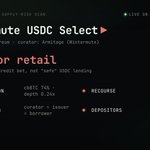
🔴 Not for retail investors — Wintermute USDC Select (Ethereum · Morpho V2 · curator: Armitage/Wintermute)
~4.91% net APY · TVL $36.5M
TL;DR: not "safe stablecoin yield" — it's a credit bet on Wintermute itself (curator = collateral issuer = borrower in one market), plus tail-liquidation risk in the vault's single largest allocation. 4.91% doesn't pay for that.
WHY (dealbreakers) 👇
1/ Biggest market = the classic "liquidation can't clear" setup, and it's 39% of the vault.
cbBTC/USDC: top-1 borrower holds 74% of the market ($315M collateral, liquidates on a 37.6% BTC drop) vs only $74M sellable DEX depth = 0.24x ratio. Traced the borrower on-chain (0xbCd1…8eE0): 42 collateral top-ups, 25 withdrawals, 22 repays since Jun'25 — an actively-managed desk, not a sleeping whale. Helps in a slow bleed. Does nothing in a fast one.
2/ v-wmtUSDC (14.5%) is circular self-dealing — and worse on paper than assumed.
Wintermute borrows $USDC unsecured on Wildcat, wraps the IOU as v-wmtUSDC, re-pledges it as collateral to borrow MORE from a vault Wintermute itself curates. Pulled Wildcat's Master Loan Agreement: assets are legally TRANSFERRED to the borrower — no escrow, no collateral, no smart-contract seizure. Default recourse = English court litigation. A legal IOU in a DeFi wrapper.
3/ $reUSD + PT-reUSD (22.1%) — NAV-priced, can't front-run a loss, but well-subordinated.
Senior tranche of a reinsurance capital stack. Oracle is exchange-rate/depeg-blind (won't fire a liquidation on impairment) — but the buffer beneath it is real: ~56% subordination below senior, off-chain reserves ($179.1M) verified to exceed tokenized claims, NAV accreting since launch. Not a dealbreaker on its own. Still can't exit ahead of a loss if one hits.
4/ Depositor concentration, and the whale is unidentified.
Top-1 depositor (0x01fb…1c384) holds 82.8% ($30.25M) of a vault with only 39.1% ($14.3M) instant liquidity. Checked Dune's official label registry + open web — no public ID. Can't confirm it's Wintermute's own aligned capital. If it exits, everyone else queues behind a drained buffer.
WHAT WOULD MAKE IT OK (each fixes one 🔴):
• $cbBTC → top-1 concentration + DEX depth both clear yellow, or allocation share drops well under 39%
• v-wmtUSDC → real on-chain collateral, not a Wintermute self-loan, or removed entirely
• Depositors → top-1 under ~40% so instant liquidity actually protects the median LP
All three ≈ a redesign, not a tweak.
👁 WHAT TO WATCH
1. cbBTC top-1 position HF + DEX depth trend on that collateral.
2. v-wmtUSDC allocation share — cap is $25M vs current $5.28M, plenty of room to grow the self-dealing slice.
One counterparty wearing curator/issuer/borrower hats ≠ diversified USDC lending.

Cheapest dollar loans against BTC, ETH and gold right now — all three are @MorphoLabs markets.
▸ vbWBTC → vbUSDC 1.72% @katana
▸ vbETH → vbUSDC 1.72% @katana
▸ XAUT → USDT 4.68% Ethereum
Your collateral stays yours. You keep the upside.
Depth is $1-2M per market.

Tested Morpho Midnight and it might be one of the most important upgrades DeFi lending has seen in years.
For the first time, on-chain credit is getting a real term structure.
What this changes for the market
Upside:
1/ DeFi moves closer to traditional finance. Institutions (funds, banks, corporate treasuries) finally get the predictability they’ve been missing — fixed rates and fixed maturities instead of rates that reprice every block.
2/ We get a genuine crypto credit yield curve. The market will show how much people are willing to pay for 1-month, 3-month, or 6-month money.
3/ Capital inflows become more realistic. The global bond market is measured in trillions. Even a small slice of that flowing on-chain would meaningfully grow DeFi TVL.
4/ New product categories open up: structured credit, RWA financing, repo-style transactions.
5/ Better rate discovery — the market sets the price, not a protocol formula.
Risks & challenges:
1/ New risk dimensions appear: pre-maturity liquidity risk, maturity concentration risk, and reinvestment risk.
2/ If too many participants aggressively chase the term premium, secondary markets can freeze during stress.
3/ Complexity increases. Not every user or protocol will adapt quickly.
4/ Previous fixed-rate attempts (Pendle, Notional, Term Finance, etc.) never reached mass adoption. Midnight solves the biggest historical pain point (capital no longer has to be locked upfront), but success is still not guaranteed.

Deep dive into another @Morpho pool with my AI pipeline.
🔴 NO-GO — Hyperithm USDC Apex (Monad · Morpho Vault V2)
~11.97% net APY · TVL $34.2M
TL;DR: this isn't diversified USDC lending. 97.7% of deposits fund ONE leveraged looper — a 3.49x levered bet on Hyperithm's own MON basis-trade fund (aHYPER), run by the same operator that admins the lending stack, priced by an oracle the fund reports itself. Exit door: $1 of instant liquidity. 12% doesn't pay for that.
WHY (dealbreakers) 👇
1/ The oracle is the fund marking its own homework.
Morpho oracle price() = 1.050521873036. aHYPER convertToAssets() = 1.050521. Exact match — the liquidation price IS the fund's self-reported NAV. It cannot mark down on a CEX-side loss until the operator marks it. "0 bad debt, 0 loss days" proves nothing under this oracle.
2/ The top-1 borrower (42.4% of the market) is the house.
Traced on-chain: borrower EOA 0x357d…7384 owns both executor contracts AND admins the Accountable "aHYPER Looping Vault" (updateTerms, unpause, setPendingBorrower). Morpho suppliers are the senior financing for a 3.49x levered loop on the curator's own fund. Collateral $18.7M / loan $13.4M / HF 1.08.
3/ Exit is a $2.9M door for a $34M vault.
Vault instant liquidity: $1 (0.0%). Market free liquidity: $2.9M. The junior looping vault itself: $2.9K available now, up-to-7-day fulfillment. In stress, junior redeemers, senior lenders and liquidators all queue at the same door and the top-1 depositor (45.9%, $15.7M) is ahead of you.
4/ The book is entirely off-chain.
aHYPER on-chain: 82.7M shares, implied NAV ~$86.9M — and ~$28K of actual USDC in the contract. The delta-neutral MON position lives on CEXs. 52% of ALL aHYPER supply sits as collateral in this one Morpho market.
TO BE FAIR (what a lazy bear case skips):
• there IS a funded junior — loopers' equity ≈ $13.8M below $31.5M senior debt (~30% of collateral). You're a senior tranche, not naked
• position is DVN-verified every 15 min, leverage disclosed, yield is organic (10.1 of the 12.0)
But the junior buffer is only as real as a NAV mark the operator controls. And the implied unlevered yield (~17% from MON funding) is regime-dependent — when funding compresses, the junior bleeds first and silently.
WHAT WOULD MAKE IT OK (each fixes one 🔴):
• Oracle → independent feed on the CEX book that can mark DOWN
• Liquidity → instant buffer >5–10% of TVL
• Allocation → not 97.7% in the curator's own asset
• Depositors → top-1 <20%
All four ≈ a redesign, not a tweak.
👁 WHAT TO WATCH
1. Market free liquidity (now $2.9M) + utilization (91.5%) — under $2M at >95% util = the door is closing.
2. MON perp funding — sustained negative funding = the junior's carry goes negative long before the oracle shows you anything.
Senior tranche of a self-marked 3.5x basis trade ≠ "stablecoin yield".

So those guys pumped the token to a $10B FDV with the support of Tier 1 CEXs, VCs, and KOLs, extracted liquidity, and then left the market


Movement Labs Files for Chapter 11 Bankruptcy With Liabilities Above $1 Million
Movement Labs, the developer of the Movement blockchain, has filed for Chapter 11 bankruptcy protection. Court filings show the company has between $100,000 and $500,000 in assets, more than $1 million in liabilities and fewer than 1,000 creditors. Its largest creditors include co-founder Rushi Manche, the Delaware Division of Revenue and Anchorage Digital. The filing follows controversy over MOVE token market-making, an internal investigation and Binance’s ban of the related market-making account. Movement Labs parted ways with Manche in May 2025.

Deep dive into another @Morpho pool with my AI pipeline.
🟡 GO — WITH CONDITIONS — RockawayX USDC Yield (Ethereum · Morpho Vault V2)
~5.94% net APY · TVL $18.4M
TL;DR: this looked like a clean NO-GO. 98% of a "USDC vault" is priced by NAV oracles that can't fire a liquidation ahead of a loss — the classic depeg-blind red flag. Then I verified each leg on-chain. Every layer came back BETTER than the surface read. It's not safe stablecoin yield — it's a fairly-priced institutional-CREDIT book. Here's the journey 👇
WHERE THE MONEY SITS
• 54% — PT-reUSD (re.xyz reinsurance token)
• 27% — stUSDS (Sky "risk capital")
• 17% — FalconX (tokenized prime-broker credit)
~100bps over a blue-chip USDC vault. That premium pays for credit + illiquidity, not free money.
WHY I ALMOST NO-GO'd IT
1/ ~98% NAV-priced oracles — confirmed on-chain (description() reads). They only move when the protocol BOOKS a loss. No price warning, no exit ahead of it.
WHY IT'S ACTUALLY A GO (with conditions)
2/ reUSD backing — VERIFIED on-chain. Senior tranche $163.6M, with ~56% FIRST-LOSS beneath it ($14.5M reUSDe mezzanine + $77M reinsurer equity). Off-chain reserves $179.1M (Chainlink PoR, updated yesterday) FULLY COVER the $178.1M tokenized claims. NAV 1.0902, accreting, zero impairment. This isn't opaque — it's one of the better-backed RWA legs I've scanned.
4/ stUSDS "can't liquidate" — RETRACTED. The contract holds ~$185M idle USDS (~100%), only $457 lent out → a deep instant redemption exit that dwarfs the DEX pool.
5/ FalconX — reputable credit, BUT the junior tranche (BB_FalconXUSDC) is deployed and funded with $0. Unsubordinated senior. And RockawayX (the curator) co-launched this exact facility. Real, but 17% and disclosed.
ENTER ONLY IF (else not for you):
• You treat it as CREDIT, not cash — you can't exit ahead of a maook.
• You size INSIDE instant liquidity after the whale leaves: liquidity 17.1% < top depositor 24.1%. ⚠️ the binding limit.
• You're OK with unsubordinated FalconX credit from a conflicted
• You've set a floor on reUSD (NAV oracle + PoR reserves) & the Dec-2026 PT maturity.
👁 WATCH
1. reUSD NAV oracle 0x72b5…1b46 + PoR reserves 0xc79a…f607 — a dredit signal. Also: reUSD mkt-cap −12.3%/30d, still unexplained.
2. stUSDS utilization — the $185M exit only exists while SKY-staker borrowing ~0.

Deep dive into another @Morpho pool with my AI pipeline.
🟡 GO — WITH CONDITIONS
@gauntlet_xyz USDC Prime on @base
~4.26% net APY · TVL $426.8M
TL;DR: 4.26% is wholesale cbBTC-collateral lending yield concentrated in ONE Morpho market, wrapped in a well-run vault. Fine for most stablecoin allocations — just not the diversified "USDC fund" the label implies.
ENTER ONLY IF (else not for you) 👇
1/ 92.9% of the vault sits in ONE market — cbBTC/USDC.
Everything else (WETH 6.1%, cbETH/wstETH ≤0.5%) is dust. You're underwriting one collateral.
2/ DEX depth for cbBTC is right at the edge — ratio 0.90.
Sellable $44.0M vs top borrower's $48.7M collateral. That position only liquidates on a ~42% BTC drop, but a crash that size usually thins Base DEX liquidity too — exactly when you need it deep.
3/ Top depositor = 72.1% ($307.8M) — bigger than the ENTIRE instant-liquidity buffer ($159.2M, 37.3% of TVL).
If they exit first, everyone else queues behind borrower repayments.
4/ 89.4% utilization across every allocated market.
Not distress — Gauntlet runs it tight (15 reallocations in 30d) — but less headroom before temporary withdrawal delays.
What's actually clean: $0 bad debt ever, 0 loss days in 775 days, real Chainlink market oracle (not depeg-blind), no whale borrower (top-1 only 13.7% of debt).
👁 WHAT TO WATCH
1. cbBTC/USDC depth_ratio (now 0.90) — below ~0.5 = real warning.
2. Top-1 depositor's balance vs instant liquidity — if they move, the buffer's gone first.
Well-run vault, one concentration bet baked in. Size accordingly.

Deep dive into another @Morpho pool with my AI pipeline.
🔴 NO-GO — August USDC V2 (Ethereum · Morpho Vault V2) ~7.21% net APY · TVL $4.09M
TL;DR: this isn't conservative stablecoin lending. It's a self-referential leverage machine run by one infra family (August/Upshift). 69% of deposits fund a single programmatic borrower with a 4.1% buffer against an event that ALREADY happened at 4.95% (the Resolv depeg) — collateralized by a token whose price the issuer reports itself. 7.21% doesn't pay for that.
WHY (dealbreakers) 👇
1/ Oracle is depeg-blind & self-marked — and it HAS dropped.
upUSDC price = convertToAssets() × Chainlink USDC/USD = Upshift's own internal NAV, not a market price. "It only rises" is false: 2026-04-29, block 24987801, NAV fell −4.95% in ONE block (−$500,000, shares unchanged) = the Resolv/RLP loss. Historical, not hypothetical.
2/ One programmatic borrower = the whole market.
0xf014 holds 100% of the market's debt ($3.16M), HF 1.04, drop-to-liq 4.1%. Not an institution — a position contract from a 470-deploy factory. Its collateral = 65% of ALL upUSDC. The 4.1% buffer is thinner than the Resolv hit (4.95%).
3/ It's circular — traced on-chain.
upUSDC vault deposits $2.23M into August V2 → adapter lends $2.75M to the borrower → who holds the upUSDC that backs the first vault. Same dollar counted twice. Real external capital < combined TVL.
4/ 20–35% sits on ONE key.
$1.15–1.93M of the book is plain USDC on an operator EOA (0x178Fb204) — single key, no multisig, no contract. Custody risk on top of credit risk.
5/ Capital is fleeing & the "whale" isn't independent.
TVL −63.7%. Instant liquidity 13.2%, but top-1 depositor is 54.5% — and that's the sibling upUSDC vault, not a random LP. One related exit drains the buffer.
WHAT WOULD MAKE IT OK (each fixes one 🔴):
• Oracle → independent feed, or NAV key not Upshift's
• Concentration → top borrower <30%, real 3rd party w/ own first
• Buffer → HF back >~1.4 (survives a ~5% mark)
• Custody → MPC/multisig, idle <5%
• Loop → stop depositing back into August V2
• TVL → flat/growing, top depositor <20%
All six ≈ a redesign, not a tweak.
👁 WHAT TO WATCH
1. convertToAssets(1e6) (now 1.0566) — any decline = a loss beinsignal.
2. Borrower 0xf014 HF (now 1.04) + liquidity vs 0x65cD's share — if the whale exits, the buffer's gone first.
Position needs continuous monitoring, not a one-shot scan.

Deep dive into another Morpho pool — KPK USDC Yield, with my AI pipeline. 👇
🟡 GO — WITH CONDITIONS (informed DeFi risk-capital only)
kpk USDC Yield · Ethereum · Morpho V2
~7.96% net APY · $4.80M TVL
In one line: karpatkey paying ~8% for a tranched, looped wrapper on Ethena USDe (76% of the collateral's backing), behind an oracle blind to a depeg.
Sound as a knowing leveraged-USDe play — not safe USDC. APY just compressed ~13% → ~8% with no change to the tail. Same risk, lower pay.
✅ ENTER ONLY IF ALL HOLD (else — not for you)
1/ You knowingly want Ethena USDe exposure, three wrappers deep.
→ Why: savUSD → avUSD is 76% USDe + ~19% Maple, looped 60% on Aave. If you wouldn't hold USDe directly, don't hold this.
→ How: Avant → Strategy Deployment.
2/ ⚠️ You accept a depeg-blind oracle — no liquidation will warn you. (binding condition)
→ Why: the feed prices savUSD only by its savUSD/avUSD exchange rate (avUSD ≈ $1, monotonic-up), so the whale never liquidates on a depeg and "0 loss days" is structural. This is now the weakest link — liquidity, the old binding constraint, has been fixed to 17.5%.
→ How: feed 0x9fBb…2589, description() = "SAVUSD / AVUSD Exchange Rate".
3/ Protection buffer ≥ ~10–15% and NAV ≥ avUSD supply.
→ Why: senior savUSD is shielded by ~$15.5M (~15%: $14.44M juniotemic USDe event could exceed it.
→ How: Avant → Risk & Protection; reconcile NAV $109M vs supply $115.77M.
4/ You accept 77% single-market concentration under one anonymous whale.
→ Why: 77.1% of the vault is the savUSD market; 73% of that is o
→ How: allocation table + borrower 0x8DFC…Eb0E.
5/ You're OK being paid less for the same risk.
→ Why: APY fell ~13% → ~8% while every structural risk held cons
→ How: re-run the scanner before entry.
👁 WHAT TO WATCH
1. USDe peg / Ethena health — your true underlying.
2. Avant buffer ≥ ~10–15% and NAV ≥ avUSD supply.
3. Whale HF + instant liquidity in the savUSD market.
4. APY vs the tail — if APY keeps falling while the oracle & concentration hold, risk/reward degrades.

My AI pipeline analyzed the StableEarn vault on Morpho, and here's what it found.
$24M in USDT deposits. ~7% yield. Risk parameters by Gauntlet. Running on Stable, Tether's own chain. Every name attached to it is picked to make you relax.
Then the scan traced where the money actually goes.
Your USDT gets lent against thUSD, which calls itself a stablecoin. Its $1 peg rides on a basket of gold, US T-bills, UAE real estate and a bit of oil, rebalanced by an AI. So the collateral behind your "stable" loan is a leveraged bet on gold and property.
78% of the entire vault sits in one market. And 80% of the borrowing in that market is a single address: a multisig holding ~$50M of thUSD. It's the strategy's own leverage loop. The diversified vault is really funding one trade.
Here's the part that would cost you money quietly. I read the price oracle on-chain. It reports a "fundamental" value, not the live market price. If thUSD trades down to $0.90, the oracle still prints ~$1.01. No liquidation fires. Nobody gets a warning. The bad debt just sits there until someone decides to mark it down.
And there's no back exit. thUSD only redeems through whitelisted, KYC'd gateways. A liquidator can't redeem it, and there's no DEX depth on a chain this new to sell into. If the peg cracks, the loss lands on the lenders. That's whoever deposited the USDT.
The vault proudly shows 0 loss days. But a NAV-priced asset never falls before someone marks it down, so a clean record here isn't a verifiable one. I hit the exact same trap on the last vault I scanned.
To be fair, nothing here is broken today. Gauntlet and Theo are real operators, the underlying yield is real (about 3.6%, the rest is token points), and the loop is well collateralized right now.
But strip the branding and you're trusting an off-chain reserve you can't audit, priced by an oracle built not to flinch.
My verdict: 🟡 conditional. Fine only if you can independently verify Tharwa's reserves. I looked and found a code audit but no proof-of-reserves.
Not financial advice, and not a call on the team. This is what my pipeline flagged.

Gauntlet curates this Morpho vault AND is its single biggest borrower — 66% of the loan, against the risk parameters Gauntlet sets itself.
I built an AI pipeline to scan Morpho vaults on-chain, and it caught this by matching the borrower's exact address.
Here's the full scan of a "safe 5% USDC" vault:
Gauntlet USDC RWA
• $11.6M TVL
• 5.19% net APY on USDC
• 0 loss days in 524 days
• curated by Gauntlet, one of the most trusted risk names in DeFi
The pipeline pulls live on-chain data and runs the vault through utilization, bad debt, every borrower's health factor, oracle source, and cross-references borrower addresses against known vaults.
What it flagged:
🔴 100% of deposits sit in ONE market (AA_FalconXUSDC). A "diversified vault" that isn't.
🔴 Top borrower = 66% of the loan = Gauntlet's own "Levered FalconX" vault, matched by exact address. Curator and biggest borrower are the same entity.
🔴 #2 borrower holds 32% at a health factor of 1.07. A 6.7% price move liquidates it.
🔴 The "equity tranche" meant to absorb first losses before depositors: size undisclosed, no named auditor, no proof of reserves.
And the 0-loss record is weak evidence. A NAV-priced asset doesn't drop until someone decides to mark it down.
Verdict: not for retail, and not for most liquid funds. You can only verify that safety buffer if you sit close enough to Pareto/FalconX to see it. That access is the real gate, not the yield.
Reputation is not disclosure. A clean track record ≠ a verifiable one.
Got a Morpho pool you're supplying into? Drop the link and I'll run the scan. 👇
