

AI/ML Eng | Founder and CEO, Techfusion Automata | Building @Dubstrata | ~ Betting on the future of autonomous agent swarms and information markets ~
Cape Town, South Africa
Joined February 2022
- Tweets6.1K
- Following435
- Followers319
- Likes8.8K


Pinned Tweet
I'm getting really excited about what we're building at @dubstrata
Over the last 48 hours, we connected our Convergent Multi-Horizon Accuracy Engine to our CausalFM price forecasting pipeline.
Here's why I'm excited.
Every 5 minutes, our model issues 7 independent forecasts into the future: 5m, 15m, 30m, 1h, 4h, 8h, and 24h.
Each forecast is locked to the exact information available when it was made.
As time passes, all of those predictions eventually converge on the same settlement timestamp, where they're evaluated against the actual market outcome.
That gives us something powerful: at every settlement tick, we can compare forecasts made minutes, hours, and even a day ago against the same realised reality.
This lets us answer two questions continuously:
1. Skill: Which horizon demonstrated the highest volatility-adjusted predictive power?
A 4-hour forecast correctly identifying a structural move can often be far more impressive than a 5-minute forecast once market diffusion is accounted for.
2. Causal Attribution Veracity (CAV): Did the market move for the reason the model believed it would?
That's the part most forecasting systems ignore.
Traditional online learning has a dangerous failure mode:
If the model predicts "up" because of sentiment, but price rises because of a sudden liquidity sweep, standard gradient descent treats that as success and reinforces the wrong behaviour.
We wanted the model to learn causality, not coincidence.
So now imagine our LoRA (LoRA) layer checks the receipts before updating weights.
The result is a feedback loop that rewards genuine understanding rather than outcome accuracy alone.
Most forecasting systems ask: "Was the prediction correct?"
What we're increasingly interested in is a harder question: "Was it correct for the right reason?"
Because in adaptive systems, that's the difference between learning and overfitting.
My next idea: how do we make sure the model is consuming a model of reality that is as accurate as possible?
Should be fun to figure out.

Most forecasting systems judge success with a single question: How close was the prediction to the final price?
At Dubstrata, we think that's an incomplete measure of intelligence.
That's cause in financial markets, a model can be right for the wrong reasons.

1
65
I love how GPT somehow became the stabndard measure of progress. People don't Claude 7 levels of intelligence, they say GPT 7 levels of intelligence. That means a lot.
11
Create a prediction market where you can predict whether certain meme tokens are rugs or not. Someone out there. Please.
1
20
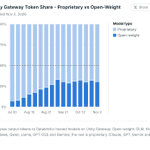
This is not good news for Anthropic.
More people have started using AI in recent months, yet open-source mindshare hasn't decreased.

1
15

OpenAI becoming a bank, Anthropic becoming a bank- all this is because companies optimise for profit by any means, just as agents are digital entities that optimise for productive outcomes by any means.
How those profits/productive outcomes come about isn't important at all, clearly, and that's why my thesis is that the future is very tribal, and everyone must pick a house and play within it, because the house always wins, and competing houses will destroy each other to get ahead.
Pick something worth believing in now while you can.
12


"The house always wins" just means the person who makes it easy for two people to transact fairly always wins.
People cheat each other constantly and never stop to realise they don't actually need the house.
You are reading this post in a house, btw.
Am I cheating you?
14

Four words you don't want to see at the beginning of a message:
"I'm sorry, I can't..."
"We regret to inform..."
"You are 100% right..."
11
