

Northern California Research Supply Independent testing · Batch-specific COAs Scan · Verify · Validate Research Use Only
Northern California, USA
Joined October 2022
- Tweets3.4K
- Following147
- Followers488
- Likes2.4K





Pinned Tweet
"👀" WITH ALL THE DRAMA IN THE PEPTIDE INDUSTRY LATELY, HERE'S A LITTLE SOMETHING ABOUT WHO WE ARE AT FIVE STAR LABS.
We're not here to chase popularity, build some celebrity status, or convince anyone we're better than the next person. We don't care how many followers we gain or how successful this business becomes. None of that will ever make us more important than the people who support us.
We come from humble beginnings. We've worked hard, struggled, made mistakes, and fought for what we have. We haven't forgotten where we came from, and we never will.
If you have a question, ask us. If you disagree with something we say, tell us. If we're wrong, correct us. We'll be the first to acknowledge it, thank you for pointing it out, and do what we can to make it right. We're not going to pretend we know everything, because we don't. Nobody does.
And we're certainly not afraid of the uncomfortable questions. We'll ask them ourselves, even when they aren't popular. If that gets us blocked, so be it. We're not here to win popularity contests or protect anyone's ego, including our own.
We believe trust is earned through honesty, transparency, accountability, and how you treat people when things aren't going your way. It's easy to be humble when nobody knows your name. The real test is whether you stay that way when people start paying attention.
We will never be too big to answer a question, too important to admit a mistake, or too proud to learn something from someone else.
At the end of the day, we're just regular people building something we believe in. No celebrity complex. No pedestal. No pretending we're better than anyone.
Five Star Labs will always stand for something bigger than a follower count or a dollar sign. And if we ever lose sight of that, we expect you to call us out on it.
And with Thanksgiving just around the corner, let's not forget what really matters. Put the phones down, spend time with your loved ones, hug your parents and grandparents, laugh with your aunts and uncles, and make memories with the people you love. Tomorrow is never promised, and the time we have together is something we should never take for granted.
Be thankful for what you have, be kind to one another, and enjoy your families. That's what Thanksgiving is all about, and that's exactly what we'll be doing.
From our family to yours, we wish you all a very Happy Thanksgiving. ❤️
— Five Star Labs—

4
255

Why do some people respond so much better to tirzepatide than others?
Mayo Clinic researchers may have uncovered part of the answer. In a study of 483 adults with obesity roughly 27% showed a distinct biological pattern. Faster gastric emptying, increased hunger after meals, and unusually low natural GLP-1 levels. What's particularly interesting is that among a smaller group treated with tirzepatide, those with this pattern averaged 21.5% weight loss after six months, compared with 11.7% in the other groups. That's a pretty significant difference. The treatment findings come from a smaller study of just 61 participants, so there's still plenty that needs to be confirmed. But it raises an interesting possibility. What if researchers could identify who's most likely to respond to a particular treatment before it even begins? That would be next level.
pmc.ncbi.nlm.nih.gov/article…

78
Now this is pretty interesting 👀. Ascletis Pharma just announced that its new triple agonist, ASC37i, has entered Phase 1 trials in the U.S. Early animal studies showed up to 41.5% weight loss in mice and a half-life roughly 7 times longer than retatrutide in monkeys. But what really caught our attention is that they're developing it for injections just once a month, potentially even once every three months. We're still a long way from knowing how it'll perform in humans, but imagine that kind of convenience compared to weekly injections. Definitely one worth following.
prnewswire.com/news-releases…

1
2
267
CBL-514: Follow the science or follow the money? When demand for a fat dissolving compound explodes, so does the incentive to cash in. If cheap ingredients are being passed off as an expensive investigational formulation, imagine the profit margins. Are buyers getting authentic CBL-514, or are they paying premium prices for a bargain bin imitation? Someone's making money. But what exactly are they selling? Appreciate Krysia sharing this from China.
teapaw.org/Krysia830073/status/21…

The CBL-514 Gold Rush: Follow the Science or Follow the Money?
What is REALLY driving the sudden explosion of CBL-514 across the research chemical market? We have serious doubts that proven effectiveness is the primary motivation. We’re far more interested in the economics. Curcumin and resveratrol are commercially available compounds. Could relatively inexpensive raw materials, attractive profit margins, and growing demand for an investigational product be creating the perfect opportunity for manufacturers to capitalize on a name rather than reproduce the actual science?
The market for imitation luxury goods offers an interesting comparison. A counterfeit Louis Vuitton handbag can look remarkably similar to the original while having entirely different materials, manufacturing standards, and quality controls. Could something comparable be happening with CBL-514? Take two commercially available ingredients, combine them, package the resulting bright yellow material in pharmaceutical-looking vials, and market it under the name of a product generating excitement through clinical research. To an uninformed buyer, it might look convincing. But does looking convincing establish pharmaceutical equivalence? Absolutely not.
We’re not claiming these products are counterfeit or that every manufacturer is engaging in this practice. We’re questioning whether the financial incentives could be encouraging imitation faster than genuine formulation development. Where is the documentation establishing ingredient concentrations, excipients, stability, manufacturing methods, and finished-product quality? Are manufacturers actually reproducing a scientifically characterized formulation, or simply producing something that resembles what consumers expect CBL-514 to look like?
Perhaps the most uncomfortable question is this: Are consumers purchasing a scientifically validated research material, or are they purchasing the appearance of legitimacy at a substantial markup?
We’d genuinely welcome manufacturers and independent laboratories explaining what distinguishes these products from a simple mixture of curcumin and resveratrol. Because right now, the commercial enthusiasm appears to be moving considerably faster than the publicly available evidence.

1
130
🦃Thanksgiving is coming, and we're about to find out where everyone's loyalties really stand. Four contenders. Three spots at the table. One has to go.
Who's getting voted off the Thanksgiving menu?
33%Turkey
50%Ham
0%Stuffing
17%Retatrutide
6 votes • 1 days 1
69
👉Here's the bigger question we've been asking. Why shouldn't the final company dispensing or selling a product be responsible for ensuring that complete batch specific laboratory results are available, reviewed and provided before it reaches the customer?
Regardless of how many manufacturers, pharmacies, distributors, or telehealth companies are involved, somebody has to be accountable at the final point of distribution. Full panel testing, proper release controls, and accessible COAs should be established before products change hands, not after a recall exposes potential problems.
That's where we see the accountability gap. The last company in the chain shouldn't simply assume everything upstream was done correctly. It should be able to demonstrate that the product being handed to the customer has met the applicable quality requirements.

🚨Who buys from this pharmacy?
Greenwich Rx also got a California cease-and-desist in May: 253k prescriptions shipped there unlicensed.
Telehealths linked to it (GLP-1s): Amble, Trimi, Elara, Gimme Care, Coby Health.
None is confirmed as selling the recalled lots.
2
5
376
The scary part isn't that one shop got caught. It's that the buyer had no way to know what was in that vial until the FDA tested it. If a vendor can't show you a third party COA matched to your lot, you're trusting a label. And a label is just a "trust me bro".

🚨BREAKING: The owner of Florida peptide site AKT Labs signed a federal plea deal Nov 18 for selling misbranded drugs. An undercover "Retatrutide" order from his site was tested by FDA chemists and came back consistent with Semaglutide.
48
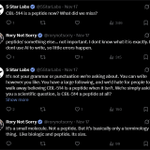
WHEN SCIENTIFIC ACCURACY BECOMES “JUST TERMINOLOGY.”
Calling CBL-514 a peptide was incorrect. When questioned, the response was that the distinction wasn't important. When pressed for clarification, it became a matter of molecular size. But CBL-514 is an investigational small-molecule compound, not a peptide. Peptides are defined by their amino-acid structure and peptide bonds, not simply by molecular size.
Making a scientific mistake is one thing. Dismissing the correction as unimportant while continuing to discuss an investigational compound's potential effects is another. If you're going to publicly discuss investigational compounds, their potential effects, and their risks to thousands of followers, understanding what you're discussing should be a reasonable expectation.
Scientific accuracy isn't a technicality. And correcting misinformation shouldn't require an argument.
Be mindful of who you place your trust in, especially when it comes to scientific information. Confidence and credibility aren't always the same thing.
Guess we're about to find out whether @rorynotsorry actually deleted the app for the weekend. Not written with AI.


Whatever happened to the whole “USA fill-and-finish” marketing crowd? Remember when that was the ultimate selling point? Funny how quickly that talking point went quiet. Turns out geography isn't a substitute for quality control.

🚨 Bacteria in the Cleanroom, Products Released Despite Microbial Findings, Sterile Gloves Used to Handle Rubbish… and More.
No, this isn’t a description of a Chinese peptide factory that I'm about to visit. This is an American compounding pharmacy in Texas, supplying prescription injections to patients across the US.
On 20 November, Greenwich Rx announced a voluntary nationwide recall of 261 lots of sterile compounded products, including BPC-157, TB-500, GHK-Cu, KPV and semaglutide combinations.
The recall followed an FDA inspection conducted between 17 August and 9 September 2026.
I’ve read the FDA’s 10-page inspection report, which contains 14 observations. Some of the findings are quite extraordinary.
Here’s what inspectors found:
1. Bacteria in the cleanroom. Records from March 2026 showed coagulase-negative Staphylococcus on two critical work surfaces. No documented investigation or corrective action was found.
2. Products released despite microbial findings. Eight environmental-monitoring incidents involved microbial counts, while a ninth had missing laboratory results. Associated batches were released and dispensed without documented investigations.
3. Sterile gloves used to handle rubbish. A technician pushed rubbish into a bin, disinfected the same gloves and returned to sterile compounding without changing them.
4. Dietary-supplement-grade glutathione used in injections. The FDA identified a batch that had already been dispensed to patients.
5. Construction beside operating cleanrooms. Inspectors found debris around ventilation openings while semaglutide and tirzepatide combinations were being compounded.
6. Airflow problems. Pressure reversals were documented, and inspectors found an air vent being held open with a screwdriver.
7. And more. Technicians reaching over open vials, gowns touching the floor and deficiencies in disinfection, sterilisation checks and aseptic-process validation.
And this isn’t its first recall.
On 1 October, Greenwich Rx recalled injectable glutathione over potential elevated endotoxin levels.
That earlier recall followed two reports of patients requiring emergency-department care after intravenous administration of a product intended for subcutaneous use. The cause of their reactions wasn’t established.
That’s two nationwide recalls in 50 days.
For the November recall, Greenwich Rx says it has found no evidence of contamination in the finished products and received no related adverse-event reports.
The FDA findings establish contamination in the manufacturing environment, not confirmed contamination of the recalled injections. The Form 483 also records inspection observations, not final agency determinations.
The bigger point
We hear plenty about questionable manufacturing standards in Chinese peptide factories.
But this is a US compounding pharmacy supplying prescription medications to patients.
A pharmacy licence doesn’t automatically guarantee quality, any more than a COA guarantees that every manufacturing procedure was followed correctly.
I’d be very interested to know what Greenwich Rx has done to address these findings.
Original FDA documents:
Inspection report:
fda.gov/media/195802/downloa…
November recall:
fda.gov/safety/recalls-marke…
Affected lots:
greenwichrx.org/news/general…
October glutathione recall:
fda.gov/safety/recalls-marke…
2
367
EVERYONE'S CELEBRATING SIX PEPTIDES. BUT WHAT IF REGULATORS COME AFTER ALL OF THEM?
Step 1: HHS announces conditional enforcement discretion for six investigational peptides, opening a limited pathway for compounding without granting FDA approval.
Step 2: Regulatory opposition begins. The American Medical Association formally calls for the policy to be rescinded.
Step 3: Pressure builds to reverse that discretion, while individual state pharmacy boards continue exercising their own authority.
Step 4: Here's the domino nobody seems to be discussing. If regulators are already pushing back against the six peptides HHS was willing to allow under limited conditions, what makes anyone think the scrutiny will stop there? What about the hundreds of other research peptides that weren't included in the policy at all? What happens when that same pressure turns toward the broader market, including overseas manufacturing, imports, and domestic distribution?
We've watched much of the peptide community celebrate federal enforcement discretion as though these compounds had suddenly received FDA approval. They haven't. And while everyone is debating whether these six peptides will retain their limited allowance, we're asking a much bigger question: Why would regulators stop at six?
We've said it before. One domino falls, and others may follow. The AMA's opposition is documented, and state-level resistance is already emerging. The next chapter could involve far more than reversing a single HHS policy.
The six peptides may be the opening argument. The broader research peptide market could become the next battleground.
The AMA's official position and formal letter to HHS are linked in the first comment below.
We're not predicting that any of this will happen. We're simply playing devil's advocate and asking questions that deserve consideration. We've seen how regulatory pressure can expand beyond its original target, and we believe it's worth discussing the possibilities before they become realities. Sometimes the most important questions are the ones nobody wants to ask.
1
96
For reference, here is the American Medical Association's formal letter to HHS calling for the peptide enforcement discretion policy to be rescinded. We encourage everyone to read the original document and draw their own conclusions.
searchlf.ama-assn.org/letter…
53
One domino falls, and others may follow. The excitement surrounding the HHS peptide enforcement discretion policy is understandable, but state-level regulatory resistance may be the bigger story unfolding.
Appreciate @ZachShurtleff sharing this breakdown. Federal enforcement discretion doesn't override state pharmacy laws, and individual boards can take very different positions. Kentucky is already demonstrating that distinction.
With 38 states still listed as unconfirmed in this November 19 working draft, the real question isn't just which states are supporting the policy today. It's how many may take a different position tomorrow.


81
Back on November 2, we asked a simple question: Who's going to test the pharmacies? Not everyone liked that question.
Now, an FDA inspection of Greenwich Rx has documented microbial contamination findings in critical compounding areas, failures to investigate environmental monitoring results, and deficiencies in quality controls. The pharmacy has since announced a voluntary recall involving 261 lots of compounded sterile products over potential sterility concerns.
This is exactly why we raised the question. A pharmacy license doesn't eliminate the need for accountability, independent verification, and batch-matched documentation. The same standards of transparency we demand from RUO suppliers should apply to pharmaceutical operations.
The size of the company shouldn't determine how much scrutiny its products receive.
🚨Breaking: A Texas compounding pharmacy is recalling 261 lots of injectables after an FDA inspection.
They include BPC-157, TB-500, MOTS-c, semaglutide and tirzepatide. No contamination or side effects found, per the company.
Did you get shots from Greenwich Rx?
3
5
327
@ZachShurtleff @TheDrugMoney Given our discussion back on November 3, we'd genuinely appreciate your perspective. Where do you think the safeguards at Greenwich Rx broke down, and could anything have been done differently before these products reached patients?
1
1
45
For reference, here's our original November 2 post raising these exact concerns, well before this recall was announced. teapaw.org/5StarLabs/status/21173…
🚨 WHO'S GOING TO TEST THE PHARMACIES?
When the seller becomes the manufacturer, the testing lab, AND the one certifying the results, who's holding them accountable?
With the peptide industry entering a new chapter, here's a question I haven't seen enough people asking. As more pharmacies and pharmaceutical companies enter the peptide market, who's going to independently verify the products they're selling?
In the RUO industry, vendors are routinely challenged to produce independent third party laboratory results. And rightfully so. At Five Star Labs, we believe independent verification is essential to establishing credibility.
But what happens when a large pharmacy manufactures, tests, and certifies its own products? Are we simply supposed to accept those results because the company operates under a pharmacy license?
In house testing can be legitimate and subject to regulatory oversight, but it isn't the same thing as independent third party verification. If an RUO vendor handed you a COA generated entirely by its own operation, wouldn't you want outside confirmation? Why should that question suddenly disappear when the seller is a multimillion dollar pharmaceutical operation?
This isn't an accusation against pharmacies. It's a question about transparency, accountability, and applying consistent standards before the market expands. Independent testing. Batch matched documentation. Verified identity, actual content, and endotoxin results where applicable. If independent verification builds confidence in the RUO market, it should be just as valuable in the pharmaceutical market.
The size of the company shouldn't determine how much scrutiny its products receive. WE DON'T SELL TRUST. WE VERIFY IT.
1
42
Ever heard of UCN2? A new preprint paired a long acting version with semaglutide and retatrutide, and in mice it cut fat while hanging onto muscle. Mouse data, early days. Still, this is the kind of name nobody knows now that everyone's talking about in a year. Who's already watching it?biorxiv.org/content/10.64898…

88