

The 69 Controversies of AI Adoption | Spreading the Word on AI Adoption | From the author of The Last AI @The_Last_AI @s_m_sohn |5/25/25|
United States
Joined May 2025
- Tweets103
- Following7.5K
- Followers123
- Likes284





Pinned Tweet
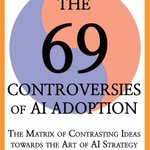
"The 69 Controversies of AI Adoption" by S. M. Sohn brings up a wide range of controversial topics related to AI adoption, to help readers imagine what AI may bring to our future and examine the realm of possibilities.
Introduction to Book
We may think of controversies related to AI as either about the forecast, or predictions of what is going to happen, and about the decisions, or what kinds of actions we should take.
Forecast: How soon will we reach AGI? How intelligent will AI become? Will ASI be friendly to humanity?
Decision: Should we accelerate or decelerate the development of AGI? Should we ban development of AGI?
The organization of the controversies takes its inspiration from the Korean flag, which may be thought of as the map of the universe.
The number “69” represents the accelerating and decelerating forces in AI, and takes from the center circle of the Korean flag. People may be familiar with this concept as “Eum” (decelerating) and “Yang” (accelerating), where two opposing forces balance each other.
Examples of the Center of Controversies:
Accelerating Force: development in AI technology Decelerating Force: regulations to mitigate AI risks
The controversies are organized into 8 directions, which take from the outer bars of the Korean flag design. The hope is that this organization will help readers find the areas they are interested in.
1. AI and Individuals
2. AI and Family
3. AI and Businesses
4. AI and Society
5. AI and Economy
6. AI and Government
7. AI and the World
8. AI and the Universe
If the goal of The Last AI was to help people share their ideas with common vocabulary, the goal of this book is to help readers develop their own views and own strategies to prepare the future.
In this sense, this is a book that raises more questions than we can answer.


2
4
2,362
The 69 Controversies of AI Adoption retweeted

Toyota: Supra Intelligence
Some Shoppers: SuperStop and Go Intelligence
Phonies: Superficial Intelligence
Government Workers: SuperOfficial Intelligence
Military: SuperCommissioned Officer Intelligence
Governments: Superpower Intelligence
Children: Superhero Intelligence
The 69 Controversies of AI Adoption retweeted
Today I read a lot of negative reaction to this post by an Anthropic employee about NVidia.
However, this is actually a rational and expected argument from an economic or strategic perspective as explained in The Last AI @The_Last_AI and the 69 Controversies of AI Adoption @69AIControversy and here's why:
1) Pespective 1: US vs China in the race towards AGI.
If we consider getting to AGI to be something meaningful, then it would hinder companies in free market economies develop it if the profitability of the industry went down.
Planned economies such as China can induce this lower profitability of the industry easily by giving directions and subsidies to its companies to give products away for free, or open-source. Some may call it dumping, or selling below price.
This explains why we would expect to see more open-weights from China. It helps collapse the profitability model of US firms that live in the market ecosystem. Slows US down, accelerates China.
2) Perspective 2: Software vs Hardware Companies.
Within US, we may also think of AI developers and hardware manufacturers as suppliers of each other, such that each prefer the price of the other to be lower for own profitabilty.
This explains why there is incentive for AI developers such as OpenAI @sama Google @sundarpichai and Anthropic @DarioAmodei to also invest in hardware to lower their cost, in addition to gaining other advantages in the race towards AGI. We see Elon Musk is amicable towards open-source, because his firms are more hardware-oriented.
In this perspective, it is perpectly expectable to see two opposing preferences, as demonstrated by Jensen Huang to prefer open-source of AI models, while Anthropic employee to prefer open-source of hardware-related proprietary knowledge owned by Nvidia such as CUDA.
What people who are criticizing this post are missing may be this layer of the competitive forces that affect these industries.
Looking forward, what may additionally complicate this matter would be how China has advantages in physical AI. We may even see open-source versions of CUDA competitor if Chinese manufacturers reach a certain level of competitiveness against Nvidia. This is probably what may keep @JensenHuang busy now more than any other competitive force.

I’m so excited that @JensenHuang is a believer in open source now, looking forward to the CUDA and GPU driver open source release!

The 69 Controversies of AI Adoption retweeted
Yes, and I hope the applicants would have read "The Last AI," the book that introduces AI Economics!
The 69 Controversies of AI Adoption retweeted
This is an interesting proposal not only as an alternative way to raise funding, but to possibly address a humanity-scale catastrophe that Elon Musk likes to emphasize.
1. On Elon Musk
To summarize the problem outlined in The Last AI (@The_Last_AI) and the 69 Controversies of AI Adoption (@69AIControversy), we may ask the following question:
What if Earth for some reason becomes suddenly uninhabitable and moving go Mars is the only option left. Who should be chosen to go to Mars and survive? Available seats would be highly limited. This may be similar to the Titanic problem, where women and children were favored, or the Noah's Arc problem, where one couple of each species was spared.
In modern societies, if this problem is to be solved by private corporations (as opposed to by the government), then the solution would be to choose from the stockholders of the company.
If what some say about SpaceX, that it does not need more funding or need to go public, is true, then we may speculate an alternative reason for Elon Musk to go public is to give this opportunity or perk to a wider base of people to go to Mars in case of some emergency. Since Tesla shareholders would be more likely to share Elon's vision, they may be better candidates to purchase SpaceX shares.
In short, if one believe the missiom of SpaceX is to save humanity from some unforeseen danger, then having a larger ownership base may mean something.
2. On Bill Ackerman
Here are a few takes on potential questions to this post:
- Why this instead of IPO? While IPOs are the standard way to go public, it costs more. The initial buyers of shares may not be as widespread as the proposed method.
- What's in it for Pershing Square? It does gain some business because it would probably not be selected to lead arrange the IPO anyway.
- Will current SpaceX shareholders lose or gain? This depends on the eventual valuation. In the sense that this method costs less, it may be favorable. Having more publicity may help raise the valuation.
All in all, Ackerman's proposal may give more publicity to SpaceX and Tesla than regular IPO. Add in the potential reason for going public as saving humanity and Elon's distaste for IPO, Ackerman's proposal may offer an attractive alternative.
---
On a side note, for anyone interested in how AI may change our business, economy, amd society, check out "The Last AI!"
The 69 Controversies of AI Adoption retweeted
1) For anyone interested in how different people may think differently about AI, check out the 69 Controversies of AI Adoption. amazon.com/dp/B0F9WZWPWB/
2) For anyone interested in describing the transition between augmentation and automation, check out this paper on AI Effortlessness: sciencedirect.com/science/ar…
3) For anyone interested in how AI adoption may progress in our business, economy, and society,check out this paper on the Three Levels of AI Adoption and the Six Levels of Autonomous Companes, papers.ssrn.com/sol3/papers.…
4) and The Last AI amazon.com/dp/B0D5B63LSV/

The 69 Controversies of AI Adoption retweeted
Trying to use AGI, which is a technology-centered concept, as a measure for AI adoption, which is more business-oriented concept, in itself causes confusion.
This is the reason for introducing the concepts of the "3 Levels of AI Adoption" and "AI effortlessness. "
The 3 Levels of AI Adoption:
The important milestone equivalent to AGI is "AI Equalization," to reach Level 2 AI Adoption, which is when AI reaches parity for each job humans were carrying out. This way, whereas AGI will be defined by AI "suppliers," Lv2 AI Adoption will be defined by AI "demand," or the users of AI.
Lv3 AI Adoption is when AI takes charge of the whole firms. This concept later became famous by OpenAI's 5 Stages of AI. Anyone wondering about Stages 2 and 4 (AI that innovates) may read about the "enablers" and "the 6 Levels of Autonomous Companies" in the same paper.
AI Effortlessness
We have categorized AI Adoption as either augmentation or automation. However, we may also place both types of AI adoption into the same dimension by measuring how AI reduces human effort. In augmentation, human effort is not reduced completely, while automation can completely eliminate effort. In the dimension of AI Effortlessness, augmentation is expressed as a number between 0 and 1, and automation (replacement automation) is assigned as 1.
This also allows applying of the concepts of "Automated Innovation." In "Advance Automation," where AI Effortlessness is above 1, AI with innovative capabilities would improve on the tasks it was previously carrying out, achieving "innovation" by AI itself.
Whereas people may think automation is just replacing humans, we may think of it as evetually "advancing" the work in some sense. The paper also provides few examples of how these progresses may be meaningful for firms and the economy.
I am excited to hear about this project and hope some of these concepts from my work could be incorporated in the new measure!
Due to X policy, I'll post links in the reply.

Defining AGI as AI that can fully automate the economy has some issues:
1. Diffusion. Automation timelines may depend more on diffusion than innovation. For example, it took decades for electricity to diffuse throughout the economy after it was invented.
2. Private Data. Many important economic skillsets are guarded (e.g., TSMC), so it's unclear how or when AI would be given access to learn them.
3. Robotics. Much of the economy is physical (construction, repair, manufacturing), which is a separate and massive challenge.
That is why we defined AGI as human-level AI rather than economy-level AI.
That said, later this month, we'll release a measurement for economy-level AI impacts.
The 69 Controversies of AI Adoption retweeted
One direction is to emphasize how people may have opposite opinions about AI, as explained in The 69 Controversies of AI Adoption.
Link in the reply due to X policy
The 69 Controversies of AI Adoption retweeted

"The ultimate form of augmentation is 1-person companies,
while the ultimate form of automation is 0-person companies." (quoting from The Last AI)
papers.ssrn.com/sol3/papers.…
Also for anyone interested in this topic, check out this paper on the 3 Levels of AI adoption.

Zero-person billion dollar companies. Early AGI-like breakthroughs. Viral Sora deepfakes.
Sam Altman broke it all down in our exclusive DevDay conversation.
Highlights:
0:00 Intro
0:43 DevDay's biggest launches
2:13 Agent Builder vs GPT Builder
3:43 The no-code revolution for AI agents
5:20 Betting pool on zero-person companies
6:50 What would 20-year-old Sam build?
10:22 GPT-5 vs Claude on GDPval
11:30 When have we achieved AGI?
12:44 Scientific breakthroughs AI will solve
13:59 AI 'work slop' costs $186/employee
16:12 Sam's viral Sora memes
20:11 Revenue sharing for cameos
22:33 1B jobs are changing
24:35 What work looks like after AGI
25:44 Global AI safety framework
27:46 Most exciting agents to build
The 69 Controversies of AI Adoption retweeted
Yes, and the answers are already available, and based on the interviews, Sam Altman appears to have already read "The Last AI," so OpenAI probably knows it as well.
As explained in my article, this 5 Stages of AI is a way to explain to internal stakeholders the "3 Levels of AI Adoption and the 6 Levels of Autonomous Companies."
The Stages 1, 3, 5 correspond to AI Adoption Levels 1,2,3 and Stages 2,4 are "enablers." (One of the reasons some people are confused about Stage 4)
What happens once these levels are achieved is explained in my book "The Last AI" which also introduces the 4 Levels of AI Adoption for society. Once you read it, you will understand why only 4 levels are necessary to get to the last AI.
Links on my profile (due to X policy on links)
The 69 Controversies of AI Adoption retweeted
After reading recent posts about Mathematicians vs Physicists, Physicists vs Economists, Economics vs Finance, etc., here's an observation about Economics vs Business Management on AI Adoption. For those who do not know me, I majored both in Economics and Business so hopefully I am not too biased.
1) Economists have to make assumptions to simplify their analyses. Otherwise, things would become too complicated to model. Because of this, it appears economists tend to be more likely to just pick one side they like and focus more on that side, either on augmentation or automation. For example, an economist can assume AI will advance little, and focus on using AI as a tool, or advance a lot and call it "transformational AI" and begin their anaysis from there.
2) Business management researchers need to go one step further down and give more thoughts to understanding what would advance AI and how it may affect how businesses make decisions inside the firm. An example of this is the Three Levels of AI Adoption for management and the Four Levels of AI Adoption for society. In this framework you need to consider both augmentation and automation and how and why they may transition from one to the other and what may cause friction or resistance to switch.
In short: if Economists find it easier to focus on either augmentation or automation, Management researchers may find it easier to focus on the transition between augmentation and automation.
For More: Differences of perspectives similar to this are abound around us. For anyone interested in how different people may think differently about AI, check out The 69 Controversies of AI adoption. (Links on the next post)
What is missing from typical H1-B discussions: Number of H1-B will not change
People who apply for H1-B far surpass the number of H1-B visas given, capped at 85,000 per year.
Unless the new fee causes applicants to drop enough, exactly the same number of people receive the visa
This quoted post is unavailable.
The 69 Controversies of AI Adoption retweeted
In that case, maybe people should check out "The Last AI" by S. M. Sohn.
amazon.com/Last-AI-Humanity-…

Not sure if this is true,
Obviously the value of MBA increases if it also leads to meeting your spouse.
Then again, the value of college also increases if you meet your spouse there, or..
So which is more valuable?
1. MBA (without meeting spouse)
2. Meeting spouse

repeat after me
the value of an MBA isn't the MBA
it's meeting your spouse
it's a multi-year dating event
your MBA practically worthless
unless you meet the love of your life
2
118


Maybe there is an asymmetry to AI Adoption such that
1) dangers or destructive forces might occur quickly and unexpectedly, like a bomb going off
2) beneficial or constructive forces may occur slowly and steadily, like in constructing a building

Extrapolating for AI, instead of LLMs, we should call them "micro-AGI."

'Vacations.'
The word is 'vacations.'

ALT FAST COMPANY Article: While retirement typically occurs, after completing a career and saving and investing for it, a new trend is emerging among Gen Z career professionals called "micro-retirement." Micro- retirements involve taking a one to two- week break from work every 12 to 18 months. Gen Z is using micro-retirement to avoid burnout, find greater fulfillment in their work, and enhance their overall well-being. However, it's not just Gen-Z:
3
311